Showing posts with label poetry. Show all posts

Wednesday, November 10, 2021

Treefollowing: Wordless Wednesday (nearly)

Flash the maple is thick with dried samaras.
Spike the hawthorn still sports a bit of red and green.

~🍂~


Though the beech is golden
I cannot stand beside it
mute, but must say

"It is golden," while the leaves
stir and fall with a sound
that is not a name.

It is in the silence
that my hope is, and my aim.
...
The Silence by Wendell Berry


This is my brief contribution to November's gathering of Treefollowers. Consider joining us—as you can see, it doesn't have to be a lot of work. Photos would have been enough, but like Berry, I "must say".


Sunday, December 9, 2018

“Trees know when history begins”

Late afternoon. These days no direct light reaches the boxelder in the nook; the sun sets too far south.

Years ago—long before I moved to the West Side—heavy-equipment operators, concrete masons, carpenters, and laborers of all sorts constructed a large building between my house and the river. They cleared and leveled the site, poured slabs, framed structures, attached sheathing and roof, and installed doors. But the ground at the base was left bare. That’s how history begins.

Today another history: a tall inside corner, a nook unkempt and likely unnoticed, a boxelder standing in the perfect right angle above thistles, tumbleweeds and trash. Trees know when history begins, always sprouting up fresh

Shoots sucker along concrete, leaves spread green across corrugated metal, a tree now just taller than the door will reach beyond the roof.
This boxelder is adventive, well-established on a site that was barren not that long ago (1). It’s not so much of a stretch to link it to Advent, which started just last week on the fourth Sunday before Christmas. Adventive and advent both come from Latin advenire, to arrive. But here the similarity ends. Though the nook appears harsh and unforgiving, living there is hardly a form of penance. That boxelder seed landed in a sanctuary—shade, runoff, no competition. Whatever we leave empty will be filled.

I came across “Up a Gulch” in one of King’s chapbooks, In the Empty Mountains. I was only a few lines into the poem when it dawned on me—this is about the boxelder I’m following! Thanks to Lithic Press for permission to include it here (2).

Bob King was well known and appreciated by Colorado poets. He started the Colorado Poets Center, a richly annotated directory of published poets living in or with strong ties to the state. His own works include seven chapbooks, two full volumes of poetry, essays, articles, short fiction, creative non-fiction and more. King passed away in April 2017, shortly after In the Empty Mountains was published. For more about him, see this tribute.

Notes

(1) Botanists disagree on the definition of adventive. Some say only non-native species qualify as adventive. Others use the term for native or non-native species that are new to a site and do no harm. I use it similarly, but without the do-no-harm criterion (too hard to judge!).

(2) Robert King’s In the Empty Mountains is available from Lithic Press, an independent small press in Fruita, Colorado:
“… these poems reveal the joys, pains, and insights of a man long on the wisdom road. He sees daily occurrences from a very broad perspective, that leads to humility that cannot hide.”
[The description in the Lithic catalogue features “Up a Gulch” as a selected excerpt!]


Wednesday, March 15, 2017

Books from a Land of Rocks

All photo-poetry montages by Hollis (click to read). Thank you, poets, for your words.

The Grand Valley, in western Colorado, is a land bounded by rock. To the north, the Book Cliffs stretch for almost 200 miles—sinuous bands of muted sandstones and shales. To the south stands the steep face of the Uncompahgre Plateau—red, yellow, buff and orange sandstone walls, on a foundation of dark ancient rock. And in between—in the community of Fruita, just off the roundabout near the west end of town, on the second floor of the old bank building—eponymous Lithic Press makes words into books and sends them off, dispersing poetry across the Southern Rocky Mountains and Colorado Plateau (in this land of rock, we find ourselves using physiographic provinces rather than political subdivisions).

First off the press was Whacking the Punchline, a small square spiral-bound collection of compression sketches by Jack Mueller, published in 2008. Since then, 27 more books—many in custom format—have been ushered into the world. Lithic recently joined a national trend of small independent presses opening brick-and-mortar bookstores. They hung out their shingle in 2015.
Lithic’s shingle features predatory Xiphactinus—“probably the most photographed fossil specimen in the world” (click on photo to view the smaller fish inside; source).
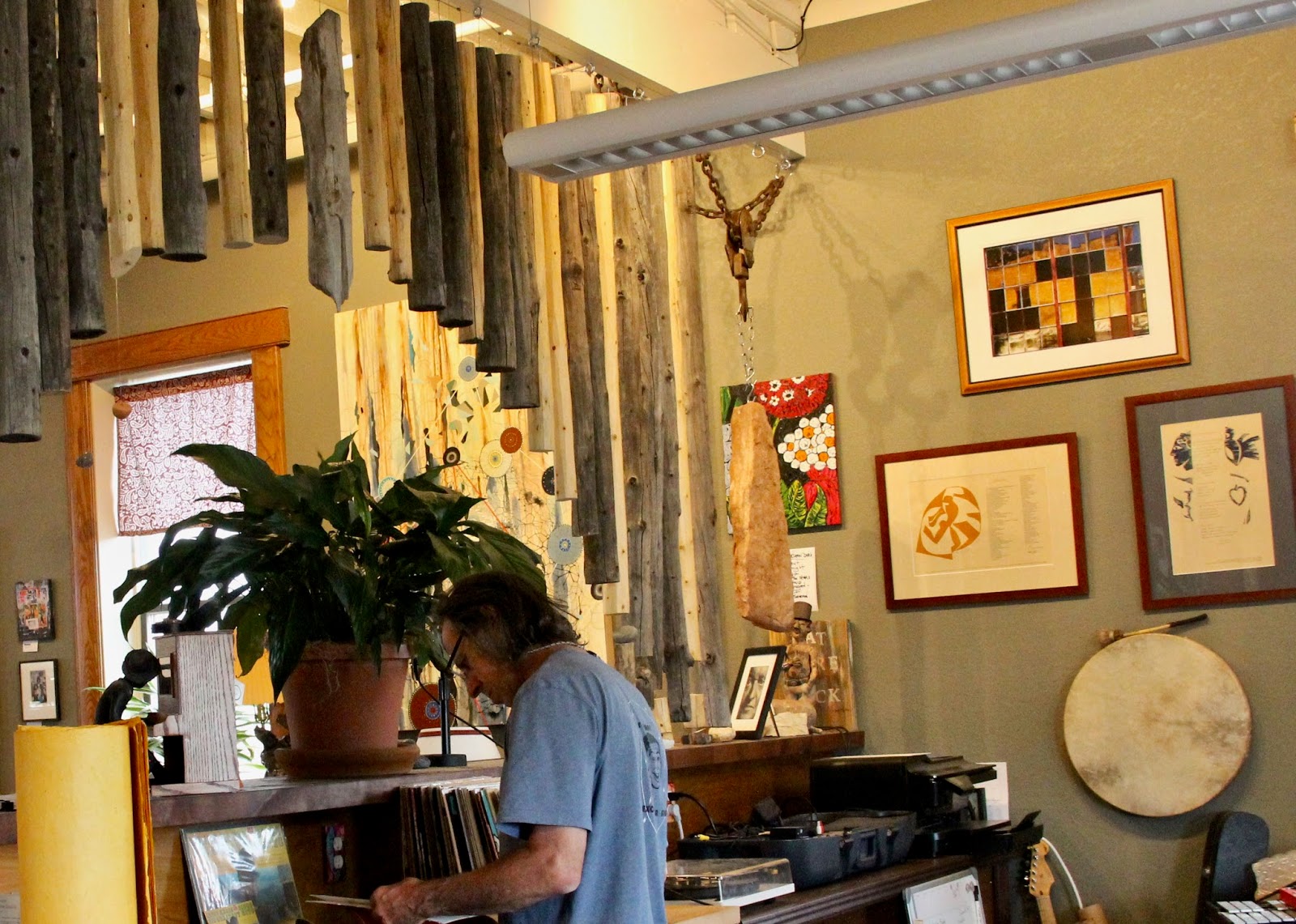
Lithic Bookstore & Gallery—a space for design, sales, poetry readings, contemplation, inspiration.
Danny Rosen, at the office.
Last September, I stopped in Fruita to enjoy the local literary scene, as I do most years. This time I cornered Lithic-owner Danny Rosen in his office. “I have some questions for you” I said firmly, swinging a six-pack for emphasis. We sat down for an interview.

How did the name Lithic Press come about?
The name stems from my background in geology; the word means stone-like or pertaining to stone. Also, it alludes to early methods of printing. Lithography involved spreading a greasy kind of ink onto etched limestone to print from one medium to another.

What kinds of books does LP publish—what subjects, genres?
So far, Lithic has published books of poetry—largely because that has been my interest. I would like to publish other genres in the future, like natural history. More than any particular subject matter, I want to work with writers who pay attention to language, tell intriguing stories, teach me something.

What’s your policy on manuscript submission?
We do not accept unsolicited manuscripts; we accept manuscripts largely by invitation. I had an open submission period last year for chapbook manuscripts (simple books, folded and stapled, 20-40 pages long). We received over 100 submissions. It was time-consuming to go through all of them, and unpleasant to send out so many rejections. I don't anticipate doing that regularly. But we did get a few books out of it.

Though we don’t advertise for submissions, they show up anyway … frequently. Seems everyone who ever wrote a poem wants a book. Maybe that's a reflection of “celebrity culture.” Being a publisher offers interesting viewpoints on human psychology! Recently we've been reaching out to writers we admire, asking for manuscripts. This year and next we have books coming out by writers in North Carolina, South Carolina, Oregon, New York, California, and Bombay.

What is the Lithic bookmaking process?
I facilitate the process. One way or another I find manuscripts (or they find me). I don't edit so much as closely read each manuscript to find errors and give suggestions. The books I've done for Jack Mueller required a lot of work, a labor of love. He's a close friend, and this friendship played a big part in the creation of Lithic Press. I wanted to publish his work—I love it so much and I think it has great value. Amor Fati took four years to complete.

Most of our books start with manuscripts that are fairly polished when we receive them—that’s what I want. My strength is to make books for strong writers, not to help make writers strong. The early phases can be very exciting, when the idea first turns into a concept of an artifact. We decide what the book will look like: size, shape, kind of paper and binding type, font and font size, and so on. Kyle Harvey does all the design and layout for Lithic. He is very talented and imaginative. I nudge him continually, to be open to what possibilities we may conjure: new kinds of paper, different presentations.
The making of a book presents possibilities at every juncture, on every page, like Jack Mueller’s The Gate, which we made as both an inexpensive chapbook and as a limited edition, cloth-bound, foil-stamped hardcover. For Kierstin Bridger's Demimonde, a book of poems written from the point of view of prostitutes in frontier mining towns in Colorado, we paired antique images with each poem and printed them on paper vellum pages.

I want every book to stand alone as a fine artifact—a handsome object that feels good in the hand, that makes a contribution to the human story—a little something to spread around, leave behind.
I’ve been fascinated with books all my life. As a kid, I was blown away by “All the Books in the Library.” To make something that will go into that library feels like important work. Someone said to me recently that I was like a midwife to the book. That’s a strange but accurate description. It’s awesome to hold a newborn book and usher it into the world.
Going Down Grand, Lithic’s pocket-sized book of poems for your next trip down.


Yet stones have stood for a thousand years, and pained thoughts found 
The honey of peace in old poems.
–Robinson Jeffers

Friday, November 13, 2015

“For each man sees himself in the Grand Canyon”


There’s one more thing you need for your trip into the Canyon—a book of poetry. Yes—a book of poetry!—even as you try to reduce your belongings to the bare essentials, try to minimize volume and weight. Maybe these extra ounces will bring you something wonderful one evening, or while you’re waiting for the shuttle, or resting at the end of a switchback. Maybe you’ll look more closely at the intimidatingly inspiring views, colored patterned rocks, drifting spiders, flowering cacti, vast air. Maybe you’ll feel something new, a reaction you hadn’t felt before (don’t jump!). You might even learn something—like where twilight and dawn go after they’re done with us.

Editors Peter Anderson and Rick Kempa selected poems they hope will “prove true companions on your own Grand Canyon journey, whether you are on the river, the trail, the rim, or elsewhere, yearning to return.” The book itself is a bit of a trip, organized as legs of a journey: On the Rim; Down and In; From the River; Emergence. They kindly left out the epic, obscure, esoteric and puzzlingly-metaphorical. This is poetry we can read, ponder and enjoy even if we aren’t particularly poetic ourselves. (That could change!)


     like nothing you had imagined, nothing
     in the pocket-sized postcards or the travelers’ guides,

     is the split continent, enormous and jagged,
     a terrible incision, terribly gorgeous,

     the late-afternoon air pouring in … (1)
A terrible incision through sunny sedimentary strata reveals the “dreaded rock”—the "hard black walls" of the Inner Gorge (2). Photo by Jack Share.

     going down, down
     by layer, down by grain,
     down under thunder-named:
     Kaibab, Toroweap, Coconino
     Sandstone. Switching back
     to shale, toenail turning
     black, rock red and raw … (3)     
Several hundred million years down the trail, another billion and a half to go. Photo by Jack Share.

     How to understand river:
     ride eight days on its back
     between walls time carved a mile deep
     rose blood-red gray-green black—
     not yet speaking its language
     give it words
     swift-running silt-laden shimmering. (4)
You never want to leave, and you never will, for it will always be with you. Photo and words by Jack Share.

     What more can we give to this world?
     Nothing but walking
     here softly,
     with our hearts
     wide open to beauty,
     with our eyes
     catching rainbows
     and shadows. (5)
Behind Ribbon Falls. Photo by Jack Share.

     I speak now of that Grand Canyon
     which lies within each of us. There
     are pre-Cambrian rocks at the center,
     the core, and talus from yesterday’s fall;
     marble and granite grown hard from the
     pressure and heat of heartbreak and
     passion; crumbling sandstone, layer on
     layer of sediment, sentiment piled on
     over a lifetime’s experience. (6)
"Extreme closeup" of extremely beautiful Precambrian Zoroaster granite. Photo by Jack Share.

These poetic reactions of minds and souls in the presence of something awesome-beyond-words are diverse and wide-ranging—descriptive, emotional, mysterious, mystical, musical, humorous, grim. Often I found myself reading about the poet as much as the canyon. As Carl Sandberg said (and Anderson and Kempa emphasize), “each man sees himself in the Grand Canyon”(7).
Jack Share contemplates his Grand Canyon. Photo by Wayne Ranney.
I’m not a poet, and I read poetry only occasionally. Yet I found a lot of pleasure in this book. Perhaps it’s not surprising, given that I love the American West and all the natural history I can glean from it. But poets create new things and new ways of looking that are fascinating. And poetry’s sparseness makes me notice details, physical and mental. It focuses my attention, much as my camera does.

• • •

Hoping to learn more, I interviewed (via email) editors Peter Anderson and Rick Kempa, and publisher Danny Rosen of Lithic Press. All are poets, and all have been down Grand one way or another.

Peter and Rick, how did the idea for Going Down Grand come about?

We’re pretty sure there was beer involved. It could have been any one of many late night conversations we periodically have about poetry and the west and books…

Why did you choose poetry—what does poetry do for the Grand Canyon that prose can’t? Do poets see or experience the canyon differently?

Interpretive writing doesn’t necessarily address issues relating to the way a place feels; poetry does—poetry invites more emotion which doesn’t usually turn up in informational prose. Also poets may be more inclined to use their imaginative powers in developing a relationship with a place.

How many poems did you consider, and how did you find them?

We looked at hundreds of poems. We solicited contemporary poems by way of print publications and websites. We also rooted around in special collections in regional university libraries in Utah and Arizona, and did a lot of research to find any and all Grand Canyon poems previously published.

Danny, what was it about Going Down Grand that led you to publish it? Did the subject influence the design of the book?

I have great respect for the sensibilities of Pete and Rick, both artistic and philosophic, and as a lover of the wild planet and with a background in geology, I find the Grand Canyon a sacred place. It is a privilege to add something to the ongoing story of comprehending and appreciating this special place.

The narrow, tall dimensions of the book [5” x 9”] mimic the canyon itself, as does the long, narrow shape of many of the poems. We wanted the book to travel well, to fit in a back pocket. We made sure it would easily fit into ammo boxes—frequently used on river trips. Pete and Rick will probably say more about this …

Peter & Rick: Yes, we hope this book travels! Our target readers are visitors to the Grand Canyon—almost 4.5 million a year, whether they experience the canyon from the river, from the trail, or—as most do—from the rim. Poetry can offer them fresh insights into an experience of place.

As a non-poet, I ask: How does one read a book of poetry?

Peter & Rick: You don’t have to plow through it from beginning to end. The nature of poetry—language distilled and compressed—can make it more intense reading. Sometime it’s fun to sample and taste a little bit at a time.

Danny: I agree! Keep the book accessible. Open it at spontaneous, felicitous moments. Read the first lines and stanzas—if compelled, continue reading! It should not be a forced march. If you are repelled, turn the page and start again with the next poem. John Wesley Powell said: “…you can not see the canyon in one view… to see it, you have to toil from month to month through its labyrinths.” So it may be with poems, read them at different times, in different moods.

Plants & Rocks: John Wesley Powell—the great geologist and explorer! When I hear that name I think of his daring descent down the Colorado River in 1869, especially his fear and exhilaration in the dark narrow reaches of the Grand Canyon’s Inner Gorge. I bet he’d be shocked to hear that people sign up years in advance and pay good money for that terrifying ride! And I wonder …

... what would Powell think of this book?

Danny: As Rick and Pete say in their Introduction, John Wesley Powell was overwhelmed with the grandeur of the canyon—and he wrote that words can not adequately represent that grandeur. 

Peter & Rick: Powell had a poetic side. He would certainly relate to many of these voices, particularly those who are grappling with geological time.

Danny: In fact, he might be amazed and gratified that, 150 years after his journey, so many people continue to respond to the canyon with words!


I—non-poet who reads
poetry STRATA! only
occasionally oblivious
to metaphor puzzled
by line
breaks loving
PLANTS!
and rocks—

I would carry
this book down Grand. (8)


Vishnu schist. Photo by Jack Share.


• • •

Peter Anderson is a former river guide, wilderness ranger and magazine editor. He teaches English at Adams State University in Alamosa, Colorado. Currently he is Artist-in-Residence at Exeter Academy in New Hampshire.

Rick Kempa has been hiking in and writing about the Grand Canyon since 1974. He teaches English and literature at Western Wyoming College in Rock Springs. He was Artist-in-Residence in Grand Canyon National Park in 2013.

Danny Rosen, founder of Lithic Press, has been involved in the Colorado poetry scene for almost 20 years. He lives five miles north of the Colorado River in the Grand Valley of western Colorado. Now in its eighth year, Lithic Press was recently joined by the Lithic Bookstore & Gallery in downtown Fruita.

Thanks once again to Jack Share of Written in Stone for the use of his photos. Jack blogs about geology with a passion that is poetic.

• • •

Going Down Grand: poems from the Canyon. Copyright © 2015 by Peter Anderson and Rick Kempa. ISBN 978-0-9883846-5-1  Available from: Lithic Press (and Park bookstores starting next season).

ENDNOTES
(1) Joan Barrow, Grand Canyon
(2) John Wesley Powell, The Exploration of the Colorado River and its Canyons
(3) Danny Rosen, Going Down Grand
(4) Beth Paulson, Canyon Notes
(5) Heidi Elizabeth Blankenship, Fence Fault
(6) Amil Quayle, Grand Canyon
(7) Carl Sandburg, "Many Hats" (Good Morning America)
(8) Hollis, In the Company of Plants and Rocks

Saturday, April 25, 2015

Cracks

Two months have passed since my report on the few street plants tough enough to survive in Laramie in February.  But now it’s spring, and I’m sure that a strong urge to grow is swelling in many seeds hiding in cracks and crannies in concrete and asphalt.  Probably fresh young shoots are already out, determined to enjoy their moment in the sun.

But I’m not there to see it.  Instead, I’m in Grand Junction, Colorado.  Of course street plants are just as common here as in Laramie, and the growing season is much further along, so I had no trouble finding material for Lucy Corrander’s April street plants gathering.  [In fact I had too much. See Urban Plants, Urban Rocks: Premiere!]

This post is special – it's a collaboration.  My host wrote a poem for the occasion!

Cracks
by Danny Rosen

Between signing the agreement—and implementation
stands a gulf where persistence reigns. In a dry land
awash in weapons, things work out best
when the day listens to the Sun.

Slowly, men continue to learn how to speak
to women, and develop new capabilities to achieve
a competitive edge; new modes of perseverance.
Cracks form – even where the Sun shines only
three hours a day in late Spring. Weeds peek, climb,
suck vague moisture, move minute nourishments
through peristaltic pressures that, squeezing for light,
widen cracks in sidewalks and life. Cracks

cracked by a fibrous yearning and racing
against Summer’s descending clock; green
shoots break apart hard rock: Persistence
is a helpless choice; first comes water, then comes ice.


Danny Rosen is a poet in Fruita, Colorado.  His poems have appeared recently in San Pedro River Review, Comstock, Fruitapulp, Pilgrimage, Santa Fe Literary Review, and Malpais Review.  After working in geology, astronomy and education, Danny decided that making books would be a most useful endeavor.  He lives among dogs in the desert of western Colorado, where he runs the Lithic Press.

Sunday, July 13, 2014

the button that would keep us there

“Our mothers wore dresses -- slim at the waist, skirts flaring”

I don’t read a lot of poetry, and much that I do read is soon left behind.  But sometimes I’m lucky enough to find a poem I really like.  It seems extraordinarily true, or well-said, or beautiful, or thoughtful, and when I read it again the next day it's just as good.
We wore dresses "so white they dazzled even the grainy eye of the camera"

Such a poem
 appeared a few days ago at The Writer’s Almanac.  It was about photography -- about how we take photos hoping to fix, set, make fast certain moments in our lives.  This seems to be a reflex, almost instinctual, perhaps something as deep as fear of death or desire for immortality.
"Everyone we knew was young then."

Or maybe we're writing our stories.  If so, then we should hold tightly those memories that fit the tales we were told as children, to overshadow disappointments that intervene.

"we looked down into the viewfinder to
press the button that would keep us there,

as if we already knew that this was
as good as it was ever going to get"
 
"that was the last perfect season"

The poem is The Last Perfect Season by Joyce Sutphen.

Sunday, March 16, 2014

"Never so ghosted or small as when alone ..."

"Never so ghosted or small as when alone
on the fragile truce of this strand where sky
and sea stretch what you can hold in the shell
of your ear, your film of skin, between your eyes,
standing on wrack and kelp amid the shoosh
of crisped surf on cockled sand and shore stones.

From further out you feel the heave and thrash
of black-green breakers, bull-headed hellbenders,
white-tipped whale waves, as the swollen lour
and weight of the world in water thunders
while crosswinds girl and breach to scour
and scrub clean the hollow and heft of yourself."

-- from On Cloughey Beach by Alan Gillis
Montaña de Oro State Park, California.

Sunday, February 9, 2014

Your African Fold -- sojourn in the Namib Desert

Quiver tree on Cambrian/Precambrian dolomite overlooking dunes of the Namib Sand Sea.

Guest post by astronomer, geologist, poet and good friend Danny Rosen.

From 2003 - 2008, for a few months a year, I ran an observatory and taught astronomy and geology in the Namib Desert in far southwestern Africa.  I wrote this poem during a period of observing the best sky I’d ever seen every night for three months. There was essentially no light pollution. The Southern Cross, Alpha Centauri and the southern Milky Way were enough, but going deeper into the sky with a fine telescope was life changing. The poem sprouted when I began sleeping under the telescope to more easily wake for pre-sunrise viewing. I got caught up in the rising and lowering of the horizons, the planetary spin, and at some point imagined the eye of a Nautilus at the center of its spiral looking out -- like the human eye in the Milky Way.

As astronomer in residence I stayed up later than anyone and walked back to my room alone. There were animals about, and endless stories of rough encounters, some nearby, not all were just legend. I heard footsteps all the time and set folding chairs around my head to keep curious hyenas away. Lured by CO2, they are known to take investigative face bites of unwary campers.

The center of our galaxy is in the direction of the constellation Sagittarius. It’s dense that way: fields of stars, clusters of stars (butterfly, coathanger, jewell box), nebula seen with the naked eye, and the big and small Magellanic Clouds, spinning around. From Namibian latitudes this area of the sky is especially bright -- seen almost straight overhead, where we look through the least of our atmosphere, the stars are most clear. (We can see Sagittarius from mid-northern latitudes but it never gets very high above the southern horizon -- so, we look through a thicker slice of the atmosphere and the view is not as sharp.) That’s a good reason in itself to travel south.

Paul Theroux, in Dark Star Safari, wrote that V. S. Naipaul helped him see the comedy of Africa. Tragedy is more obvious with all the difficulties of the post-colonial period, and ever burgeoning and needy populations. People die young, life goes on, there is laughter and song, silly things are done, vehicles get stuck in the sand, there are difficulties with the hi-lift jack ...

It’s a hard rock desert canyon landscape inhabited by people whose ancestors go way back, overlain with a European cultural fabric, and a vestige of Pleistocene megafauna. Rhino on the desert floor. Continental knife and fork at the German Club. Eco-lodges with camouflaged diesel generators.
Des with Bev

Your African Fold

The sunrise in your gray eyes speaks
the history of man with no words.
Silence spirals across the sky.
This nautiloid look from the inside.

Wrapped in saugins and duvet,
with eyes wide against the sounds
outside, trembling at your footsteps
in the dawn moonlight, Sossusvlei,
I miss your naked eye nebula,
your pale chanting evenings,
the truth of your false cross.
I still see the baboons staring
down the gravel highway I drove
all the way to fata morgana herself,
her moist finger motioning me to jump
from the cliffs of my unspoken east.
I can still hear the what-what of your
quick click chit chat this that and the other,
tell me another story so hard from the start,
far from home, close to the heart. The tragedy
of the easy tip, the comedy of the kitchen lip,
the opera of the landy stuck in the sandy
and old jack hi-boy only knows one way to go.
Pull the damned thing out, sounds
Mr. Basso Profundo, ‘un-air these tires man,
get thee out of this godforsaken land.
’Godforsaken? Why,
here He comes just now, walking
through the shadow of a quiver tree,
out across the gravel plain, walking on one leg
with one arm and one eye that can still find
the road ahead. Namib lands,
I’ll sail through your lagoons anytime,
and paint butterflies in your sand all night.
I’ll lay by your side as you die before your time,
and see you rise again with Mimosa. Mimosa,

I can still feel the bowl of your soft dark belly
hanging above me every night, tucking me in,
rolling me over and over until I’d been rolled
into the arms of your African fold.

☆☆☆☆☆

Sossusvlei is an area of the central Namib Desert. The name derives from the Nama word "Sossus" -- no return or dead-end -- and the Afrikaans word "Vlei" -- marsh (similar to a playa lake). Gervasius Nangolo, a handyman, was a good friend -- he had gray eyes. Pale chanting goshawks are a common bird of the Namib. The False Cross is an asterism made of stars in the constellations Vela and Carina (part of the mythological ship Argo Navis that Jason sailed on his quest for the golden fleece). Many native people of the Namib, and throughout southern Africa, incorporate clicks into their language. Quick, loud, sharp clicks. Talk radio is great! (here's a cool instructional video).

Quiver trees (Aloe dichotoma) almost resemble Joshua Trees but have a more surreal nature. Gravel plains are the desiccated remains of horizontal rock layers that have broken down in place and been transported very little. They are emblematic of how geologically stable the area has been since Gondwanaland broke up and Africa split away from South America 130 million years ago. The “Lagoon” is a nebula in Sagittarius. The “Butterfly” is a star cluster in Scorpius. A “lay-by” is a roadside rest with a picnic table. I spent part of every night with Mimosa -- a star in the Southern Cross. For some reason, I thought the word "saugins" was a kind of blanket or comforter, but when I later looked it up, I couldn’t find it at all. Apparently, I made it up, but kind of liked the sound of it anyway and decided to keep it.
The quiver tree (Aloe dichotoma).
Euphorbia virosa -- the poison tree, 
Fairy circles below the Virgin's Nipple. Various explanations for the barren, sandy or gravelly circles in the midst of grassy plains have been proposed over the years, including ants, termites, and grass-killing gas emanating from the soil. A recent hypothesis suggests they're caused simply by plant competition for water and minerals. As University of Wyoming's Doc Mears might have said, probably all these possibilities are true in part.
Hartmann's Mountain Zebra, commonly seen on the Namib grasslands.
Gemsbok (Oryx gazella) on thick grassland (the area averages less than one inch of precipitation per year).  "Oryx" are a signature species of the Namib.


Dan Rosen lives outside Fruita, Colorado, where he runs the Western Sky Planetarium and Lithic Press, a free independent press devoted to making fine books for an old planet.