 |
| Oenothera nuttallii. |
I awoke in the middle of the night to a powerful fragrance emanating from the kitchen—a mix of jasmine and wintergreen and the benzyl benzoate beloved of veterinarians. I didn’t notice the abundant nitrogen-bearing compounds, for their disgusting stink was masked by perfumey scents and sharp animalic notes. But I should be clear—only later would I learn these details. At the time, I only recognized the thick sweet yeasty smell of Nuttall's evening primroses in bloom.
True to their name, evening primroses open at dusk. Nuttall’s evening primrose is well-suited to dim light, with a strong fragrance that lures pollinators to a large white target, where they’re rewarded with nutritious nectar. While sipping the nectar, the visitor inadvertently picks up pollen, and hopefully carries it to the receptive stigma of another evening primrose of the same species—leading to fertilization, seed production, and the perpetuation of life.
 |
“A 5-spotted hawkmoth, Manduca quiquemaculata, drinks nectar from an opening Oenothera harringtonii flower. If you look closely [click on image], you will see that pollen has accumulated on the moth’s proboscis. Hawkmoths are important pollinators of many members of the evening primrose family, Onagraceae, and other night-flowering plant species.” (Krissa Skogen; used with permission)
|
The evening primroses in my kitchen were collected from a nearby abandoned railroad. I brought them home intending to make macro portraits, but I waited too long. The petals wilted and turned pink, signaling “all done.” Other flowers were waiting in the wings, however—folded and rolled up in their buds. They bloomed that night, filling my kitchen with their potent scent. After a few photos, I took them outside to the woodshed, leaving the door open for any pollinators that might be around.
 |
This flower’s clearly finished, being pink. Pollinators, you might as well look elsewhere.
|
 |
| Midnight in the kitchen. |
 |
| Morning in the woodshed. |
The flowers remained open for several hours that morning. Inside the shed, they stayed still enough for the macro portraits I had hoped for.
 |
The petals are highly reflective, and release aromatic compounds—terrific advertising.
|
 |
There really is yummy nectar down in this hole!
|
Evening primrose pollen comes in strings, held together with viscin threads. Most online sources define “viscin” as a product of the mucilaginous sap of mistletoe, but there's more to it. In some plants, including orchids and evening primroses, pollen grains are held together with clear elastic viscin threads. More info here and here.
 |
| Viscin threads and pollen grains hang from anthers. Note extended 4-lobed green stigma. |
Oenothera nuttallii is thought to be an outcrosser. Keeping the stigma beyond the anthers discourages self-pollination.
 |
| Finally starting to wilt. But the stigmas are still out there waiting for pollen. |

I had read that some evening primrose flowers open very quickly, so I collected stems with buds, hoping to catch them in the act. I put them in a vase in the kitchen.
 |
Drooping slender buds looked too young. Plump ascending buds looked more promising.
|
 |
| Surely these are ready to bloom! |

At 7:30 I turned off the lights and opened all the windows, bringing the cool dimness of dusk to the kitchen. I took up watch, reading by headlamp, but for an hour I noticed nothing. At 8:35 I let the dog in, and returned to that strong distinctive fragrance—a flower was fully open! These evening primroses are fast indeed. Soon others followed.
 |
8:42: Splits develop in the calyx, stigma lobes emerging.
|
 |
8:42.5: Calyx folded back, petals are starting to unfurl.
|
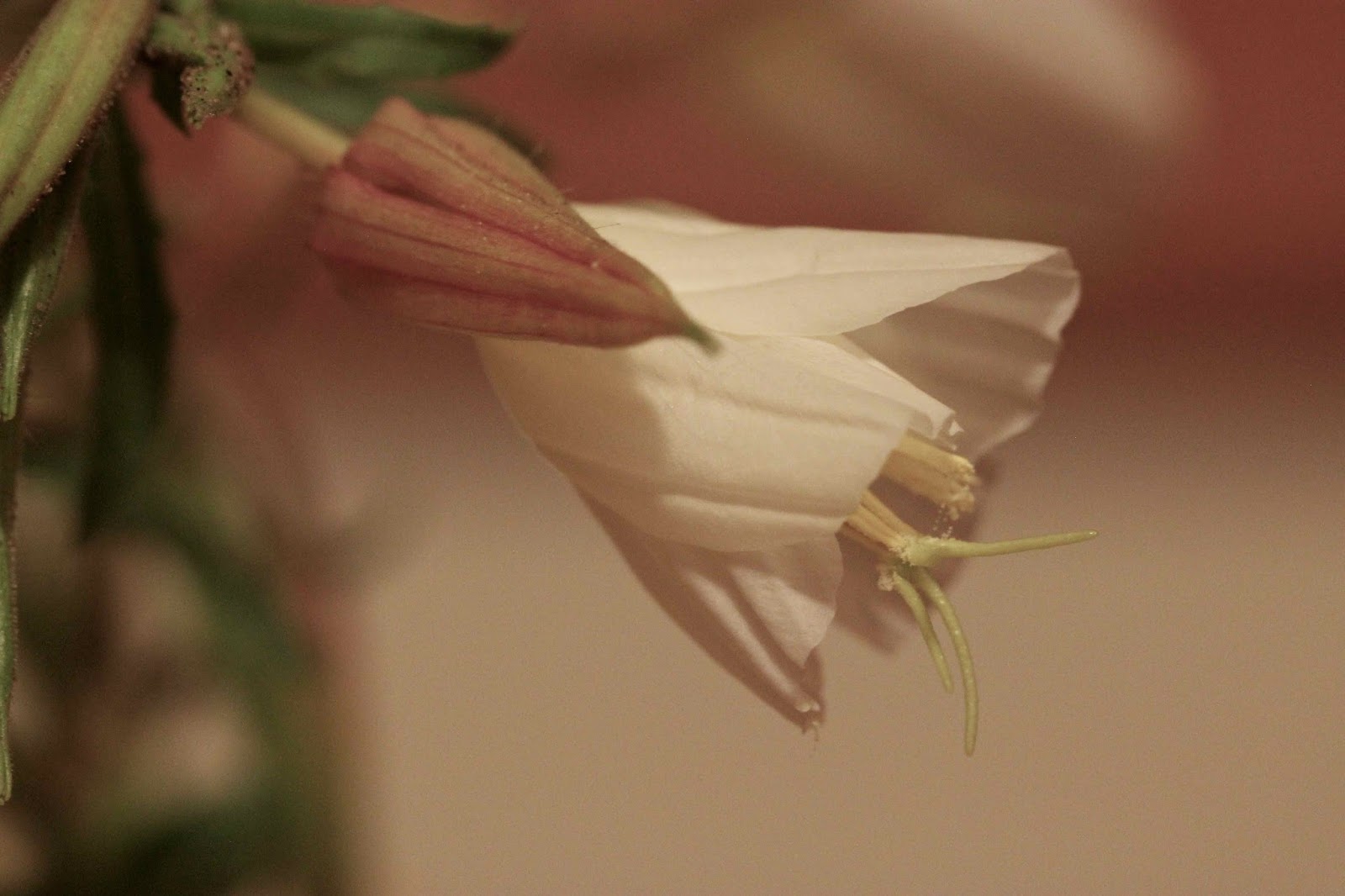 |
8:43: Petals continue to spread and unfold.
|
 |
| This one wasted no time. |
 |
| Petals spread and unfold. Fold lines remain visible until flowers close the next morning. |
By 8:50, when I turned off the camera, four flowers had opened, and were filling the kitchen with their thick distinctive scent. I moved them outside and wished them the best.
Nuttall’s evening primrose is said to have a strong or even unpleasant fragrance. Eager to know more, I went searching. But Google and academic databases produced nothing specific for Oenothera nuttallii. I found a slender lead—a paper about volatile compounds in yellow-flowered evening primroses. Author Rob Raguso promptly responded to my inquiry:
“Specific to O. nuttallii, we have a large data set and a paper in prep on the phylogenetic distribution of floral scent in Oenothera section Anogra, including both lab and field data for O. nuttallii. It is a fascinating plant and there is much more to be learned about it! I hope to have the paper submitted by the end of the year, with my co-authors. Will be happy to share with you once it is.”Floral scents are complex. Sometimes only a single compound is involved, but more often there are 20 to 60, or even 100 (Knudsen & Gershenzon 2006). Raguso and his colleagues have identified 16 volatile compounds in Nuttall’s evening primrose. The majority, about two-thirds of all emissions, are really foul-smelling nitrogen-bearing compounds. Yet to me, these evening primroses smell sickeningly sweet at worst, and only when they're confined to a small room.
The explanation lies in our differential reactions to specific compounds, as Raguso explained:
“… an important point is that human (and insect) perception of plant volatiles is not always dominated by the most abundant compounds. In the case of O. nuttallii, there is a relatively large and consistent presences of methyl salicylate, known to many as wintergreen oil! Also, there is a small amount of a very sweet, perfumey compound called cis-jasmone, which has a very penetrating effect to human subjects. So the blend is very dimensional, from sharp "animalic" notes (as described by the great chemist/perfumer Roman Kaiser) to distinctive wintergreen and jasmine scents, with a heavy, almost medicinal presence lent by the largest volatile compound in our sample, benzyl benzoate.”
Which pollinators find this blend irresistible? Moths. The Raguso lab is currently studying responses of hawkmoths to compounds released by Nuttall’s evening primrose. Krissa Skogen has shown that the hawkmoths that pollinate Harrington’s evening primrose will travel up to twenty miles in a night. Do equally wide-ranging hawkmoths pollinate Nuttall’s evening primrose? If so, the required outcrossing is almost certainly assured!
 |
A receptive stigma extended well beyond the anthers, waiting for pollen from afar.
|
Sources (in addition to links in post)
Many thanks to Rob Raguso, Professor and Chair of the Dept. of Neurobiology and Behavior at Cornell University, for sharing his research results for Nuttall’s evening primrose.
Krissa Skogen of the Chicago Botanic Garden provided the great photo of the hawkmoth and evening primrose. For more about her research on hawkmoths and Harrington’s evening primrose, see Science Scents.
Knudsen, JT, and Gershenzon, J. 2006. The chemical diversity of floral scent, in Dudareva, N, and Pichersky, E, eds. Biology of floral scent. CRC Press.
Raguso, RA, et al. 2007. Floral biology of North American Oenothera Sect. Lavauxia (Onagraceae): advertisements, rewards, and extreme variation in floral depth. Annals of the Missouri Botanical Garden 94:236-257. http://www.jstor.org/stable/40035498


