Showing posts with label chalk. Show all posts

Wednesday, November 28, 2018

Kansas Chalk: odds, ends & final thoughts

I too wended my way to this wonderful group of chalk outcrops.

Kansas geologists seem to be apologetic about their state. I say this because in the various guidebooks and websites that I read before my trip, the writer often began with something like the following:
“At first glance Kansas is_________, but there are_________things to see.”
The first blank contained words like boring, monotonous, covered in corn, flatter than a pancake. The second would counter with interesting, unusual, entertaining, educational, surprising, etc.

Some of my own impressions match the first blank: mile after mile of corn and sorghum (milo), orthogonal networks of perfectly straight roads, very few people except in widely-scattered small towns, and expansive vistas with little topographic relief (Kansas truly is flatter than a pancake, as has been shown scientifically (1)).
Pancake on left, Kansas on right (1).
But those impressions quickly faded as I explored western Kansas, which is indeed interesting, unusual, entertaining and educational. And I wasn’t surprised. The more I travel, the more I’m convinced that an open, curious and friendly mind makes for a great trip. But would Kansas have been as interesting without my passions for geology, botany and history? … that’s an unanswerable question.

Knowing that today’s chalk outcrops were once limy planktonic muck at the bottom of a sea gave the landscapes an other-worldly feeling. Imagine a sea inhabited by giant fish and marine reptiles with pterosaurs flying overhead, where today’s chalk monuments rise above shortgrass prairie and yucca!
Modern-day creature of the chalk. This tarantula was 15 ft up, crawling straight down the face!
Dan Burgevin’s “Processions of the Prairie” shows this fascinating juxtaposition of Kansas past and present. It’s on display at the Fick Museum, above one of George F. Sternberg’s Xiphactinus fossils. When I asked about the painting, I was given a poster version! (from a stack donated to the museum for local school kids).
The Fick Fossil Museum was a nice surprise. It’s in Oakley, population 2045, a small town with big grain elevators south of Interstate 70. I was the only visitor that weekday afternoon. The museum was overseen by a woman who obviously was working on other things. But she was happy to stop and visit when I walked in. Most locals I met were proud of and eager to talk about their chalk.

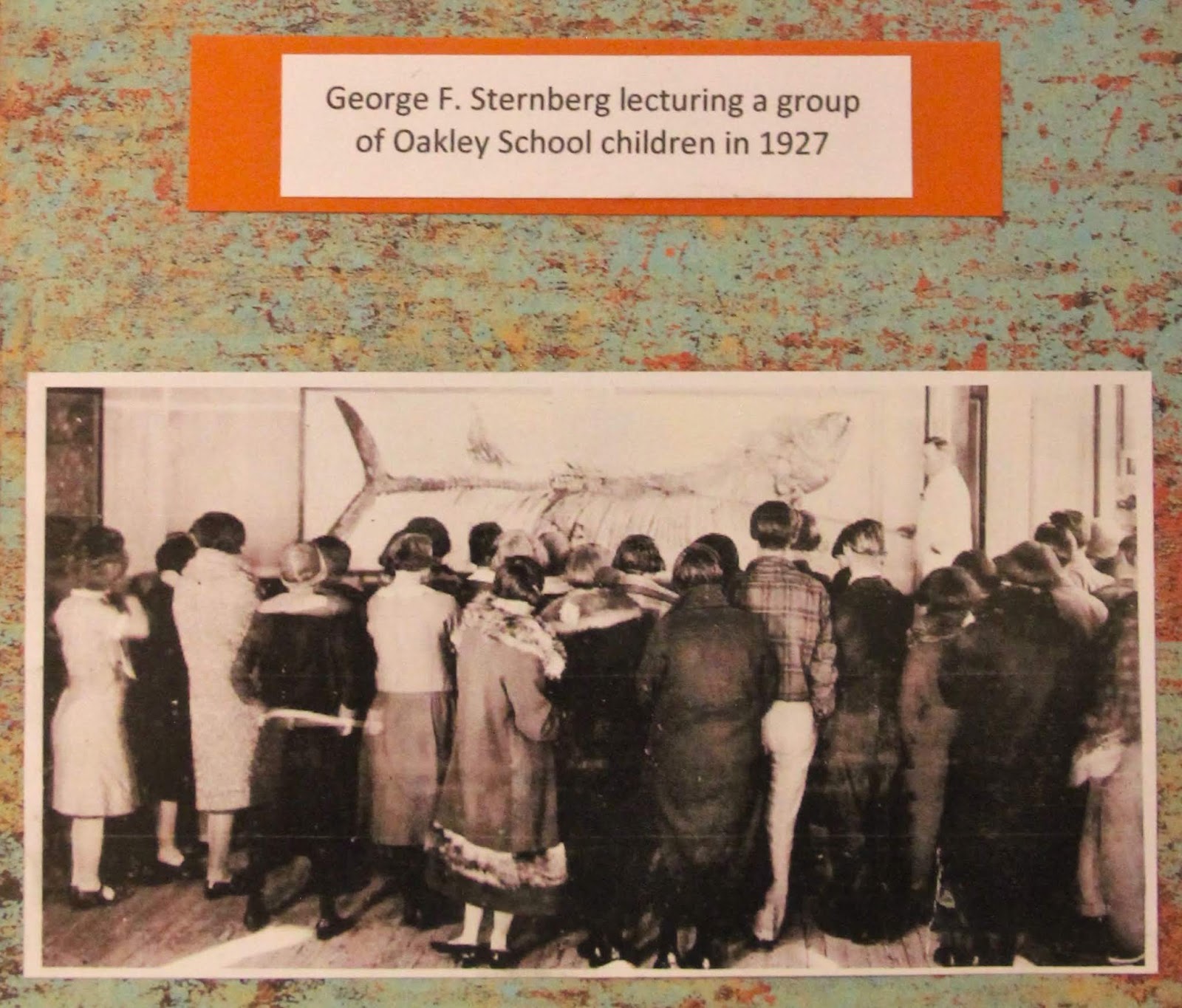
The museum was created by Ernest and Vi Fick to house their fossil collection and Vi’s artwork. It also includes fossils donated by legendary paleontologist George F. Sternberg, old photos from the time when Sternberg was excavating fossils from the chalk, and other historical items from the area.
Tylosaurus, the Kansas marine fossil.
Vi Fick worked in what has to be a unique medium—fossils! She incorporated many small fossils, often painting them first, to make landscapes. This speaks to how incredibly abundant some types of fossils are in the chalk—sharks’ teeth, vertebrae, small shells.

For a Wyoming naturalist, Kansas is different kind of place. There's very little public land. Most chalk exposures, and all of the more spectacular ones, are privately owned. Yet it’s still possible to see the chalk up close. The owner of Monument Rocks (Chalk Pyramids) has opened this National Natural Landmark to the public! This is so different from Wyoming, where landowners tend to be almost paranoid about letting strangers on their land.
I was disappointed to learn that the chalk badlands of Little Jerusalem are now closed to public access. But the new owner of the Smoky Valley Ranch, The Nature Conservancy, will open it in the near future. Now I have a reason to go back! Check out the Wichita Eagle’s video: Drone View of Little Jerusalem. Currently, there are horse/foot trails open to the public in the prairie portion of the Ranch (dogs on leash), where there are occasional exposures of chalk in small drainages.
Little Jerusalem, Kansas (source).
Chalk in a small draw on the Smoky Valley Ranch.

In putting together these posts about the Kansas chalk (2), I wondered: Would other people find it as intriguing as my stories and photos suggest? Another unanswerable question! Experiences are so strongly shaped by our past and our hopes for the future. Our stories are our own.

Notes

(1) Kansas is indeed flatter than a pancake. In fact, it’s “considerably flatter” as has been shown utilizing topographic geodetic survey:
“One common method of quantifying ‘flatness’ in geodesy is the ‘flattening’ ratio. … we approximated the local ellipsoid [for both Kansas and a well-cooked pancake] with a second-order polynomial line fit to the cross-sections. These polynomial equations allowed us to estimate the local ellipsoid’s semi-major and semi-minor axes and thus we can calculate the flattening measure f.” Full details here.
(2) Other posts about Kansas Chalk: To Kansas to See the Chalk, A Ghost Rock Speaks and Charismatic Kansan Megafauna.

Monday, November 19, 2018

Charismatic Kansan Megafauna

Eerie eye of a hungry mosasaur!
This is the third in a series of posts about my visit to the Kansas chalk (1)—the remains of the great Western Interior Seaway which covered a large swath of North America roughly 100 to 60 million years ago. I was most taken by the chalk itself—its planktonic composition, the conditions in which it formed (imagine Kansas underwater!), and the bizarre picturesque outcrops in the valley of the Smoky Hill River. However it’s not the chalk that most people get excited about, but rather what it contains—lots of well-preserved fossils of gigantic beasts now long gone.

This is not to say I had no interest in the chalk’s fossils. In fact, I was eager to see the creatures of the Seaway, and I devoted an entire day to the Sternberg Museum of Natural History in Hays. It was well worth the hundred-mile drive (each way).

But first a quick review. About 87 to 82 million years ago, Kansas lay in the middle of the Western Interior Seaway, far enough from shore that little terrestrial debris washed in. Instead, seafloor sediments were dominated by dead plankton, mainly the calcareous scales of coccolithophores, which rained down in abundance.
Red X marks Kansas (USGS).
Coccolithophores thrived in the Kansas sea. Their microscopic scales formed chalk beds 600 feet thick! (source).
Occasionally carcasses of bigger creatures fell to the seafloor and were entombed in the limy muck. With pressure from overlying sediments, the muck became chalk. Uplift, retreat of the sea, and finally erosion exposed the chalk and the remains of those long-dead animals—today’s fossils.
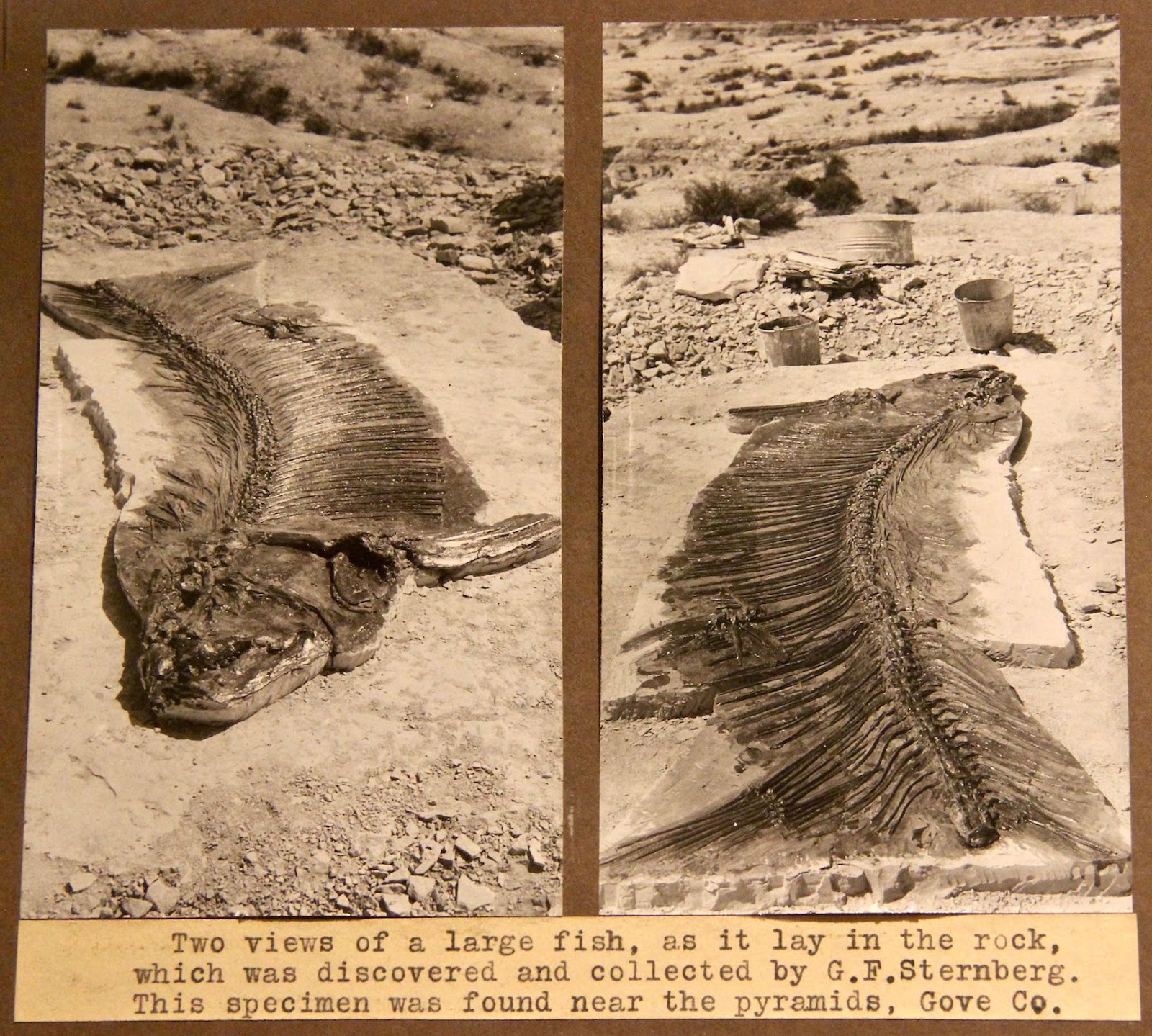
Collecting a Xiphactinus fossil (large fish) from the Kansas chalk, early 20th century (Fick Museum, Oakley).
Originally, a fossil was simply something “obtained by digging” (from L. fossilis). But in the 18th century, usage became restricted to preserved remains of living organisms (including impressions, and traces such as burrows and tracks). Fossils are common in the Smoky Hill Chalk, and often spectacular. Not surprisingly, when word got out that there was a treasure trove of novel fossils awaiting discovery in western Kansas, the big names in North American paleontology got really excited.

In 1870, Professor Othniel Marsh of Yale and his students rode the Union Pacific Railroad as far as North Platte, Nebraska. Joined by a military escort, they explored the fossil-rich country of western Nebraska before continuing across Wyoming to Salt Lake City and finally San Francisco. On the return trip, they made just a quick stop in Kansas, in the valley of the Smoky Hill River. But it was long enough for Marsh to make the discovery that sparked his passion for the Kansas chalk—a strange hollow bone, probably the finger of something that flew! Though it was the end of the day and fast getting dark, he carefully excavated the bone and precisely noted the location.

The next year, Marsh returned to the site and collected the wing bones of a giant pterosaur—far larger than any previously described, and the first found outside of Europe. After several years of taxonomic wrangling, it became Pteranodon (2), now one of the two state fossils of Kansas (3).
Marsh with his students, ready for adventure! (source)
A few years later, local farm boy and fossil enthusiast Charles H. Sternberg enrolled at Kansas State Agriculture College, where he heard some exciting news. Professor B.F. Mudge (also the state geologist) would lead a party of students to search the chalk for fossils for Professor Marsh! Though the expedition was full, Sternberg “made every effort within my power” to join. But he was turned down.

In despair, and desperate to collect fossils in the chalk, Sternberg wrote to another leading paleontologist, Professor Edward Drinker Cope of Philadelphia—who happened to be Marsh’s arch rival.
“I put my soul into the letter I wrote him, for this was my last chance. I told him of my love for science, and of my earnest longing to enter the chalk of western Kansas and make a collection of its wonderful fossils, no matter what it might cost me in discomfort and danger.”
Sternberg explained that he was too poor to finance a trip himself, and asked for $300 for a wagon, horses, camping gear, a cook and driver. He sent no recommendations “from well-known men” but did mention his earlier work collecting fossil leaves in central Kansas. Cope quickly replied, sending a draft for three hundred dollars and a note: “I like the style of your letter. Enclose draft. Go to work.”

What are the chances today that a preeminent scientist would send funding to some unknown local?! Those were different times, it’s true, but there’s another likely factor—Cope’s bitter rivalry with Marsh (4). Cope surely was eager to get his hands on fossils from the Kansas chalk. As it would turn out, that $300 was a wise investment.

Charles H. Sternberg spent four hard but happy and productive years collecting fossils for Cope, the beginning of a fossil-collecting dynasty that included Charles and his three sons—George F., Charles M. and Levi. The Sternberg family often named children after relatives, so the full story can be hard to follow. But for this post, we only need to know Charles H. and his oldest son, George F. The latter was named after his uncle, George M., an army surgeon stationed in Kansas (and later US Surgeon General) who convinced his father to move the family there to farm.
By age 17, Charles H. Sternberg (1850-1943) knew he would devote his life to fossil-collecting. His father thought it a poor choice (source).
George F. Sternberg (1883-1969) collected his first important fossil, a novel plesiosaur, at age nine. His contributions to Kansas paleontology were monumental (Fick Museum, Oakley).
After graduating from high school, George F. worked in the family fossil business full time, earning widespread respect for his collecting and research. Lack of a college education was never a problem until the Western Branch of the Kansas Normal School (today’s Fort Hays State University) discovered that without a college degree, Sternberg could not be hired as a professor. So he became museum curator, a position he held until 1962. After his death in 1969, the museum was renamed in his family’s honor.

George F. Sternberg (source).
At the Sternberg Museum, I paid a modest fee and entered the first floor of exhibits. I immediately spotted George F. Sternberg, who was carefully excavating a huge fish fossil! It was one of his most famous discoveries—the Fish-Within-A-Fish—a Xiphactinus that died not long after swallowing a Gillicus. It’s on display next to George.
At 14 feet in length, this is a rather average Xiphactinus.
George F.’s Fish-Within-A-Fish advertises the Lithic Bookstore and Gallery in Fruita, Colorado. 
Just across from Xiphactinus is a huge Dragon of the Sky—Pteranodon, the Kansas flight fossil (3) and logo of the Sternberg Museum. It was the fossilized finger bone of a Pteranodon that got Professor Othniel Marsh excited about the Kansas chalk. Marsh’s first description had some serious errors due to lack of body parts and careless packing—a Xiphactinus tooth got mixed in (source). Based on wing bones and the errant tooth, Marsh concluded this animal was similar to European toothed pterosaurs. But when skeletons were found with skulls, he had to revise his thinking. This pterosaur had a giant crest on its head and no teeth—a brand new kind! Marsh changed its name to Pteranodon (2).
Note the massive crest atop Pteranodon’s head and framed on the left (museum logo added).
The exhibits were so beautiful, as well as educational, that I spent a lot of time taking photos and notes.
Shark vertebrae.
GillicusXiphactinus’s last supper—also was a predatory fish.
Seymouria is much older than the chalk, but was too photogenic to ignore. An amphibian with reptilian features, it lived roughly 275 million years ago. This one is about two feet long.
Exhibits about local geological history and stratigraphy were a terrific help in understanding the context of Kansas chalk. I'm glad I visited the Museum early in my trip. Below are two formations from the stratigraphy exhibit—the beloved Niobrara Formation (because it includes the chalk) and the younger Pierre Shale, which is made of fine terrestrial sediments indicating the Seaway was in retreat.
The Sternberg is a natural history museum that includes much more than fossils from the Smoky Hill Chalk. But they were my focus, and they kept me busy for several hours. Not surprisingly, these are mainly marine animals—shellfish, sharks, fish (some huge!), giant turtles and other hulking creatures like the mosasaur, a giant reptilian marine predator (5).
Though big, reptilian and now extinct, mosasaurs (above and below) are not a dinosaurs. Why? … see Were Pterosaurs and Mosasaurs Dinosaurs? for a simplified explanation.
The most popular members of the Mesozoic megafauna are rarely found in the chalk—the dinosaurs. They were terrestrial, so were absent from the Seaway. A notable exception is Niobrarasaurus—notable enough that it has its own exhibit. It’s a puzzle: How did a terrestrial creature end up on the seafloor far from land? Perhaps it died on shore, and its bloated carcass washed out to sea where it floated for some time before finally sinking. This is the “Bloat & Float” hypothesis.
A reptilian tank with armored plates.
Niobrarasaurus was named for the Niobrara Formation, of which the Smoky Hill Chalk is a member. The creature was “built like a tank” and covered in armored plates, which may have helped maintain the bloat. This fossil was excavated from the chalk in 1930, and shipped off to the University of Missouri in Columbus. Seventy-two years later, Niobrarasaurus was repatriated, and is now on display at the Sternberg Museum.

Not Cretaceous, but I couldn’t pass it by!
After several hours on the first and second floors, including an irresistible detour to see all 22 of our rattler species live! (behind glass), I checked the gallery guide and saw there was a third floor, featuring an Upland Diorama. Memories surfaced of the simple small-scale less-than-realistic dioramas in the natural history museums we visited as kids. I have fond memories of those visits, so I started up the stairs. But before I got even halfway, it became obvious …
Oh my! Hadrosaur ahead!!
… my expectations were wrong! This is a life-size realistic total-immersion diorama. Pterosaurs flew overhead, specifically Pteranodon sternbergii, named for George F., who collected the first specimen in 1966. Life-size sculpted creatures mingled with more of their kind in the panoramas on the walls behind.
These scenes would have been in Colorado, on the west shore of the Western Interior Seaway. And there on the beach I spotted the dead bloated Niobrarasaurus, not yet washed out to sea.
From the beach, I descended through the Schmidt Exhibit, walking away from shore along the floor of the Seaway. First there were sandy beach deposits, then finer sediments—silt and clay—in deeper water. Far from shore, I reached the wonderful limy muck—planktonic debris overlying limestone and chalk (sediment labels added).
Finally, the walkway rounded a corner and I floated off through the waters of the Western Interior Seaway  face-to-face with its charismatic megafauna!
Yikes! Xiphactinus!!

Notes

(1) Other posts in this series are To Kansas to See the Chalk and A Ghost Rock Speaks.

(2) Some paleontologists now place Pteranodon sternbergii in the genus Geosternbergia (source).

(3) Pteranodon is the Kansas flight fossil. Tylosaurus, a mosasaur, is the Kansas marine fossil. Both are from the Smoky Hill Chalk. Nothing wrong with having two state fossils, especially given Kansas’s impressive fossil heritage! More here.

(4) The Marsh-Cope rivalry was bitter and brutal. Both “used underhanded methods to try to outdo the other in the field, resorting to bribery, theft, and the destruction of bones. Each scientist also sought to ruin his rival's reputation and cut off his funding, using attacks in scientific publications.” (from Bone Wars).

(5) The photo at top of post is the mosasaur Tylosaurus, the Kansas marine fossil (full skull below). It’s on display at the Fick Museum in Oakley, which is much smaller than the Sternberg, but fascinating and worth a visit.

Sources

Liggett, GA. 2001. Dinosaurs to dung beetles: expeditions through time. Hays, KS: Sternberg Museum of Natural History.

Sternberg, CH. 1909, reprinted 1990. The life of a fossil hunter. Indiana University Press. Recommended reading!

Sternberg Museum of Natural History. Gallery Guide. Available here.

Wednesday, October 31, 2018

A Ghost Rock Speaks

Photo by Greg Willis.
“Geologists have been somewhat chary about acknowledging that this soft, white, calcareous material is in reality chalk.” (Calvin 1895)

In 1868, biologist Thomas Henry Huxley presented a lecture to the working men of Norwich titled On a Piece of Chalk—the chalk that every carpenter carried in his breeches-pocket (1). But everyday utility was mentioned only in passing; Huxley’s objective was much more ambitious. “I have been unable to think of any topic which would so well enable me to lead you to see how solid is the foundation upon which some of the most startling conclusions of physical science [geology] rest” (all quotes by Huxley unless noted). He then proceeded to recount the story told by chalk.

Graham Young recently wrote of rocks as ghosts. Unlike human ghosts—disembodied souls, fleeting suggestive figures—a rock ghost has a physical presence. Yet it too is disembodied—an altered piece of a former landscape, or as Young noted: “a concrete relic of the lost place and time in which it was formed.” Such ghostly remains provide a glimpse into the past, but it’s often dim. Sometimes though, we’re lucky enough to meet rock ghosts that speak in great detail. Chalk has been especially generous in this regard.

Chalk is a form of limestone, and as such, is composed of calcium carbonate (CaCO3). The source and structure of the calcium carbonate are what make chalk distinctive—remarkably white and soft enough to write with (2), “almost too soft to be called rock.” In his lecture, Huxley explained that a microscope reveals chalk to be a mass of tiny discs called coccoliths, which were also discovered in abundance on the seafloor during the 1857 survey of the route for the first transatlantic telegraph cable. This probably surprised most in the audience, but there was no arguing. Chalk clearly had formed in the sea!
Coccolithophore covered in coccoliths. Note scale bar—how many coccoliths must fall to the seafloor to produce 1000 vertical feet of chalk?! (source).
Coccoliths are the calcareous scales of coccolithophores—marine phytoplankton (3). Being plants, they photosynthesize, making food from sunlight, water and carbon dioxide. They also extract calcium from seawater, and combine it with carbon dioxide to manufacture calcareous scales. When they reproduce or die, their coccoliths separate, and slowly drift down and settle on the seafloor. Insignificant debris you might think, but coccolithophores are so incredibly abundant that their scales form thick layers of limy muck. With the pressure of overlying sediments, the muck becomes rock. But because the seemingly delicate coccoliths are tough and hard to compress, the rock is soft—chalk.

Huxley moved next to an even more surprising but unavoidable conclusion revealed by chalk—the nearly-incomprehensible amount of time involved in its formation. “… it must have taken some time for the skeletons of animalcules of a hundredth of an inch in diameter to heap up such a mass as that.” He explained his rough calculation of the minimum time required to build the thousand feet of chalk underlying Norwich, based on rate of coccolith accumulation—12,000 years!

At that time, the idea that one small part of nature’s work required 12,000 years was mind-boggling to most people. Now we see it as a gross underestimate. Probably coccoliths accumulated for something like ten million years to build England’s chalk.
White cliffs of Dover, England, seen from the deck of the ferry to France; Makiko Itoh.
Huxley continued, with still more startling news: the earth has changed radically many times. Just look—the disembodied soul of a seafloor that we know as chalk now stands above water and sometimes far from any sea. Therefore it must have been “upheaved & converted to dry land,” forcing us to conclude that “the earth, from the time of the chalk to the present day, has been the theatre of a series of changes as vast in their amount, as they were slow in their progress.”

But here Huxley hit a dead end. It was clear from the rock record that the earth’s surface was continually subjected to elevation and depression. But when asked “Why these movements?” … the rocks were silent.
“I am not certain that any one can give you a satisfactory answer to that question. Assuredly I cannot. All that can be said, for certain, is, that such movements are part of the ordinary course of nature, inasmuch as they are going on at the present time.”
Huxley with sketch of gorilla skull, c. 1870 (source).

Huxley had to end chalk’s story there, but fortunately our accumulated knowledge has grown significantly in the 150 years that have passed. The theory of plate tectonics now takes care of Huxley’s unanswered question. The earth’s crust consists of giant plates that move, stretch, split, collide, dive under, and override—producing uplift and downwarping in the process. It was during a time of major crustal change, when sea levels were at a maximum, that the oceans invaded the continents and created large shallow epicontinental seas where chalk formed.
Epicontinental seas were widespread in late Cretaceous time—as is chalk today (source).

Huxley's lecture was limited to European chalk. He made no mention of chalk in North America, but that was hardly surprising. At that time even preeminent North American geologists were unwilling to acknowledge that the soft white rock reported from the heart of the continent was indeed chalk.

In 1865, DC Collier—resident of Central City, Colorado, editor of the Daily Miner’s Register, and a man with an interest in geology—was traveling to Atchison, Kansas by Butterfield stage. About 250 miles east of Denver, in western Kansas, they were forced to stop on multiple occasions due to threat of Indian attack. This allowed Collier time to explore the white bluffs nearby.
“With my revolver cocked in my hand … I was able often to go half a mile from coach or camp among the bluffs. On one occasion, in company with a companion I was able to climb to the top of a bluff of pure chalk, so soft that I could cut and carve it with the knife I carried in my belt, and so fine that it covered my clothes as thoroughly as when in my college days a classmate wiped the blackboard with my back.”
Collier collected a mosasaur jaw about four feet long and some vertebrae, just a few of the many fossils he saw in the chalk. Unfortunately his research came to an end when a military escort arrived, allowing them to to continue east. Collier later gave his fossils to Oberlin College, and, at the urging of Professor James D. Dana of Yale, submitted an article to the American Journal of Science about the Kansas chalk. It was published in 1866 (4).

Yet Dana dismissed reports of North American chalk for decades, as did Joseph LeConte of the University of California, also a preeminent geologist of the time. It wasn’t until the third editions of their highly-regarded geology manuals that they revised their descriptions: “in North America [there is] no chalk, excepting in western Kansas, where, 350 miles west of Kansas City, a large bed exists” (Dana, 1880); and “recently good chalk composed of foraminiferal shells, and containing flints, has been found in Texas” (LeConte, 1890).

Fast-forward 150 years:

I was introduced to chalk (the rock) by Huxley, whose intriguing lecture I found in collection of natural history essays. I was especially excited when I later learned that the central part of North America was once covered by an epicontinental sea where coccolithophores thrived, and coccoliths rained down on the seafloor to form chalk. Some of the best exposures are not all that far from where I live, so last month I made a pilgrimage to western Kansas to visit the white bluffs and monuments in the valley of the Smoky Hill River (see To Kansas to See the Chalk).
Late Cretaceous Western Interior Seaway; X marks Kansas (USGS).
Extent of Smoky Hill Chalk, western Kansas (5).
I arrived in the dark, having driven 450 miles with multiple unplanned-but-worthwhile stops. So it wasn’t until the next day that I saw my first chalk. It wasn’t entirely what I expected.
Descriptions of Kansas chalk, especially for public consumption, often reference the famous chalk of Europe (usually the White Cliffs of Dover), as it’s similar in age and composition. But up close, there’s a clear difference. European chalk occurs as thick deposits with few obvious bedding planes, suggesting extremely stable conditions for millions of years. The only visible layers are occasional thin bands of flint. In contrast, Kansas chalk is distinctly layered. Apparently the environment wasn't so stable here.
After my trip, I found a 1982 paper by geologist Donald Hattin about the Smoky Hill chalk. The man must have devoted a huge amount of time and effort to this project, for the resulting description, based on 25 localities, included 600 feet of chalk, much of it laminated (layered). For many localities, Hattin described on the order of 60 to 80 layers! He identified more than 100 bentonite seams—thin beds of altered volcanic ash—and described 23 recognizable marker beds. Much of the layering was subtle, varying mainly in the concentration of fecal pellets—coccolithopore poop.
I loved the photogenic layered chalk!
Lacking Hattin's skill, I contented myself with admiring accumulations of broken shells. I imagined them sloshing around on the mostly flat seafloor, sometimes piling up behind small features.
Broken shells, common in the chalk.
Thin layers of something ... limestone? ... with scattered shells.

Thus ends my story of chalk. But I want to add Huxley’s final words, because they're more fitting than anything I could write about this ghost rock. It “has become luminous, and its clear rays, penetrating the abyss of the remote past, have brought within our ken some stages of the evolution of the earth. And in the shifting ‘without haste, but without rest’ of the land and sea, as in the endless variation of the forms assumed by living beings, we have observed nothing but the natural product of the forces originally possessed by the substance of the universe.”

Notes

(1) Huxley was a strong proponent of scientific education for adults, perhaps because he was largely self-educated.

(2) Most “chalk” now used for writing, marking boards, decorating sidewalks, etc. is made of gypsum (calcium sulfate).

(3) At the time of Huxley’s lecture, it was unknown whether coccoliths were produced by organisms or through chemical precipitation. Huxley himself wasn’t sure, finding “the nature of [coccoliths] extremely puzzling and problematical.” However, by the time the lecture was published in Macmillan’s Magazine, later in 1868, he was convinced they were products of “independent organisms” as he explained in an endnote.

(4) Calvin (1895) described earlier reports of chalk-like rock from the central part of North America, such as “prairie chalk” in 1841, and “chalky limestone” from the surveys of Meek and Hayden in the 1850s.

(5)  The Smoky Hill Chalk is sometimes called the Niobrara Chalk or simply the Chalk.

Sources

Calvin, S. 1895. Composition and origin of the Iowa Chalk. Reports of the Iowa Geological Survey 3: 213-236. Available online.

Collier, DC. 1866. Notes on chalk and Cretaceous deposits in eastern Colorado. American Journal of Science, 2nd series. 41: 401-403. [The chalk Collier described was in Kansas.]

Diffendahl Jr., RF. 2017. Great Plains geology. University of Nebraska Press.

Hattin, DE. 1982. Stratigraphy and depositional environment of Smoky Hill Chalk Member, Niobrara Chalk (Upper Cretaceous) of the type area, western Kansas. Kansas Geological Survey Bulletin 225.

Huxley, T. H. 1868. On a piece of chalk (lecture given to the workingmen of Norwich). Published later in 1868 in Macmillan's Magazine, and as a book by Scribner in 1967. Available online.