Showing posts with label Wyoming weather. Show all posts

Saturday, December 9, 2023

Junipers in December & Views from Above

Trail 1 dusted with snow.
Once again we ventured northeast of Laramie to visit the two three Rocky Mountain Junipers we're following (I added the Fallen One several months ago). It was cold and windy and snowing lightly off and on. But it felt good to get out of the house! And it's time to acclimatize—they say this will continue for awhile.
We made it. "Northern" tree on left. Field assistant on limestone for scale.
Of the two standing trees, the northern one has a good crop of berries on the east (leeward) side. I saw none on the west side. The southern tree has no berries. Perhaps it's male (Rocky Mountain Junipers are usually dioecious, trees are male or female).

East side of juniper, protected from the wind and laden with berries (dark spots, click image to view).
Next I checked the third tree, the Fallen One. It's clearly female, with a very healthy crop of berries.

Fallen one in distance.
Mature juniper berries often have a glaucous bloom, making them frosty blue.

Then we turned to face the wind, and made our way back to town.

Headed home. What appears to be mountains on the horizon is a cloud bank.

Recently a reader asked where these junipers are in relation to Laramie. So I captured and sent her a photo from Google Earth. And wow, was I surprised! The limestone is much more impressive from the air. It's the gently sloping start of the foothills of the Laramie Mountains to the east.

Arrow marks approximate location of the junipers. Paler areas east of town are exposed slabby limestone.

A better view; black spots are scattered junipers.
This is my contribution to the December gathering of Tree-followers, kindly hosted by The Squirrelbasket. Best wishes to all!

Wednesday, April 14, 2021

Tree-following in April—Peak Laziness

My trees, Spike and Flash, have done nothing that's obvious to humans. I give them water during warm spells, hopefully they're putting it to good use. I check the buds most days. But this morning I just took a photo through the window, which explains the faint grid. That's Flash on the left, by my truck; Spike on the right.

Again we have fresh snow, just like in my report a month ago. And again we're happy. Everything has been so dry here in the Laramie Valley.

Travelers are not happy however. Again Interstate-80 is closed, another rolling closure. If you have 1:34 min:sec to spare, check out WYDOT's Ralph Tarango and Doug McGee explaining rolling closures. They do a good job. And "Remember, if there's ice & snow, take it slow!"
Curtis Street exit, Laramie, Wyoming (WYDOT).


Monday, April 13, 2020

A Tree

Question: If Laramie stays below freezing, will Covid 19 die?*

Winter returned to Laramie. Our temperatures haven’t been above freezing for three days, and lows are in the single digits (ºF). But inspired by our founder Lucy Corrander, who is back as of this month (!), I went to LaBonte Park to look for a tree to follow. And that’s exactly what I found—a tree.
A tree in LaBonte Park.

The shape and bark were appealing. I have no idea what kind it is but that’s okay—a pleasant surprise to look forward to when spring truly arrives.
I decided to commit to following this tree, whatever it is. Too much uncertainty in life these days; a firm commitment feels good.

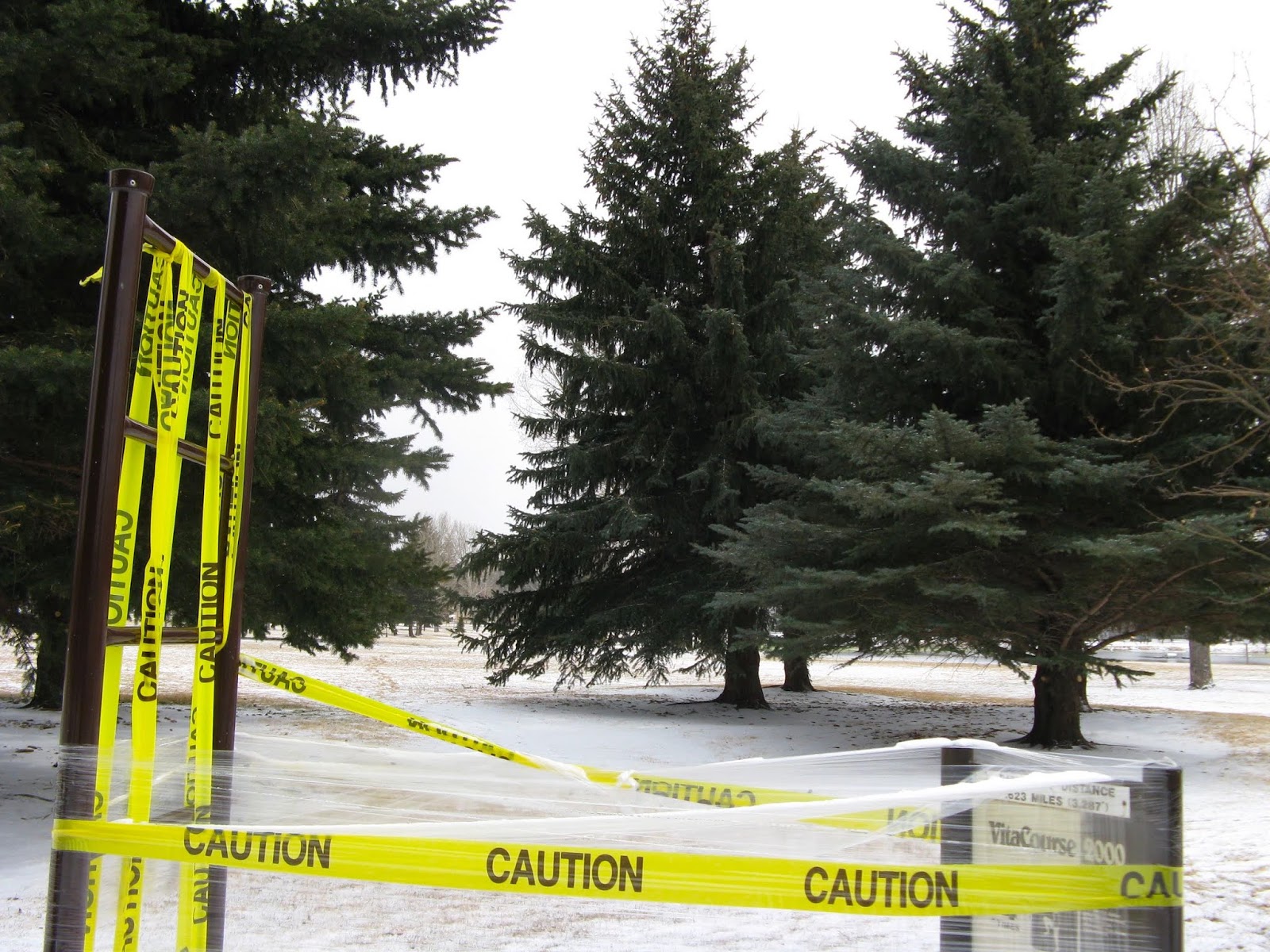
There weren’t many human visitors in the park. Was it because Covid 19 had closed the picnic shelters and exercise stations?
Or was it because it was 14º F? No! We’re a tough people!! I saw several dog walkers and a birder. Summer waterfowl are returning, migrants are passing through; there were gulls and ducks on LaBonte Lake. Next visit, I will carry binoculars. Hopefully it will be warmer.
Consider joining us. Tree-following is fun and interesting, and in Covid 19 times, any tree or any tree article will do! More information here.

*Answer: Probably not. Coronaviruses generally are stable in a frozen state, surviving for up to two years at -20°C.

Monday, November 11, 2019

Tasty Haws on Leafless Trees

Poplars at the Visual and Literary Arts building, University of Wyoming.
This year our fall colors include lots of pale browns, especially on poplars and cottonwoods. These are leaves that died and dried on the tree. The cottonwoods in my yard are still half-covered in dead leaves. Of course they're impossible to rake, and unfortunately our green waste pickup service ends this week.

But the trees I’m following—a pair of hawthorns next to the Visual and Literary Arts building—are all but bare. Last month they were covered in dull green leaves (and some rust-colored ones). I don’t know if they turned brown before or after falling, but in any case, the trees went from leafy to leafless in less than a month.
Early October.
Early November.
With no leaves it was easy to see the haws, which were wrinkled and shriveled. I suspect the hard frosts a few weeks ago are to blame. Actually “hard” is a gross understatement. We were hit by a blast of arctic air and suddenly it was winter—in mid-October! One day the high was 4º F (-16º C), and early the next morning we had a low of -15º (-26º). Fortunately, beautiful fall days have returned, with highs in the low 50s F.

Last month, several readers suggested I harvest haws and make jam or syrup. It probably would have worked out—with enough sugar and someone besides me as cook. So it didn't happen. But I did eat a handful of shriveled haws, straight off the trees.
All hawthorns (Crataegus spp.) produce 'edible' berries, i.e., not toxic (as long as you spit out the seeds, which contain cyanide). But the berries of many species are bland at best. So it was a nice surprise to find the haws on these trees were relatively tasty. They were mealy, but slightly sweet and with a nice flavor. Maybe shriveling up with the hard frosts concentrated sugars and tasty compounds … ?

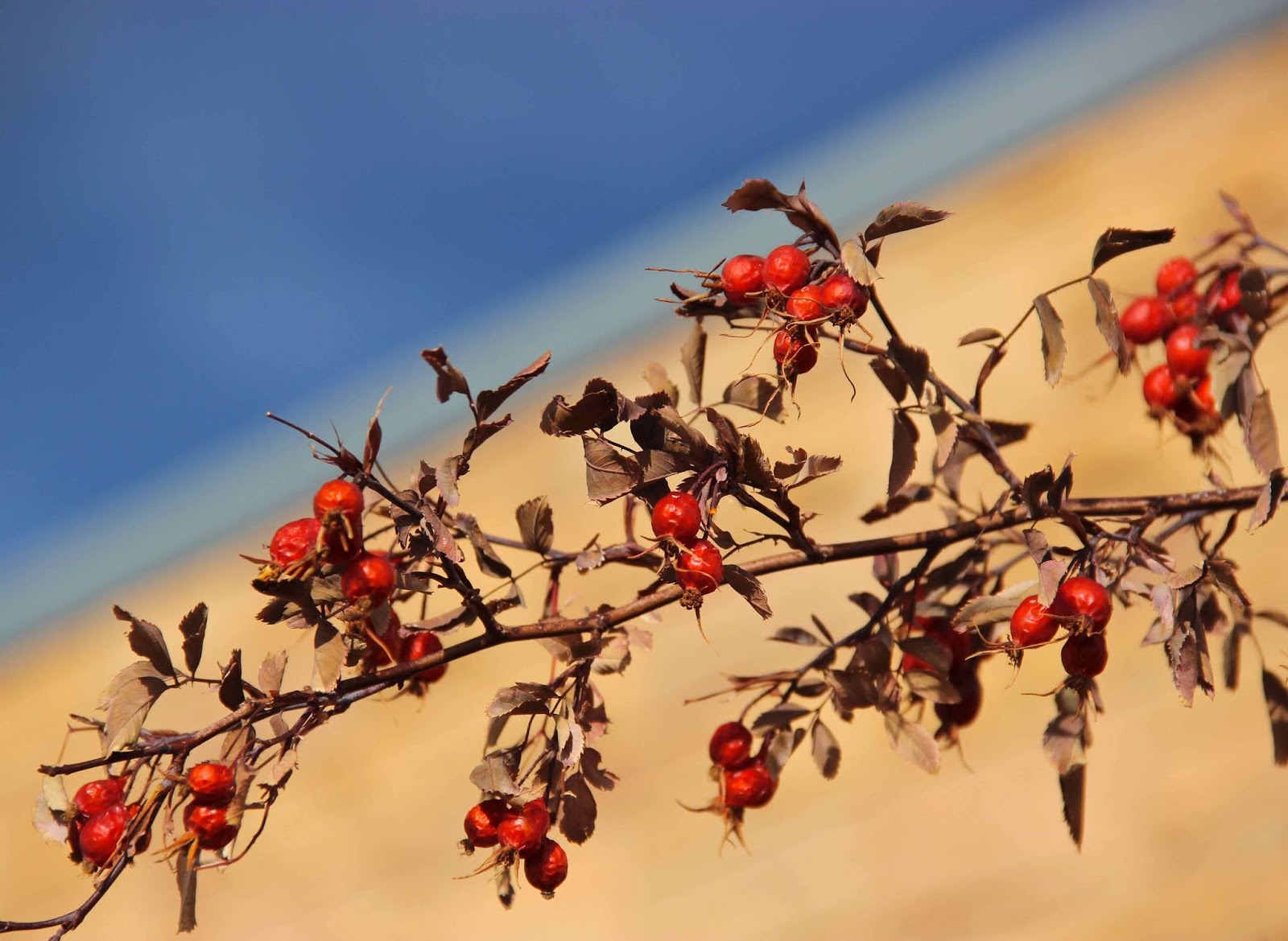
Why are there rose hips in this post? Because we love color this time of year! These are for Lucy, the original Tree Follower.

After waving to the Woman at the Entrance, who was of two minds that day, I entered the building for my monthly art fix. The main gallery was closed but no matter—the This and That Gallery was open, with new exhibits.

This featured Alexandria Pawlow's Song & Dance:
Decorated skulls by Sophia Spicer—Skull Candy—were on display in That:

This is my contribution to the monthly virtual gathering of tree-followers, kindly hosted by The Squirrel Basket. As the year draws to a close—just one more report on these hawthorns—I've started thinking about a tree to follow in 2020. It's a good time to join in the fun!—more information here.

Tuesday, October 8, 2019

Jack Frost and Aeolus – Partners in Art

On the crest of the Medicine Bow Mountains, just 50 miles west of Laramie, Wyoming, stands the Snowy Range—a sharp-edged thousand-foot-high six-mile-long ridge of quartzite that glistens in the sun. Trails run along its base, cross it at the Gap, and climb to various points along the summit, including Medicine Bow Peak, the high point at 12,014 ft. Though the trailheads are in the subalpine zone, they're just an hour’s drive from town, making the high country surprisingly accessible. And the scenery remains spectacularly photogenic, even after thirty years of hiking there.

But with hundreds of photos of “the Range” already, do I really need to carry a camera? This is one of life’s persistent questions. Fortunately, I can still convince myself there’s a chance of finding something new, fascinating, or at least entertaining.
Emmie's first visit to the Snowy Range.
Contemplating the final push to the summit of Medicine Bow Peak, just out of view on right.

The Snowy Range is a very popular hiking area in the summer, but my favorite time to visit is early fall, especially on weekdays. Temps are cool, and the lower light makes for richer scenery. Usage is low, parking is no problem, and well-mannered dogs can hike off leash.
Looking back toward trailhead at Lewis Lake, below Sugarloaf (on right).
Last Thursday we hiked one of the most popular trails in the Snowy Range, the short but nontrivial jaunt from Lewis Lake up to the Gap Lakes. There were just four cars in the parking lot, and two people along the trail, enjoying lunch at the Gap. The only other creatures seen were a marmot, a chipmunk, two pikas and a seagull. It was a quiet fall day aside from the wind, which wasn't bad.

From North Gap Lake, a short trail east led to the Shelf Lakes—small shallow sparkling lakes below immense piles of quartzite talus. It was here that I was happy to have brought the camera.
View west from Shelf Lakes; Medicine Bow Peak is bump at left end of ridge, above and right of snowfield.
From a distance, I saw that the far end of the first lake was rimmed with white, looking like salt along the shore of an alkaline lake, as we would see down in the Laramie Basin.
Note white line along vegetated lakeshore mid photo (not rocks on right).
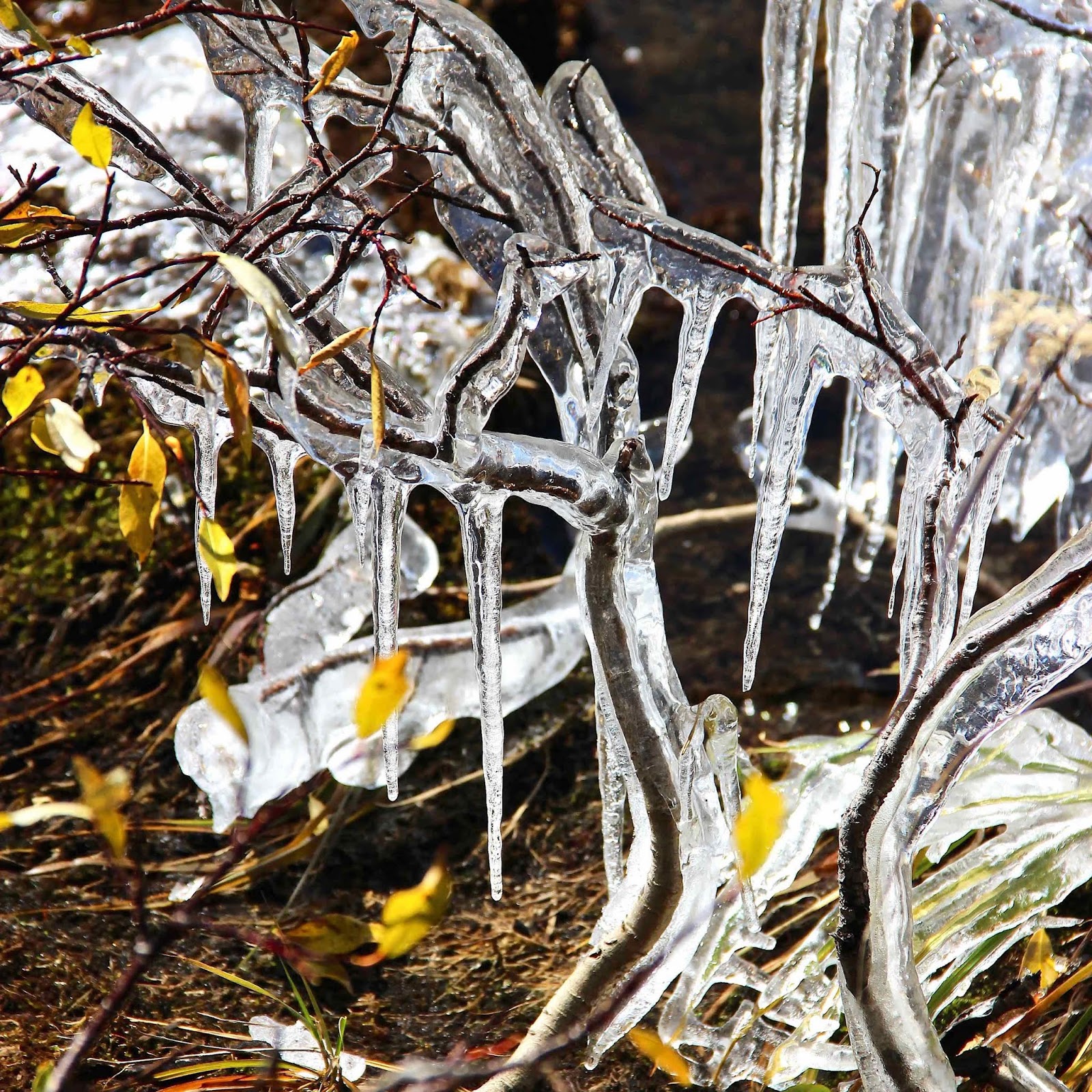
But it wasn't salt. Each of the Shelf Lakes was lined with ice sculptures at the east end—which happened to be the downwind end. Apparently it was cold and windy enough recently for waves breaking against the shore to build up ice on plants and rocks.
We spent about an hour admiring the artwork, and then ate lunch by one of the lakes, sitting next to the downwind side of a giant boulder.
Botany geeks—if you look closely (click on images below), you can see that the graminoids encased in ice are mostly sedges (Carex), not grasses.
The branchlets of low shrubby willows (Salix) were strong enough to support long artistic drips. And with their stems encased in ice, a few willows appeared to be dancing.

As always, Jack Frost disappeared after creating his sculptures, so I was left to speculate as to the process. However, his hypothesized collaborator, Aeolus, was still very much present—whispering, whining, and even howling a bit, as he stirred up eastbound wavelets on the lakes and confirmed my theory, at least in part.
Click on image to see a few tiny white caps in the distance (shallow lake).