Showing posts with label seed dispersal. Show all posts

Wednesday, January 9, 2013

First Expedition of 2013

Close encounters with a pygmy snow wolf ... oh my!!
As soon as project reports were done, I grabbed the camera and headed out.  Contrary to popular belief, Wyoming botanists do not need to hibernate in winter.  Sure enough, this was a fascinating and productive expedition.

The first photo stop was non-botanical.  I’m intrigued by unusual or puzzling views of common objects, interesting arrangements of shape and color, like this:
It’s one of the benches along the river.  In summer, a man sits here and reads while his old dog wanders around in the shallow water completely absorbed, searching for crawdads.

Then I found this set of shadows ...
... and another version, in a different place
They're cast by slats on the footbridge.  It used to be a railroad bridge, now it's part of the Greenbelt Trail.  In summer, a kingfisher sits on the telephone wire just upstream, watching and fishing.
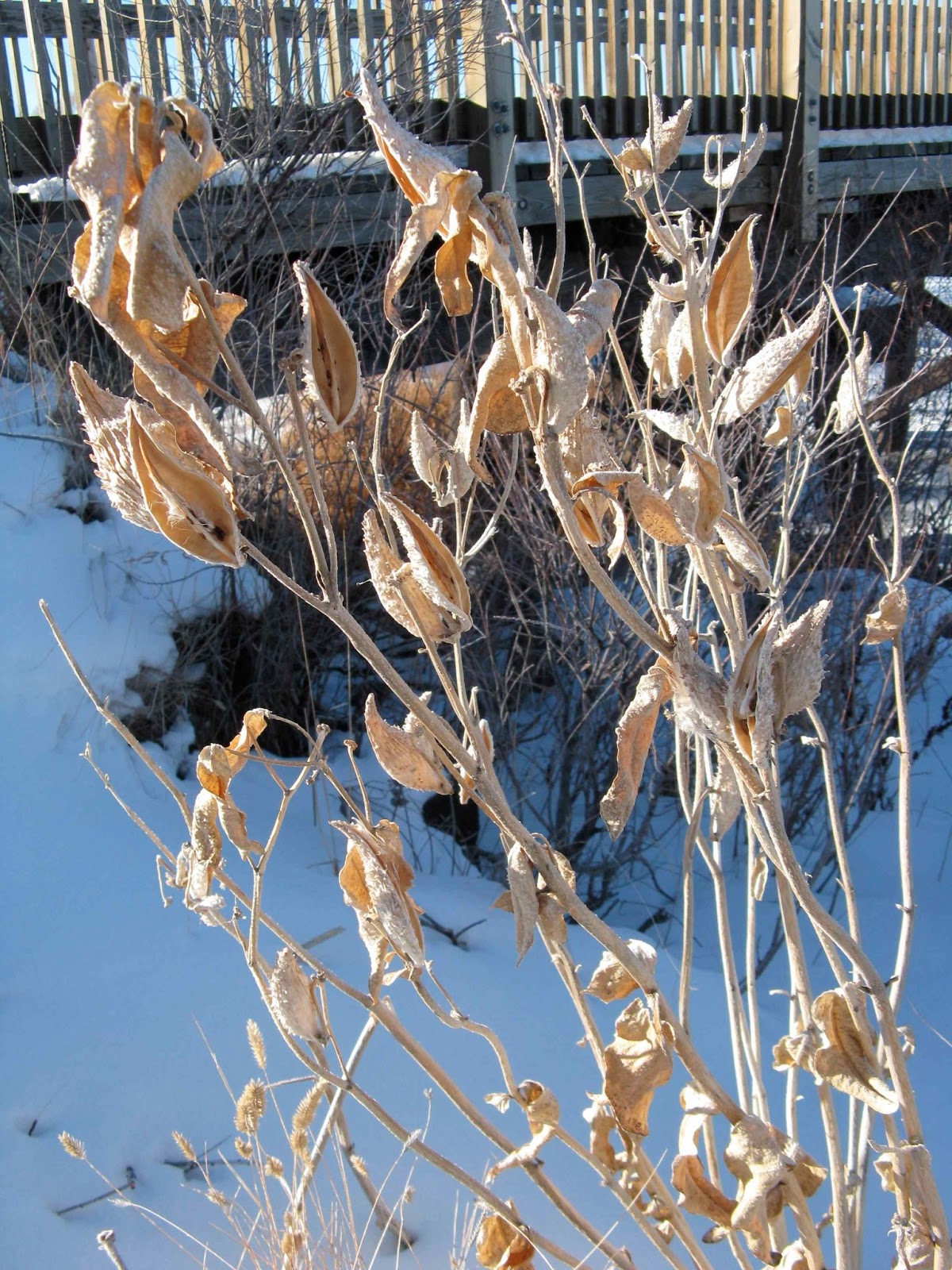
Next to the bridge, I found the showy milkweed was still standing.  Six months ago, it was covered with large clusters of ornate pink flowers.
Showy milkweed (Asclepias speciosa); by vicki watkins.
After pollination and fertilization, the ovules became seeds, and the little ovaries grew into these big pods, four to five inches long.
Our word for the day is anemochory, meaning seed dispersal by wind.  Milkweed seeds are topped with plumes so they can travel far and wide on the Wyoming wind.
When the pods have dried out enough, they dehisce and cast their progeny to fate, leaving an empty shell behind, reminiscent of an empty bed in the room upstairs.

Now over the river and into the cattail marsh ... no muck and easily passable this time of year.  Cattails in winter look a lot like cattails in summer, except that stems and leaves are straw-colored instead of green.
Narrowleaf cattails (Typha angustifolia).
Here’s the tail of the cat, which botanists prefer to call an inflorescence (flower cluster), with many thousands of flowers -- male in the upper cluster, female below.  Obviously cattails don’t go for showy flowers.  Theirs are tiny, with just the bare essentials -- no petals, no sepals, only reproductive structures and some bristles.

Below:  male flowers with long anthers and bristles, and male inflorescence, long after pollen has been released.
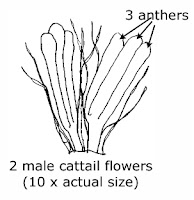


(Illustrations by the author.)
Above:  female inflorescence, and a single flower composed of a stalked ovary and numerous bristles (only a few are shown), ready for anemochory.

Now down to the river’s edge.  Here are more plants, and they just recently sprouted even though it’s -10º F!  How is this possible?  These are specially-adapted ice ferns -- particularly nice ones this morning, with large fronds; some are almost an inch long.
But these white ferns can’t photosynthesize.  In fact, sunshine is their demise and they will die soon.  And of course I’m kidding ... these fernlike stellar dendrites really were created by Jack Frost early this morning while we were all still asleep.

It was at this point, engrossed in snow ferns, that we were approached by the dreaded pygmy snow wolf!  Fortunately, Sparky scared it off ... 

When I returned home, I found these guys smiling.  Why so cheery?
Frost on the back door window is finally starting to melt, and the little bears are happily dancing in the sunshine.

The Laramie River Greenbelt Trail tours the riparian / light industrial ecotone along the Laramie River in southeast Wyoming.

Sunday, February 19, 2012

Leaving Home

Your children are not your children.
They are the sons and daughters of Life's longing for itself ...
You are the bows from which your children as living arrows are sent forth.
Kahlil Gibran, The Prophet

Do you remember leaving home?  I do -- like many teenagers, I could hardly wait and I seized upon Gibran’s words when I read them.  Now years later they still make sense to me, though they seem a bit maudlin.  But the feelings of a parent (which I am not) are very different ... a human parent, that is.  Isn't it interesting that many humans have a hard time letting their children go, while most animals and plants take the opposite approach -- rebuffing, excluding and even hurling their progeny into the unknown.

Plants will go to great lengths to send their propagules packing.  Some seeds simply fall to the ground and never go much further, but many are dispersed far and wide.  Most end up in inhospitable places with their mission unfulfilled, but some will colonize new sites and even expand the range of the species.


Wind and water are common means of scattering seeds, and plants have many adaptations for these vectors.  Among the more familiar are the plumose seed tails of dandelions (above, courtesy The Guardian) and the buoyant outer coat of the coconut (below).


Some plants enlist animals, a strategy called zoochory.  Seed transport internally is called endozoochory; epizoochory refers to transport on the exterior of an animal. Epizoochory is a relatively rare means of seed dispersal, used by less than 5-10% of all plant species, but it can be quite effective, especially if the animal is wide ranging (Sorenson 1986).


To right, Sparky participates in epizoochory (click to view).


Adhesion mechanisms for epizoochory include sticky mucus and, more commonly, structures such as barbs and hooks.  The hooks on the burrs of burdock (Arctium spp., photo to left) were the inspiration for Velcro.  In 1948, Georges de Mestral, a Swiss electrical engineer, was pulling burrs from his dog’s fur after a day of hunting, and became curious as to what gave them their adhesive power.  A look under the microscope revealed a fearsome array of hooks, prompting de Mestral to wonder if something similar could be constructed for use as a reversible fastener.  By 1951 he had a working product, the first patent was granted in 1955, and after additional refinement, Velcro was introduced commercially in the late 1950s.  Though slow to be accepted initially, it eventually became so popular that the registered trademark “Velcro” is now a generic term for hook-and-loop fasteners around the world.  The interesting story of the “zipperless zipper” can be found here.
Velcro up close -- hooks on left, loops on right.
The burrs that Sparky brought home are from our wild licorice, Glycyrrhiza lepidota.  The name of the genus comes from the Greek glykys -- sweet -- and rhiza -- root.  Roots of most species of Glycyrrhiza contain glycyrrhizic acid, the active ingredient of the sweet distinctively-flavored extract used in tobacco products, pharmaceuticals (to mask bitterness), beverages (foaming agent) and of course candy, although many “licorice” candies now contain anise instead.

Commercial licorice products come from the cultivated licorice, Glycyrrhiza glabra, but the root of our wild licorice was once a source of sweetener as well, for Native Americans and early settlers in the western United States.  Today, wild licorice root is used in herbal and homeopathic remedies (here for example).  Glycyrrhizic acid is known to have beneficial medicinal effects, mainly in diseases related to cortisol regulation, and the biochemical pathways and physiological mechanisms have been elucidated.  However it is dangerous in large dosages, causing hypertension and even death.  Dalton (2002) provides a succinct overview of the benefits and dangers of glycyrrhizic acid.


Glycyrrhiza lepidota, wild licorice (click to view).
Wild licorice (also called American licorice) is native to and widespread in North America, growing in many different habitats.  It is a robust perennial herb that can reach four feet in height.  The underground part of the plant is robust as well, consisting of an extensive network of rhizomes and fleshy roots that produce adventitious shoots; thus wild licorice is rarely found as a single above-ground plant, but rather as large colonies.  It is excellent browse for both wildlife and cattle (USDA NRCS), and yet is classified as a weed in many US states, for example Wyoming, North Dakota, Missouri and Nevada, probably due to its ability to persist and expand with disturbance.  The burrs are more clearly a hazard for sheep ranchers, causing dockage if present in wool.
Single wild licorice leaf with
leaflets pinnately arranged.


Wild licorice is a member of the pea family (Fabaceae), and like many peas, its leaves are pinnately compound, i.e. subdivided into leaflets arranged along the axis of the leaf.  Look closely at the photo below and you can see that the leaves are glandular punctate, with tiny round resinous glands.


Close-up of wild licorice leaf; from Matt Lavin’s Flickr site devoted
to the plant diversity of sagebrush steppes.  Click to view glands.


The flowers of the wild licorice are like most pea flowers, with characteristic petals -- a banner, two wings and a keel (photo above from CalPhotos; illustration to right from Montana Plant Life).  And like all members of the pea family, its fruit is a legume.  But what legumes! ... not exactly something you would put in the soup pot.

Legumes (fruit) of wild licorice -- also known as burrs.
By fall, the pretty flowers of the wild licorice are gone and the leaves have withered and died, leaving only standing dead stalks topped with menacing legumes.  The wise walker with a dog avoids wild licorice patches this time of year.  The tiny hooks are very tough, and sometimes burrs can be removed only with scissors.
With time the tissues soften, and by late winter it’s fairly easy to pull licorice burrs from dog fur.  By late spring, when the first new green growth is appearing, the previous year’s fruit are gone -- dispersed to parts unknown, and it is again safe to walk the river trails.

Sources (in addition to links in text above)

Dalton, L.  2002.  What’s that stuff?  Licorice.  Chemical & Engineering News 80: 37.

Sorenson, A.E. (1986) Seed dispersal by adhesion.  Annual Review of Ecology and Systematics. 17: 443-463.

USDA Forest Service Fire Effects Information System -- Glycyrrhiza lepidota.  Accessed February 2012.

USDA PLANTS Database -- Glycyrrhiza lepidota.  Accessed February 2012.

USDA National Resources Conservation Service.   Plant Fact Sheet for Glycyrrhiza lepidota.  Accessed February 2012.  http://plants.usda.gov/factsheet/pdf/fs_glle3.pdf