Showing posts with label Populus tremuloides. Show all posts

Sunday, May 8, 2022

Spring has arrived in the Laramie Mountains :)

I have good news! When I visited the trees I'm following this year—a balsam poplar and a quaking aspen in the Laramie Mountains—I found persistent snow but also many signs of spring. It was so nice to see the area coming alive. Made me feel more alive myself!

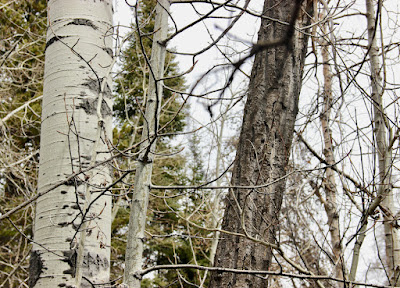
At my height, the two trees showed no signs of change.

Populus tremuloides left, Populus balsamifera right.
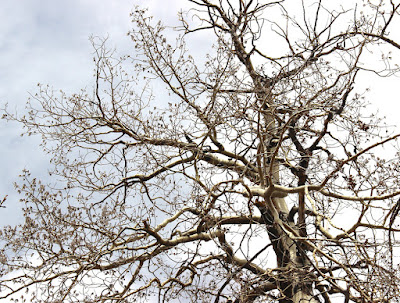
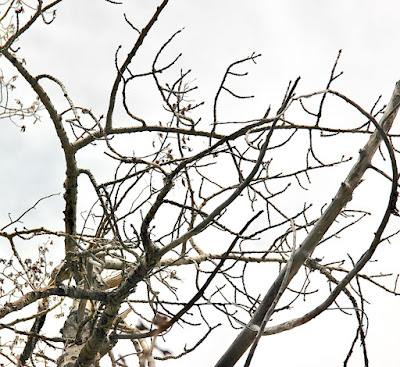
High above, the aspen was in full bloom. The poplar was still dormant, which is normal for that species.
Aspen canopy covered in catkins.
Poplar canopy with just a few dead leaves.
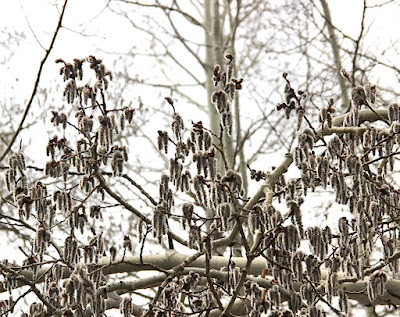
The aspen flowers were much too far away to examine, so I checked other trees nearby. Those with catkins within reach revealed themselves to be male (quaking aspen are dioecious).

Aspen tree in full bloom.
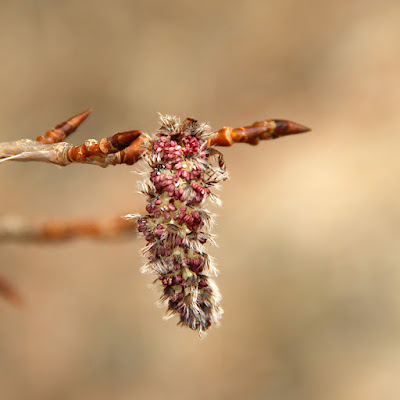
Catkin of male flowers; click to view dark pink anthers.
Aspen grow in clones, which can be huge. Can I assume the trees in this area are a single clone and therefore my tree is male? I don't know. We'll let the mystery be.

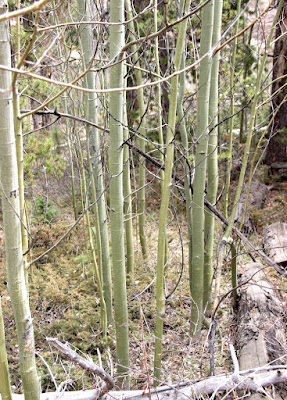
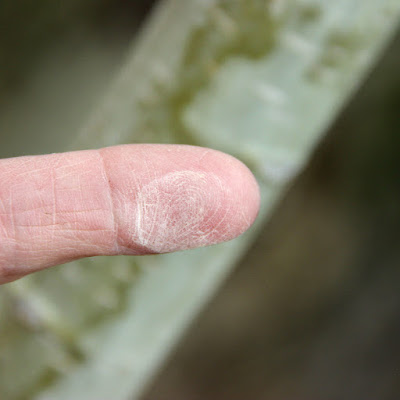
Aspen with green photosynthetic bark were common, but occurred in groups. Some clusters were obviously green, others were nearly white. As I mentioned last month, there's a theory out that aspen bark is thin because dead cells are shed each year, forming a powder on the surface. I tested several trunks, rubbing my finger on the bark, and decided ... well ... maybe.

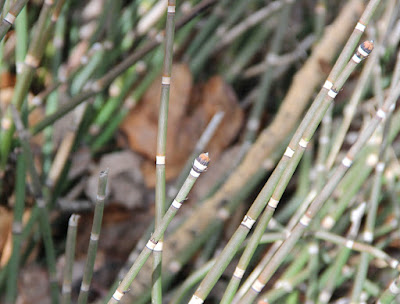
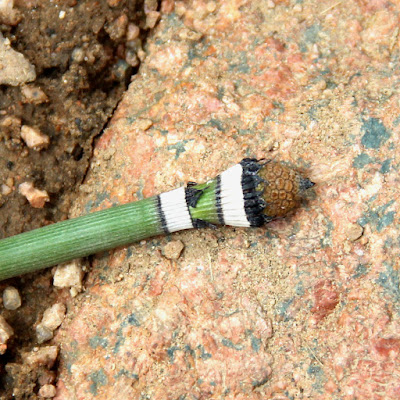
The scouring rushes (Equisetum) along Pole Creek near my trees are much greener now—time to get busy with photosynthesis! Several had young cones.
Click to view equisetum cones mid photo and upper right.
The brown scales of the cone have sporangia on their lower surface, which will mature to release spores.
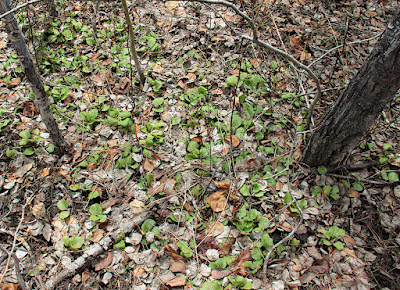
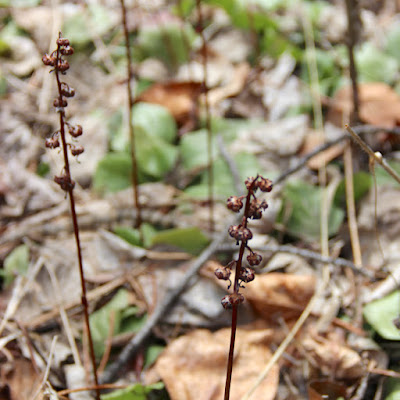
There was another nice surprise close by—a patch of pink wintergreen, Pyrola asarifolia.
Leathery evergreen leaves.
Last year's capsules with persistent curved styles.

For more tree-following news, have a look at this site, kindly hosted by The Squirrelbasket. If you'd like to join us, see the information here (it's really easy :).

Sunday, April 10, 2022

Tree-following: today's topic is BARK

For those in cooler climates who follow deciduous trees, this time year is often spent searching for alternative news. Our trees still show no evidence of change, at least not externally. That was the case when I visited my poplar and aspen last week. So I pondered their bark, which is more interesting than one might first think. The two trees are close relatives, both in the genus Populus. Yet they have very different bark strategies.
Populus balsamifera, balsam poplar (I'm pretty sure).
Populus tremuloides, quaking aspen.
We all know bark is the outermost layer of a mature tree trunk. But how does it form and why? Here's a diagram and explanation for those whose memory of plant anatomy is a bit fuzzy (like mine was).
From Idaho Forest Products, modified.
Bark is composed of dead cells from the cambium—the very thin layer of living cells between a tree's bark and the wood inside. The cambium layer is where the trunk and branches increase in diameter.

Cambium cells divide to produce vascular tissue—xylem and phloem. The xylem and youngest sapwood (sometimes considered equivalent) transport water and nutrients up the tree from the roots. Dead xylem cells accumulate to become wood inside the tree.

In contrast, the phloem transports energy-rich sugars down from photosynthesizing leaves to the rest of the tree. Dead phloem cells accumulate to become bark. These cells are often impregnated with protective substances, like strengthening lignin, waxy suberin, or pest-deterring tannins. The result typically is a thick tough textured covering. See Wikipedia for more about the complicated and variable process of bark formation.

Now back to our visit to the two Populus trees. There was still plenty snow on the shaded trail. Some if it had turned to dicey ice, but all in all it was a fine hike.

Oh dear! Did something happen to my field assistant? Why is she lying down?
No worries! She was just squirming in ecstasy on the hard-packed snow. This endears her to everyone who comes along ... we should all be so happy :)
Enough snow had melted to allow a close look at the two trees. Near the ground they're very similar. But proceeding upwards they diverge radically (aspen on left).

The balsam poplar (right) has thick furrowed bark nearly to its crown. But not the aspen. For most of its height the "bark" is quite thin. Does this put it at a disadvantage? After all, bark contributes to a tree's survival in many ways, e.g., physical protection for the sensitive cambium and vascular tissue, reduction of water loss, and protection from disease and foragers.

But of course there's a reason for the aspen's thin bark! Nature isn't stupid!!

In fact aspen bark is exceptionally helpful, for it's photosynthetic. This is why it often has a greenish tinge. Photosynthetic bark gives trees a head start in spring, generating energy-rich sugars before leaves appear. It even out-performs young spring leaves, for awhile. However, those photosynthesizing cells need plenty of sunshine, so dead cells are shed every year—often detectable as powder that can be rubbed off  (more here). Having just now learned this, I will try it on my next visit!

Very close to my trees I discovered a large patch of scouring rush—also known as horsetail, genus Equisetum. This is a real treasure given my current love affair with ferns and horsetails. So now I will be following them too.

Equisetum flattened by snow. 
A bit of green here and there (click to view)—signs of spring?
And so my tree-following expedition proved productive once again—always something of interest! Check here for news from other followers. The Squirrelbasket, our very kind host, provides information here for those wishing to give it a try.


Monday, January 10, 2022

Tree following 2022: looking for a tree, I find two

Balsam poplar?
Just before Christmas, I set out to find a tree to follow in 2022, specifically a balsam poplar. A few grow along one of my favorite nearby hikes. Since I go there often, it seemed a convenient tree to follow. Also, balsam poplars are not common in our area, so I look forward to getting to know one.

Balsam poplar is boreal, with outliers in North America as far south as Colorado (source).
There ARE balsam poplars here ... somewhere.
December is not the best time for spotting these poplars. They're leafless, and grow among their relatives, quaking aspens, which they resemble. But I found several candidates—mature trees with furrowed bark nearly the length of their trunks. Mature aspen also have furrowed bark, but only at the base.
I think this is a balsam poplar, Populus balsamifera.
Quaking aspen, Populus tremuloides.
Large leaf is likely from a balsam poplar, with smaller aspen leaves.
Then I met up with a very nice pair of trees—a large most-likely balsam poplar right next to a magnificent aspen. These will be my followed trees in 2022.
Tree buddies.
Aspen crown silhouetted against the sky. The light was too dim to catch the poplar.
I took a few more photos, but soon it was dark. While I enjoy cold and snow, winter days are too short for me. At least they're getting longer now!

Holly-leaf or Oregon grape, Berberis repens (NOT a true grape).

Recognize these "twigs"?
Equisetum! (scouring rush). 
Pale yellow vertical lines are aspen trunk reflections on ice.
More ice art.

This is my contribution to the first gathering of tree-followers for 2022, again kindly hosted by The Squirrelbasket. It's a great time to join in the fun—it's easy and stress-free. More information here.

Thursday, April 24, 2014

How aspen use green ... or do they?

Our aspen are starting to flower but are still leafless.  Doesn’t matter, they can photosynthesize anyway.
New Under the Sun is hosting April’s Berry-Go-Round; the theme is plant color:
“You can talk about your favorite colors, unusual colors, pigment biosynthesis, how plants use color, how humans have painted new colors onto our favorite plants, color patterns, temporal color changes etc.”
This time of year, “plant color” makes me think of the bright flashes that start appearing in the drab brown-and-gray landscapes that have been with us all winter -- yellow sagebrush buttercups and purple pasque flowers and fresh green leaves popping from buds.  But even though Spring technically arrived over a month ago, it’s still late winter here.  There are occasional wildflowers -- a few brave individuals blooming -- but most are waiting. Trees are still leafless.  However, if you walk through aspen, a bit of green might catch your eye.
Quaking aspen, Populus tremuloides.  Notice it’s greener on the south side.
Some aspen trees have green bark.  It’s more obvious in younger ones.  In 1957, L.C. Pearson and D.B. Lawrence were living in Minnesota where green-barked aspen are common.  They looked at cross-sections of bark under a microscope and found that the green color was localized in plastids (compartments within cells).  This was intriguing, as others had suggested it was due to a parasitic fungus.  They realized that these were just regular plastids, not some abnormal growth.
A bright green layer visible through the very thin (0.2 mm) outer layer of bark.
They decided to investigate further.  They periodically collected bark and leaves from the north and south sides of aspen trees, extracted the green pigment, and analyzed it.  Absorption spectra for pigment from both bark and leaves matched that of chlorophyll, used by plants to photosynthesize and convert sunshine to food.  They also were able to show that the green pigment in the bark was photosynthetically active.
Absorption spectra of pigments in aspen dissolved in ether.  Data of August 3.  Chlorophyll a measured at 6600 A [peak on right].  From Pearson and Lawrence 1958; PDF available here.
Chlorophyll levels in bark were highest when leaves were just starting to appear, and then dropped off, suggesting green bark is a way to get a head start on the growing season.  Maybe this is why deciduous aspen can thrive where growing seasons are short ... where most other trees are evergreen conifers.
The bark is paler green in shady situations.
Before you go, let’s clarify one thing.  Contrary to what was suggested in the title, aspen don’t “use” green.  In fact most plants don’t -- they throw it away.  Chlorophyll is green because it reflects green light.  It absorbs red and blue for photosynthesis.  Here’s another spectrograph, this one in color so you can better see what colors plants use -- not green.
“Absorbance spectra of free chlorophyll a (blue) and b (red) in a solvent.”  Source

Friday, May 31, 2013

The Girls are in Bloom (too)

Admiring the opposite sex.
Quaking aspen don't get much attention these days.  Most people are gawking at and raving about brightly-colored spring wildflowers, especially the pasque flowers, while the aspen trees remain leafless, just standing there, seemingly doing nothing.
Quaking aspen, Populus tremuloides.
But looks are deceiving of course.  In reality their growing season is already well underway ... just look at the trunks.  Aspen are famous for smooth white bark, but in this stand it’s more of a pale green, especially on younger trees.  The bark contains chlorophyll, for converting sunlight to energy, and these trees are photosynthesizing even without leaves. In fact, the green bark may out-produce the leaves until well into the growing season (Pearson 1958).
Green aspen bark may to be more common where growing seasons are shorter (Pearson 1958). 
Not only are the aspen photosynthesizing, they’re in full bloom!  Few notice because the flowers are so small and drab ... though in the right light, they can be quite lovely.
Backlit male catkins (flower clusters).
Aspen are dioecious, i.e. male and female flowers are found on separate individuals.  Moreover, aspen readily spread by vegetative propagation (root sprouts), so an entire stand may be a single individual and all trees will be the same sex.  Until last week, all stands I had hiked through were male. 

Male aspen flowers are reduced, incomplete and imperfect ... but hardly inadequate!  They should be admired for their elegant efficiency.  They have just what it takes to produce pollen and cast it to the wind.  [reduced = tiny; incomplete = missing parts; imperfect = unisexual]
A male aspen flower is just a disc with stamens; hairy floral bract on right.  From FNA.
Male quaking aspen were featured in a previous post, The Boys are in Bloom. The only reason I didn't include female trees was that I hadn't seen any.  Now finally I have.
Female quaking aspen in full bloom.
The female flowers are showier than the males.  They're green for one thing, and bigger, especially as the ovaries ripen.
Female catkin with green flowers and brown fringed floral bracts;  ca 1 in long.  Photo courtesy dgm.
A female flower consists of a pistil perched on a cup-shaped disc.  The plump ovary is topped by a brown 2-lobed stigma, ready to receive pollen (click on photo above).  Below, pistil in cup-shaped disc on left; capsule on right has split to release seeds; from FNA.
With time, the ripening ovaries swell and the stigmas wither.  At maturity, each ovary becomes a capsule containing seeds topped with fine hairs.  Eventually the capsules will split, and the seeds will take to the wind.  In the photo above, suture lines are visible on some of the young capsules.  Note fringed floral bracts and remains of brown stigmas.

Why has it taken so long to find female trees?  Are they less common?  I can’t say as I haven’t sampled sufficiently (should hike more, work less).  Do females bloom later?  I don’t think so -- I saw both male and female catkins on my hike last week.  The males were drooping, looking tired and spent.  The females were fully elongated, with plump green capsules.  The flowering season was coming to an end.
I kept on through the shady grove.  It was chilly and I was thinking about turning around when suddenly I was surrounded by trees glowing in the sunshine.  They were starting to leaf out.  Young aspen leaves are yellow-green -- not nearly as showy as the brilliant gold and orange ones of fall, but gorgeous enough when backlit!


Literature Cited
Pearson, LC and Lawrence, DB.  1958.  Photosynthesis in aspen bark.  American Journal of Botany 45:383-387.