Showing posts with label Rocky Mt Juniper. Show all posts

Saturday, December 9, 2023

Junipers in December & Views from Above

Trail 1 dusted with snow.
Once again we ventured northeast of Laramie to visit the two three Rocky Mountain Junipers we're following (I added the Fallen One several months ago). It was cold and windy and snowing lightly off and on. But it felt good to get out of the house! And it's time to acclimatize—they say this will continue for awhile.
We made it. "Northern" tree on left. Field assistant on limestone for scale.
Of the two standing trees, the northern one has a good crop of berries on the east (leeward) side. I saw none on the west side. The southern tree has no berries. Perhaps it's male (Rocky Mountain Junipers are usually dioecious, trees are male or female).

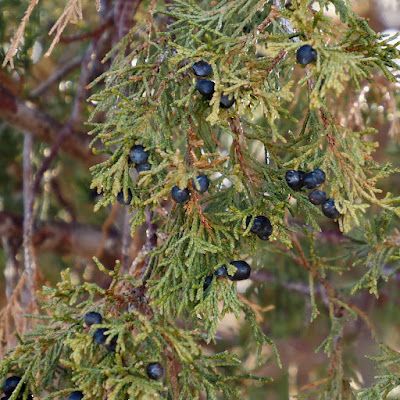
East side of juniper, protected from the wind and laden with berries (dark spots, click image to view).
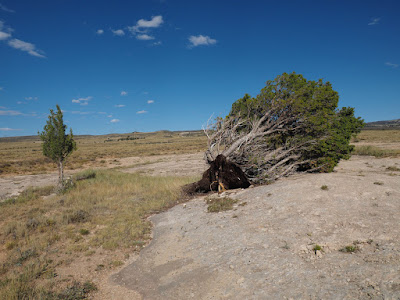
Next I checked the third tree, the Fallen One. It's clearly female, with a very healthy crop of berries.

Fallen one in distance.
Mature juniper berries often have a glaucous bloom, making them frosty blue.

Then we turned to face the wind, and made our way back to town.

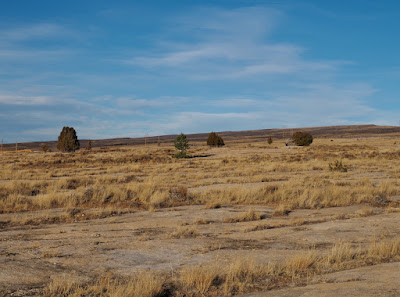
Headed home. What appears to be mountains on the horizon is a cloud bank.

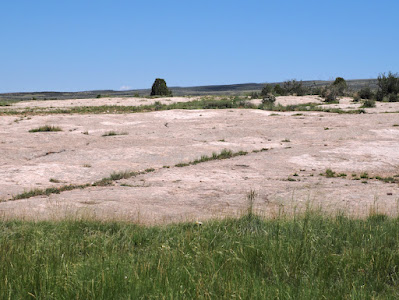
Recently a reader asked where these junipers are in relation to Laramie. So I captured and sent her a photo from Google Earth. And wow, was I surprised! The limestone is much more impressive from the air. It's the gently sloping start of the foothills of the Laramie Mountains to the east.

Arrow marks approximate location of the junipers. Paler areas east of town are exposed slabby limestone.

A better view; black spots are scattered junipers.
This is my contribution to the December gathering of Tree-followers, kindly hosted by The Squirrelbasket. Best wishes to all!

Monday, November 13, 2023

"Trees are poems ... "

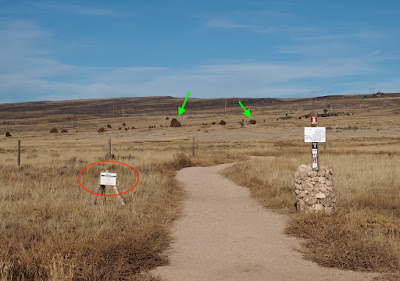
The usual view. Left arrow marks my junipers, right points to the fallen one. Note sign on left.

Late yesterday afternoon we visited the two Rocky Mountain Junipers I'm following this year. It was a perfect time to go—cool, surprisingly calm, with low golden light.

We started on Trail 1 as we always do, in spite of the recently added sign. Leashes are now required on this trail. Neither of us like them so we went without, yet we traversed the next fifty yards safely! ;) Then we left the trail to travel cross country across slabby limestone, making a beeline for the junipers.

The Fallen One.
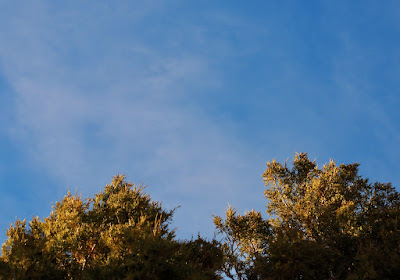
My junipers against the sky.
“Trees are poems that the earth writes upon the sky.” Khalil Gibran

I came upon this by way of Joran Viers, City Forester of Albuquerque, and Michael H., who sent it my way. Gibran likely was thinking of deciduous trees with large intricate canopies rather than the small dense "canopies" of our tough little junipers. Yet poems were worth considering, and I looked through the lens to check.
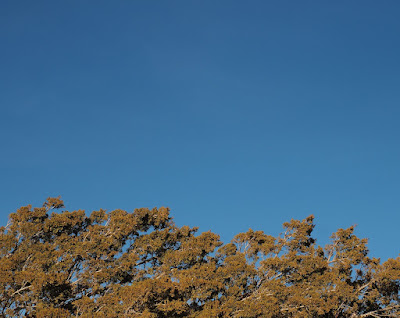
Junipers poem viewed from the west in golden light.
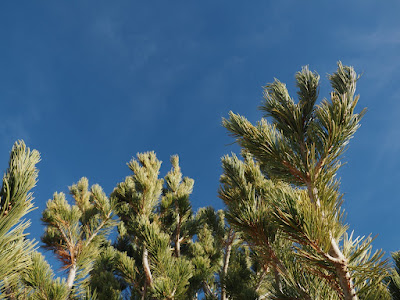
Limber Pine poem with a bit of a breeze.
Lots of juniper berries ... a nice ending to the season.
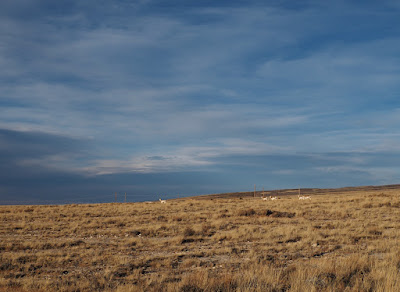
As we continued east cross country, I discovered we weren't alone. We were being carefully watched by a pronghorn buck and his companions.
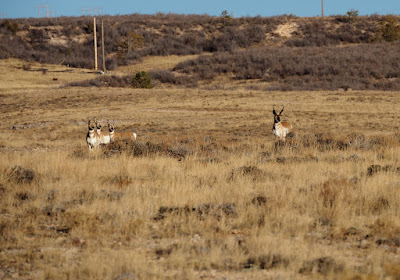
They were much more interested in us than we were in them.
Off to more interesting things (click to view).
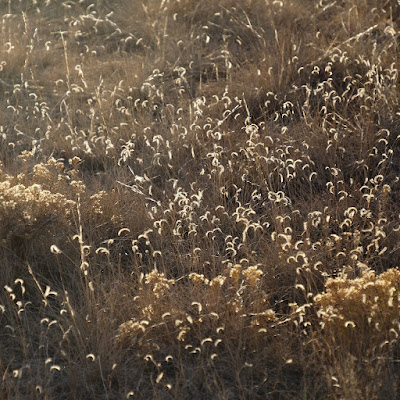
This is typical pronghorn behavior here ... watch for awhile then amble off. My field assistant has no interest in animals this large, being programmed to hunt small burrowing rodents (basenji genes). And I'm more interested in plants. So we too ambled off, heading west back to the car through the prairie. The grasses were beautifully backlit, and it was hard to keep moving.
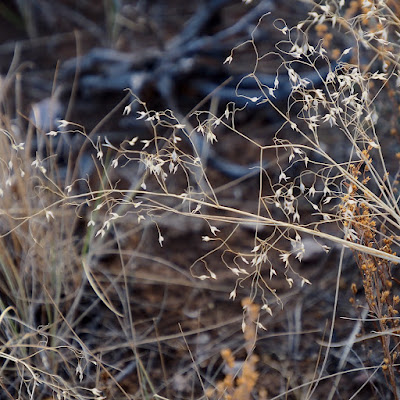
Indian Ricegrass, Achnatherum hymenoides.
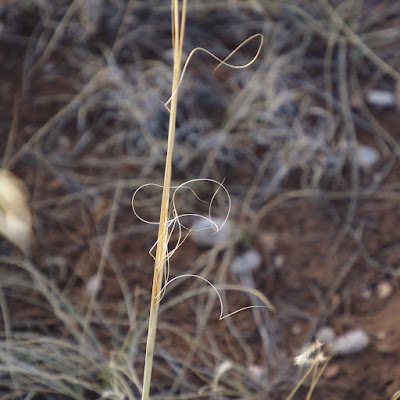
Curled seed tails of Needle-and-Thread, Hesperostipa comata.
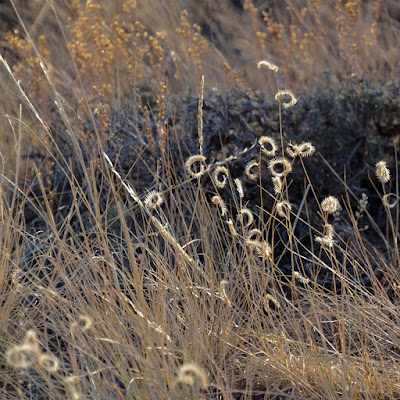
Blue Grama, Bouteloua gracilis (up close below).

This is my contribution to the monthly gathering of Treefollowers, kindly hosted by The Squirrelbasket. Come join us ... it's free, fun, and always interesting.

Wednesday, September 13, 2023

Tree-following: Good News (mostly)

After skipping a month, we headed off to visit the Rocky Mountain Junipers I'm following this year. There were big changes. The grass is mostly straw-colored now, as it would have been several months ago if we hadn't had so much rain. Seed heads were dense, showing how productive the season has been.
Needle-and-Thread, Hesperostipa comata. Needles and threads (seeds and seed tails) are mostly gone now.
Blue grama, Bouteloua gracilis, has my favorite dried inflorescence. It curls so elegantly.

When we reached the junipers, I wasn't expecting much based on July's visit. But I was wrong. On the east (lee) side of the larger tree were plenty of dark blue berries. Wow, how did this happen?! The yellow ones in July looked so sickly. Now I wish I didn't skip August.
Healthy-looking canopy.
Technically these are fleshy cones. Being gymnosperms junipers have neither flowers nor fruit.
Yellow are immature, dark blue are mature.
It was a warm day, good to have a tree and a bit of shade.
But not everything was good. Recently one of the neighbors fell.
When it fell, it revealed a large woody root leading into a crevice in the limestone—the tree's anchor and source of water. I will always be amazed that something this large can grow on such a harsh site and in a semi-arid climate!

This is my contribution to the monthly gathering of Tree-followers, kindly hosted by The Squirrelbasket. More news here.

Thursday, July 13, 2023

Tree-following: Junipers in July

My field assistant stayed home (too warm). But I managed to find both my trees and the shutter release button, thereby verifying my visit.
Several months had passed since I last visited the Rocky Mountain Junipers I'm following this year. What a changed landscape! We had a cool wet spring, and a cool wet summer so far. Many are wondering—have we've ever seen the Laramie Basin so green so late?

I suppose it still looks arid to those elsewhere. But for us, this is LUSH!

Needle-and-Thread, Hesperostipa (Stipacomata.
It was impossible to capture the grass diversity in a photo. For example there are least four species in the one below: Needle-and-Thread, Indian Ricegrass, Blue Grama, and Western Wheatgrass.
Grass enthusiasts can click to enlarge the image and search for species.
I soon left the trail to cross slabby limestone to the junipers I'm following.
Hello little Limber Pine. I'm back.
There was a light breeze at most so for the first time I was able to photograph the foliage and "berries" (technically fleshy cones). Only the darker tree (above) has berries. They are yellow brown, perhaps immature. It is said that they take two years to mature and turn a glaucous blue.
Berries can barely be spotted in the foliage.
But I wonder—will these berries mature? They look a bit sickly to me, maybe from our multi-year drought. We shall see.
This is my contribution to the July gathering of Tree Followers, kindly hosted by The Squirrelbasket. More news here.