Showing posts with label Colorado botany. Show all posts

Friday, May 27, 2022

Pioneering Botanist Frank Tweedy, from Boom to Bust

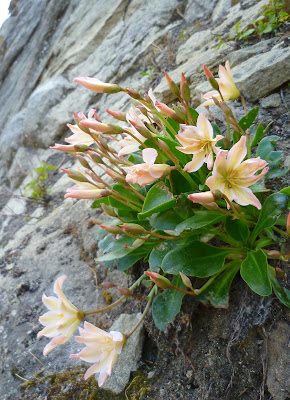
Tweedy's Pussypaws, Lewisiopsis tweedyi, is one of at least 35 species named for topographer and botanist Frank Tweedy. Thayne Tuason photo.
In the summer of 1882, in the Cascade Mountains of Washington Territory, three men left Snoqualmie Pass to climb a high peak nearby. One of them stopped occasionally to examine wildflowers—a passion he came to regret when he realized he had fallen behind. He shouted repeatedly. But the responses were so faint they could have been echos. "I wandered all day and climbed several peaks," he would write many years later (Tweedy 1926).

Frank Tweedy was an assistant topographer with the Northern Transcontinental Survey, which was in the process of establishing a railroad route to the coast. The boss, R.U. Goode, had hoped to set up a survey station on a peak near Snoqualmie Pass, but Tweedy carried the theodolite (for measuring angles). Because of his botanical dawdling, the day ended in failure.

"You jolly well made an ass of yourself!" Tweedy fumed, while waiting for the others to return to camp. But to his surprise, he wasn't fired. Instead Goode calmly explained, "You can't make a success of two things, botany and topography both, at the same time." But Goode was wrong.
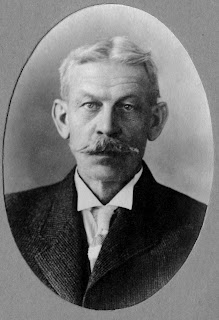
Frank Tweedy, date unknown. Union College archives, used with permission.

New England Beginnings

Frank Tweedy was born in New York City in 1854. After graduating from Union College (Schenectady) with a degree in civil engineering, he spent four field seasons surveying and mapping for the Adirondack Survey. He also collected plants.

Tweedy's botanical training remains a mystery, but his specimens show he was a serious and able botanist (1). He didn't shy away from difficult groups, and apparently found wetland plants especially interesting, collecting bulrushes, pondweeds, bladderworts, and numerous sedges. He published his discoveries—state records and notable range extensions—in the Bulletin of the Torrey Botanical Club.
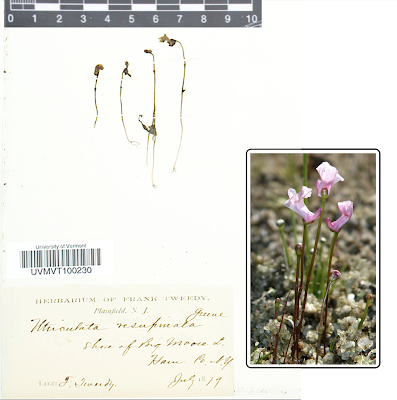
Tweedy specimen (in part) of Northeastern Bladderwort, Utricularia resupinata. "I do not think it uncommon through northern New York," he reported in 1880. US National Herbarium, scale in cm; added color photo by Doug McGrady (CC BY 2.0).

To the American West, Land of Discovery

Tweedy's botanizing underwent a radical change in 1882, when he was hired by the Northern Transcontinental Survey and sent to Washington Territory. No longer need he concern himself with range extensions. This was a botanical frontier, largely unexplored. A sharp-eyed collector might well find "novelties"—species new to science!
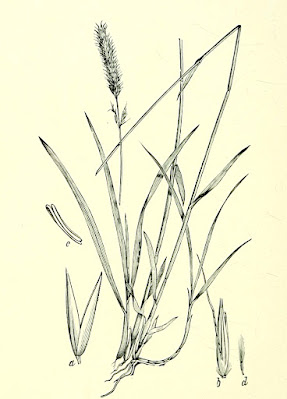
During two seasons of survey with the NTS, Tweedy made at least 112 plant collections, representing 90 species. Among them was a reedgrass grass from the Wenatchee Mountains, which Frank Lamson-Scribner, an expert on grasses, recognized as a new species—Deyeuxia tweedyi (now Calamagrostis tweedyi). This was the first of many novelties named to honor Frank Tweedy.
Tweedy's Reedgrass, from American Grasses by Frank Lamson-Scribner, 1897.
In 1884, Tweedy joined the US Geological Survey in Yellowstone National Park, where he surveyed for four topographic maps, made 605 plant collections, and published the highly-respected Flora of the Yellowstone National Park (1886). Among his collections were several novelties, including Tweedy's Plantain, Plantago tweedyi.
Tweedy's Plantain. Andrey Zharkikh photo.
Tweedy worked for the USGS in the Rocky Mountains for two decades, collecting plants wherever he went. Among his more productive projects were the Livingstone and Dillon topographic maps in southwest Montana, where he nabbed at least ten new species, including Tweedy's Daisy, Snowlover, and Thistle (Erigeron tweedyi, Chionophila tweedyi, and Cirsium tweedyi [now part of C. eatonii]).
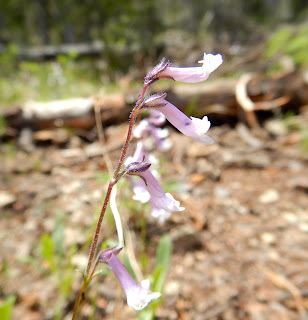
Chionophila tweedyi, Tweedy's Snowlover. Matt Lavin photo.
But it was in Colorado that Tweedy hit the jackpot ... or so it appeared. In the 1890s and early 1900s, while working on the Telluride, Durango, Boulder and Central City topographic maps, he made well over a thousand collections, some twenty of which were determined to be new species! Yet if we check current Colorado plant lists, we find nearly all of those novelties have vanished.

Names Come and Names Go

As budding botanists, we're taught to use scientific names in spite of the off-putting Latin. We're told they are unambiguous, universal, and enduring. But then when we go out into the real world, we learn otherwise. Scientific names do change, and more frequently than some of us would like!

There are many reasons for name changes, but one is especially common—the "law of priority" (Mori 2013). If a given species is described and named by more than one botanist, the first-published name is accepted (others become synonyms). The law of priority was frequently broken in the 19th-century American West, understandably. Floras and relevant literature were inaccessible or non-existent, and communication with other botanists was slow at best.

In the case of Frank Tweedy's discoveries, an additional factor was at play. Like many plant collectors then, he sent specimens of interest to experts at botanical institutions. They decided which were new species, and then described and named them.
Per Axel Rydberg, author of Flora of the Rocky Mountains and adjacent plains (1917).
Tweedy sent many of his specimens to Per Axel Rydberg at the New York Botanical Garden, an expert on Rocky Mountain plants and a notorious splitter. He often recognized new species based on what others considered minor details (Tiehm & Stafleu 1990). Indeed, many of Tweedy's novelties that were named and published by Rydberg did not survive later taxonomic study. Of the twenty supposed new species from Colorado, only one has survived—the North Park or Sagebrush Beardtongue.

In 1901, Tweedy was surveying the Encampment mining district, which was mostly in southern Wyoming. However, "By reason of the faulty determination of the forty first parallel ... the State boundary was located approximately one third of a mile north of its proper position [and] consequently a narrow strip along the southern edge of the district ... is in the State of Colorado" (Spencer 1904). It was in this sliver of Colorado that Tweedy collected an interesting beardtongue. He sent the specimen to Rydberg, who designated it the holotype (basis for description) for a new species, Penstemon cyathophorus.
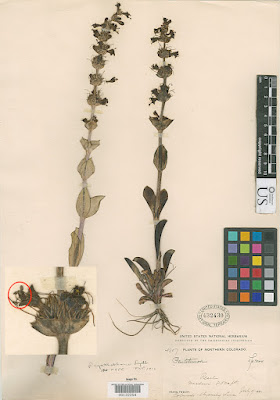
Tweedy's 1901 North Park Beardtongue specimen (US National Herbarium). Click to view 4 exserted stamens circled in the added closeup .
Today's botanists find the North Park Beardtongue difficult to identify with confidence unless it's in full flower. It's quite similar to Harrington's Beardtongue, differing mainly in the number of stamens exserted prominently (not just a little!) beyond the corolla lip—four in Penstemon cyathophorus, two in P. harringtonii. Despite the subtle distinction, this Rydberg species has survived its latest trial—update of the genus Penstemon for the Flora of North America.

End of an Era

Why did Tweedy find only one true novelty in Colorado? The answer probably is timing. Though the Rockies would continue to yield new plant species, the great era of botanical exploration was coming to a close by the early 1900s. No longer could a sharp-eyed plant collector rake in novelties (Williams 2003).

Did Tweedy realize what was happening? Is that why his large-scale botanizing ended after his Colorado projects? We don't know. In any case, after a field season in New Mexico, he worked for the USGS in Washington DC until his retirement in 1926. He lived another decade before passing away in 1937 at age 83 (Lesica & Kruckeberg 2017).

In his day, Frank Tweedy was highly respected as a pioneering botanist in the American West, with at least 35 species named in his honor. So it's surprising how few of today's botanists have heard of him. And until a few years ago, his presence online was negligible. But that has changed. Now there's a Wikipedia article where you can learn more about Tweedy's successful endeavors "in both botany and topography, at the same time." (2)
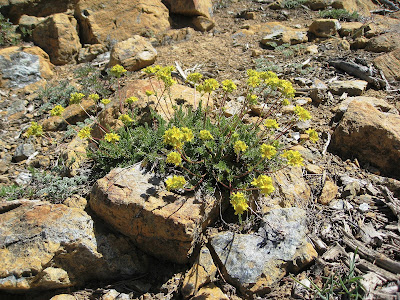
P.A. Rydberg named Ivesia tweedyi for Frank Tweedy, who made the first collection in 1883, in Washington Territory. Photo by brewbooks.

Notes

(1) The SEINet Portal Network is the source of information here about Tweedy specimens, unless noted otherwise. Digitization of herbaria is a work in progress; counts likely will change.

(2) Despite his early reprimand, R.U. Goode likely approved of Tweedy's double successes, for he became a close friend, and served as best man at Tweedy's wedding.

Sources (in addition to links in text)

Lesica, P and Kruckeberg, A. 2017. Frank Tweedy (1854–1937) in Potter, R, and Lesica, P (eds.). Montana's Pioneer Botanists: exploring the mountains and prairies. Montana Native Plant Society.

Spencer, AC. 1904. Copper deposits of the Encampment District, Wyoming. USGS Prof. Paper 25.

Tiehm, A, and Stafleu, FA. 1990. Per Axel Rydberg: a biography, bibliography, and list of his taxa. NY Bot. Gar. Mem. 58 (75 pp).

Tweedy, F. 1926. The Confessions of a Tenderfoot. Unpublished memoir.

Williams, RL. 2003. A Region of Astonishing Beauty—the botanical exploration of the Rocky Mountains. Roberts Rinehart Publishers.

Saturday, July 17, 2021

A "Peculiar" Miner's Candle

Miner's candle; southern Laramie Mountains, Wyoming.
In 1869, botanist Benjamin Hayes Smith of Denver, Colorado Territory, collected a plant with a tall straight inflorescence, the small clusters of white flowers subtended by prominent leafy bracts. Did he think it unusual? We don't know.

Smith gave it and other plants he collected in the Denver area to Thomas Conrad Porter, botanist with the Hayden Expedition of 1869, who did consider it noteworthy. He described and named it as a new species in Hayden's 1871 report.

Like me, Porter was impressed with the inflorescence. "... cymis plurimis in axillis foliorum conglomeratis pedunculatis superne subsessilibus confertisque;" he wrote in the obligatory Latin, before explaining that "the stout virgate spike made up of numerous glomerate cymes, crowded in the axils of the linear cauline leaves, which much exceed them in length" was unusual enough that "I have ventured to give it a name." He chose Eritrichium virgatum, in reference to the inflorescence. (Virgate means long, straight, and slender.)

The inflorescence takes up most of the plant! 

Below each flower cluster is a long leafy bract, or leaf if you prefer.

Over the next half century, taxonomists would revise the section of the borage family containing this species several times, moving it from genus to genus, often noting the distinctive inflorescence. In 1885, the great Asa Gray called it Krynitzkia virgata. "The slender leaves subtending the cymes of the virgate thyrsus are an inch or two long, all but the uppermost several times longer than the flower-clusters."

Two years later, Edward Lee Greene put it in Oreocarya. And finally, in 1927, Edwin Blake Payson of the University of Wyoming moved it to Cryptantha, where it remains today. He wrote: "The strictly erect, rod-like stems with the closely set white flowers are unique. The numerous elongated leaf-like bracts add to the peculiar appearance and serve to separate the species from its relatives." That's another reason I like this plant. Not only is it stunning when in bloom, it's easy to identify! (Cryptntha is a genus notorious for id challenges.)

"elongated leaf-like bracts add to the peculiar appearance" (photo by Patrick Alexander 2011).
Spectacular hairs, common in the Boraginaceae, make a 10x hand lens a good investment! (Patrick Alexander).
Surely such a distinctive plant would have a fitting common name. But no. The sources I checked all call it "miner's candle", which also applies to several close relatives. (If you know of another, please leave a Comment.)

Also peculiar is the distribution of this miner's candle. It's restricted to rocky slopes at lower elevations in the Rocky Mountains of Colorado and southeast Wyoming. In Plant story: miner's candle, Cryptantha virgata, wandering botanist Kathy Keeler finds this odd. "The Rocky Mountains extend 3000 miles (4800 km) from northern British Columbia in Canada to New Mexico in the southern United States, so there would seem to be a lot of similar terrain where miner's candle could grow. But it doesn't."

Cryptantha virgata (Rocky Mountain Herbarium, U WY)

But there's more to distribution than potential habitat. Seeds have to get there, seedlings have to survive. Maybe the distribution of Cryptantha virgata is limited because it hasn't dispersed to all potential habitat ... yet. Maybe it's only recently evolved, and now is slowly spreading.

The Denver area in 1869, by William Henry Elliott of the Hayden Expedition.

Sources (most available online at Biodiversity Heritage Library)

Elliott, Henry W. Sketches made by the artist of the Geological Survey of Colorado & New Mexico. US Geological Survey Open-File Report 03-384. PDF

Gray, A. 1885. Proceedings of the American Academy of Arts and Sciences 20: 279.

Greene, E.L. 1887. Pittonia 1: 58.

Hayden, F.V. 1871. Preliminary Report of the United States Geological Survey of Wyoming and Portions of Contiguous Territories: 479–480 [in Porter's Catalogue of Plants].

Payson, E.B. 1927. A monograph of the section Oreocarya of Cryptantha. Annals of the Missouri Botanical Garden 14: 270.

Williams, R.L. 2003. A Region of Astonishing Beauty: The Botanical Exploration of the Rocky Mountains. Roberts Rinehart

Wednesday, May 8, 2019

Tree-following Stand-in: Singleleaf Ash (or is it?)

Obviously I’m not in Laramie, Wyoming, where it’s currently snowing. Instead, I’m 350 miles to the south and 3000 feet lower—in Fruita, Colorado. Unfortunately I forgot to visit the still-unknown tree that I'm following before I left home, but maybe that's just as well. I'm pretty sure it hasn't changed since last month's report.

Yesterday I considered various candidate stand-ins. Though this is dry country, there are many to choose from—maybe a tree in my friend’s yard or along the Colorado River path or in one of Kenton’s very cool native landscaping projects. But then I remembered the Singleleaf Ash and my mind grew dreamy. That would be my tree.
Fraxinus anomala, McInnis Canyons just south of Fruita, 2012.
“It had the distinctive one-winged fruits of ash trees! But could this be an ash? with only simple leaves instead of the compound ones typical of the genus?? and growing in the desert??? Yes! ... evolution has reduced the compound leaf to a single leaflet, hence the name. The scientific name suggests that the botanist who first described this tree was surprised as well: Fraxinis anomala.”
So wrote a fledgling blogger seven years ago (yikes!). I kept reading …
“Single-leaf ash, Fraxinis anomala, is a tree of the high-deserts of western North America. It grows from westernmost Colorado, where this photo was taken, west to easternmost California and south into northern Arizona and the northwest corner of New Mexico.” (1)
I knew the Singleleaf Ash grows in the dry canyon country just south of Fruita. But how easy would it be to find one? It's hardly common, requiring more water than most desert plants.
“… [some] ‘desert’ trees avoid arid conditions by growing where more water is available. Desert washes look dry much of the year, but often there is water fairly close to the surface, within root-reach. Tree cover often is greater in washes.”
When I hiked the Pollock Bench Trail in the McInnis Canyons National Conservation Area, I scanned each wash along the way. Soon I spotted my tree, plus a great perk for my field assistant.
While she frolicked in the muddy water, I again pondered the unusual leaves. In the absence of other evidence, it's really hard to believe this tree is an ash!
As I wrote seven years ago, most species of ash have compound leaves, meaning with multiple leaflets. The Green Ash leaf below, with seven leaflets, is typical.
Fraxinus pennsylvanica, courtesy TreeLib.
Fraxinus anomala is indeed an oddball among the ashes. Its undivided leaves are guaranteed to confuse a botanist unfamiliar with this tree. In my googling, I came across an essay by Craig Holdrege, a kindred spirit, who noted:
“To my amazement, I recognized the fruits as ones I knew as belonging to ash trees (the genus Fraxinus, Figure 2). Later I saw specimens with flowers that were also characteristically those of an ash. But ash trees always have divided leaves—so I thought—and the leaves of these shrubs clearly had simple round blades and long leaf stalks.”
Craig didn’t mention the problematic common name, which apparently didn’t bother me either seven years ago. But now I can’t ignore it. Why is this tree called Singleleaf Ash? After all, it has far more than a single leaf.

Maybe the answer seems obvious … it’s because most ash species have leaves with multiple leaflets, whereas Fraxinus anomala leaves have only one (2). But if you think about it, the common name doesn’t truly describe the situation. Though the leaves of Fraxinus anomala are sometimes described as simple (not compound), more likely they’re actually evolutionarily-reduced compound leaves, now with just one leaflet. Consider the California or Two-petal Ash (Fraxinus dipetala) below, thought to be a close relative of F. anomala (3). It’s easy to imagine a simple evolutionary step from multiple leaflets to just one.
Fraxinus dipetala; poto by Keir Morse (CC BY-NC-SA 3.0).

Therefore … [FANFARE!!!!] … Fraxinus anomala should be called the Singleleaflet Ash! Not impressed? Nor am I. This is just my mind entertaining itself. Let’s move on to something more interesting—the trees.

Three trees grew next to a shallow wash with low sandstone steps (above)—two on the left and one on the right. Does the second tree from the left look different? a bit more yellow? Yes … because it was covered in young samaras (seed pods).
 
I noticed that both the single leaflets and the samaras are shorter and broader than is typical for ash species (compare photos below). Is the same developmental thing going on? It’s fun to speculate, but for an answer, we’ll have to wait for the evo-devo folks to take an interest in ash trees.
Leaflets and samaras of the Green Ash (source).
Singleleaf Ash samaras from my 2012 visit to McInnis Canyons (different tree).

Notes

(1) I’ve since learned that the range of Fraxinus anomala extends into Mexico. It also has been reported for Wyoming, my home territory, but I could find no documentation online … something to investigate when I get back.

(2) Some individuals of Fraxinus anomala produce three or even five leaflets, but these are uncommon.

(3) Wallander, E. 2008. Systematics of Fraxinus (Oleaceae) and evolution of dioecy. Plant Systematics and Evolution 273:25-49.

For this month's tree-following news, and information about joining us, see May's gathering, kindly hosted by The Squirrelbastket.

Friday, December 2, 2016

A Pioneering Geologist on Uinta Plants

Linosyris?

Required reading for my recent trip to the Uinta Mountains included several reports from early exploratory expeditions. The Uintas are rich in this kind of literature—the great pioneering geologists Ferdinand Vandeveer Hayden, Frank Emmons (working for Clarence King), and John Wesley Powell all passed through in the decade after the American Civil War. Their writing is scientific and filled with detail. But it's not boring, infused as it is with the excitement of discovery. Passing through the same landscapes, camping by the same rivers, pondering the same outcrops, I feel some of that excitement myself.

Though these men were geologists, they didn’t ignore plants. Usually they had a botanist along, or at least someone capable of collecting and preparing specimens. Those specimens that survived the rigors of travel were sent to experts, who studied and identified them, perhaps describing much-coveted “novelties”—species new to science. A plant list was included in the final report. The leaders themselves recognized the more common plants, and they often described the vegetation of the areas they passed through, in addition to geology, wildlife, natural resources, and any people they encountered.

In September of 1870, Ferdinand Vandeveer Hayden led his US Geological and Geographical Survey of the Territories into Brown’s Hole—the broad valley of the Green River in the eastern Uinta Mountains (now Browns Park):
“There is but little timber along the immediate valley of Green River—only a few bitter cottonwoods and willows; but on the hills there is a thick growth of the low piñon and cedars. … in the valley, there is a universal growth of the sage, (Artemisia tridentata,) greasewood, (Sarcobatus vermicularis, ) and Linosyris.”
When I visited Browns Park 146 years later, also in September, I found the vegetation much the same. There were occasional stands of bitter cottonwoods (today’s narrowleaf and lanceleaf) along the Green River, and pinyons and “cedars” (junipers) covered the hills. In the valley bottom, sagebrush and greasewood were extremely common. But Linosyris? I had never heard of this “universal growth” plant. Yet there was nothing common I didn’t recognize. Did geologist Hayden really know what he was talking about? Was Linosyris a misidentification?

A google search revealed that Linosyris grows in Asia, Europe and Great Britain. There are no species native to North America. But when I looked at images, I realized Hayden probably was correct … probably he was just another victim of nomenclatural change.

According to Google, the three plants below are called "linosyris." What very common plant of the basins of the American West do you think Hayden saw? [1. Type specimen of Linosyris (Aster) grimmii from Turkestan, Muséum National d'Histoire Naturelle; 2. Galleta linosyris (“goldilocks”); 3. Linosyris villosa, Russia, maybe today's Aster oleifolius.]


As botany students, we’re repeatedly assured that scientific (Latin) names avoid the horrendous ambiguity of common names. But then when we go out into the real world, we quickly learn that these names change too, as taxonomists study and reclassify plants. To make things worse, experts don’t always agree. Old literature is especially challenging.

But Hayden’s Linosyris puzzle was easy to solve. In the “Catalogue of Plants” at the end of the report was Linosyris graveolens, under Compositae (Aster family). graveolens and compositae were the final clues. This is our rubber rabbitbrush, Ericameria nauseosa var. graveolens, which used to be a member of the genus Linosyris.

Rabbitbrush is extremely common in Browns Park. It definitely qualifies as “universal growth”—especially in September when it’s covered in flowers.
Bright golden floral displays can’t be missed.
Rubber rabbitbrush in morning sun.
Stems have a felt-like covering of dense white hairs.
As you may have guessed, rabbits like rabbitbrush. In fact, many wildlife species benefit from its abundance. Birds and small mammals use it for cover. Deer, antelope, elk, small mammals and birds feed on the leaves, flowers and seeds. Rabbitbrush is visited by a wide range of native insects, especially in late summer and fall. It’s said to support more native bee pollinators than any other cold desert shrub in the Intermountain West (Waring 2011).

Typical of the Aster family, what look like rabbitbrush flowers aren’t flowers. They’re small heads of tiny flowers, each with reproductive parts—stamens and pistils. [The Aster family was originally called Compositae because what look like flowers are actually composites. Not that long ago, it was changed to Asteraceae to be consistent with naming rules.]
The pungent flowers explain the scientific name, Ericameria nauseosa. But they're not that bad. I would say resinous rather than nauseating.
Flowers are tubular, less than a half inch long. Stamens and pistils emerge from the tubes. Source.

I took many photos of rabbitbrush in Browns Park … unintentionally. It was that common.
With dark dikes intruded into the ancient Red Creek Quartzite (more here).
With more rocks from the core of the long-gone Red Creek mountain range.
On a CO2 pipeline project (more here).
Approaching the Gates of Lodore on the Green River.
Rabbitbrush lined most of the roads in Browns Park, which isn't surprising since it thrives on disturbed sites. It often dominates initially, but in the absence of continued disturbance, becomes just a minor part of the native vegetation.
Above and below: rubber rabbitbrush along the Irish Canyon road, which cuts through the north flank of the Uinta Mountains near the east end of Browns Park.
Rabbitbrush is taking over the dugout where James Jarvie lived in 1880, his first year in Brown’s Hole.

In between Linosyris graveolens and Ericameria nauseosa, rubber rabbitbrush was called Chrysothamnus nauseosa. This is my choice of names because Chrysothamnus means “golden shrub”—which they certainly are! Rabbitbrushes are super difficult to classify, and experts surely will continue to rename them. Maybe someday some taxonomist will move rubber rabbitbrush back into Chrysothamnus, proving me prescient ;-)

Rubber rabbitbrush is the most complex of the rabbitbrushes, with 24 subspecies and varieties, many of which overlap or hybridize. Within these, there are multiple ecotypes, for example adapted to different soils. And within ecotypes there’s a “great deal of variability in morphological characteristics and chemical composition” (Scheinost and Ogle 2010). No wonder rubber rabbitbrush is so successful—so widespread and common. And no wonder rabbitbrush taxonomists struggle to classify them. In this case, maybe it’s best to use common names after all.
Rubber rabbitbrush and rainbow on my last day in Browns Park.


Sources

Anderson, L. 1995. The Chrysothamnus-Ericameria connection (Asteraceae). The Great Basin Naturalist, 55:84-88. Retrieved from http://www.jstor.org/stable/41712868

Porter, TC. 1871. Catalog of plants. in Hayden, FV. Preliminary report of the United State Geological Survey of Wyoming, and portions of contiguous territories. Washington: Government Printing Office. [Thomas C. Porter was professor of botany, geology and zoology at Lafayette College in Easton, Pennsylvania.]

Scheinost, PL, Scianna, J, and Ogle, DG. 2010. Plant guide for rubber rabbitbrush (Ericameria nauseosa). USDA-Natural Resources Conservation Service, Pullman Plant Materials Center, Pullman, WA. https://www.nrcs.usda.gov/Internet/FSE_DOCUMENTS/nrcs144p2_042451.pdf. Accessed 2016, November 29.

Tirmenstein, D. 1999. Ericameria nauseosa. In: Fire Effects Information System [Online]. USDA Forest Service, Rocky Mountain Research Station, Fire Sciences Laboratory. Nomenclature updated 2014. http://www.fs.fed.us/database/feis/. Accessed 2016, November 29.

Waring, GL. 2011. A natural history of the Intermountain West; its ecological and evolutionary story. University of Utah Press.


Friday, July 3, 2015

Selenium & the Prince’s Plume – an unfinished tale

Did an errant prince from days of yore in search of El Dorado1 drop his helmet?

I thought this might be the case ... I was in the right part of the country.  But then I walked closer and saw that the glowing yellow mass was an herbaceous plant.  It was over a meter tall, with a dozen stalks, and was covered in hundreds of yellow buds and flowers.  A multitude of insects crawled, flitted and otherwise wandered through the yellow paradise – a scene full of life.
The many critters were so active that it was hard to capture them in photos.
Was this a healthy garden, a lush mountain meadow, a well-watered stream bank?
Not at all.  It was a high desert in western Colorado.
And as it turned out, the yellow-flowered plant was indeed a prince’s plume! – Stanleya pinnata.  It grows on arid sites in the western USA.
This prince's plume has trapped a tumbleweed.
Prince’s plume is a member of the mustard family (Brassicaceae), and like most mustards it has flowers with four sepals, four petals, six stamens and a single pistil – all yellow in this case.  There also are four nectar glands per flower – probably why there were so many insects about.
The long exserted stamens are dramatic!
After fertilization, the ovaries elongate to become narrow spreading siliques containing small seeds about 2 mm across.
In the mustard family long narrow capsules are called siliques.
Stems and leaves of prince’s plume are a distinctive waxy bluish-green.  In subspecies pinnata, the basal leaves are deeply lobed (upper ones are entire).
A pinnately lobed basal leaf.
I was impressed to find this tall fecund herbaceous perennial in such an arid environment – the annual precipitation at nearby Gateway averages 11.3 inches or 28.7 cm (source).  And aridity is only one of the challenges.  Prince’s plume is a reliable indicator that there's selenium in the soil.

Selenium in trace amounts is beneficial to plants, and dietary selenium is required by animals, but there’s a fine line between benefit and toxicity.  Plants containing selenium are toxic to most animals, and too much selenium reduces seed production in many plants.  Yet it doesn't bother the prince's plume. 
Stanleya pinnata (S. tomentosa at the time) from a study of seleniferous soils and toxic vegetation in Wyoming (Beath et al. 1946).
Prince’s plume doesn’t just tolerate selenium, it accumulates it – mainly in pollen, ovules, and leaf margins.  In fact, it’s a hyperaccumulator, containing 10 to 100 times as much selenium as other plants at the same site.  These levels are detrimental to most plants, but in prince's plume there appears to be no impact on pollinator visitation nor on reproductive output, perhaps due to the chemical form in which the element is stored (El Mehdawi & Pilon-Smits 2011).

Furthermore, prince's plume benefits from accumulating toxic amounts of selenium – it discourages both chomping herbivores and sucking pathogens.  For example prairie dogs eat prince's plume if selenium levels are low, but avoid plants with high concentrations (Freeman et al. 2009).  Presence of selenium has been shown to deter phloem-feeding aphids also (El Mehdawi & Pilon-Smit 2011).
Prince’s plume in Utah.  Courtesy USDI Bureau of Land Management.

This would seem a perfect plants-and-rocks story – a geobotanical tale of selenium and the prince’s plume.  Unfortunately we haven’t figured out the geological part.  Prince’s plume grows in western North America on seleniferous soils derived from fine-grained sedimentary rocks – shales, mudstones and siltstones (source).  Some geologists attribute this selenium to Mesozoic volcanic activity, but others disagree (reviewed in Rosenfeld and Beath 2013, pp 9-12).  Once again, more work needs to be done … the search continues.

Footnote:
1  The North American El Dorado was one of the mythological Seven Cities of Gold which lay somewhere north of Mexico (16th century).  UPDATE:  See Richard's Comment below for more information about this El Dorado and its location (about 250 miles south of where I found the prince's plume).


Sources (in addition to links in post)

Beath, OA.  1946.  Some rocks and soils of high selenium content.  Wyoming Geological Survey Bulletin No. 36.

Brown, TA and Shrift, A.  1982.  Selenium: toxicity and tolerance in higher plants.  Biological Reviews 7:59-84.

El Mehdawi, AF and Pilon-Smits, EAH.  2011.  Ecological aspects of plant selenium hyperaccumulation.  Plant Biology 14:1-10.

Freeman, JL et al.  2009.  Selenium protects the hyperaccumulator Stanleya pinnata against black-tailed prairie dog herbivory in native seleniferous habitats.  Am J Bot 96:1075-1085.

Rosenfeld, I and Beath, OA.  2013.  Selenium: geobotany, biochemistry, toxicity, and nutrition.  Academic Press.