Showing posts with label ethnobotany. Show all posts

Wednesday, January 7, 2015

Am I following a cottonwood of the bitter kind?

The Laramie River is lined with the wrong kind of cottonwood, including mine (left).
... we arrived on the 10th March at a small branch of the North fork of the Platte, where we found an abundance of wood.  This stream is about one hundred feet wide, meandering north-eastwardly through a beautiful and fertile valley ...  It’s margin is partially wooded with large cottonwood of the bitter kind.  The sweet cottonwood ... is nowhere to be found    William Henry Ashley, 1825 (Dale 1918)
Cottonwoods were an important winter fuel in the American West in the 1800s, not just for heat but also to fuel the main mode of transport – the horse.  When grass was poor or covered in snow, the inhabitants – Indians, explorers, trappers and early settlers – collected young branches and inner bark to feed their horses.
Young cottonwood branches and upper branches of older trees were provided as forage for their [Teton Dakota] horses and were said to be as “good for them as oats.”  White trappers and travelers have recorded their observations as to the value of the cottonwood as forage.  (Gilmore 1919)
When the round leaf or sweet-bark cottonwood can be had abundantly, horses may be wintered with but little inconvenience.  They are very fond of this bark, and, judging by the effect produced from feeding it to my horses last winter, I suppose it almost, if not quite, as nutricious as timothy hay.   William Henry Ashley, 1825 (Dale 1918)
Horses survived and even thrived on sweet cottonwood at lower elevations, but they wouldn’t eat the bitter cottonwood of higher valleys and mountains.  In winter a horse would starve in these places.
No sweet cottonwoods anywhere.
Fur trader William Ashley and a small band of trappers camped for several days in the Laramie Valley in March of 1825, while exploring a “central route” to the Pacific.  They had been in the region long enough to know the cottonwoods.  They recognized those along the river as “of the bitter kind” while "The sweet cottonwood, such as affords food for horses, is nowhere to be found" (Dale 1918).

Not all trappers were as savvy.  In the fall of 1831, a party led by Captain AK Stephens chose the Laramie Valley for their winter camp.  Game was abundant, and the river was lined with cottonwoods.  But they didn’t notice that these were the wrong kind until the snows came; then it was too late to move.  They survived, as there was plenty of game and firewood, but their horses didn’t.
My cottonwood tree shortly after new-years day, 2015.
On new-years day, notwithstanding our horses were nearly all dead, as being fully satisfied that the few that were yet living must die soon, we concluded to have a feast in our best style; for which purpose we made preparation by sending out four of our best hunters, to get a choice piece of meat for the occasion. These men killed ten Buffaloe, from which they selected one of the fattest humps they could find and brought in, and after roasting it handsomely before the fire, we all seated ourselves upon the ground, encircling, what we there called a splendid repast to dine upon. Feasting sumptuously, cracking a few jokes, taking a few rounds with our rifles, and wishing heartily for some liquor, having none at that place we spent the day.  Zenas Leonard, 1832 (Leonard 1904)
WY Game & Fish also mistakenly assumed that cottonwoods along the Laramie River were of the sweet kind.
Today we call the sweet cottonwood “Plains cottonwood” or Populus deltoides ssp. monilifera.  The bitter one is the narrowleaf cottonwood, P. angustifolia.  Historians have assumed that early travelers such as Ashley found narrowleafs along the Laramie River (e.g. Dale 1918).  However the cottonwoods I’ve found there appear to be the lanceleaf cottonwood, Populus x acuminata, a widespread natural hybrid between the Plains and narrowleaf cottonwoods.

Below are leaves from the three cottonwoods.  From top to bottom: sweet Plains cottonwood (source), bitter narrowleaf cottonwood (source), and a cottonwood from the Laramie River – probably the hybrid lanceleaf, with broader blades and longer petioles.
When a bitter narrowleaf cottonwood crosses with a sweet Plains cottonwood, what's the result ... bitter or sweet?
Maybe I'll recruit friends to taste the inner bark of the three cottonwoods.  We could do blindfold taste tests ... how scientific!  But will I find any such intrepid companions?
Was it lanceleaf cottonwoods that the trappers camped in, finding them as bitter and unpalatable as the narrowleaf “parent”?  Or did they camp among narrowleafs – the true bitter cottonwoods?  To answer this, we need to know where specifically narrowleaf and lanceleaf (hybrid) cottonwoods grow in the Laramie Valley and vicinity.

I thought this would be easy to figure out.  In Laramie we’re lucky to have the Rocky Mountain Herbarium, at the University of Wyoming.  It's the largest herbarium between St. Louis and those on the West Coast, and the largest anywhere for Rocky Mountain plants.  The local area is generally well-represented, yet when I looked for lanceleaf cottonwood specimens from the Laramie Valley, I found only four ... and none from the river.  Most were collected on the university campus.  There was one specimen of narrowleaf cottonwood from the river, upstream in the mountains to the west.

This summer when mature leaves are available, I’ll collect a specimen from my cottonwood and add it to the Rocky Mountain Herbarium, thereby immortalizing the tree!  Hopefully I can decide what this cottonwood would best be called.  Is it sufficiently different from the narrowleaf to be called a lanceleaf?  With back-crossing, every variation is possible.  If time permits, I’ll visit other places along the river to see which cottonwoods grow where.  There's so much to learn ...
The distant cottonwood (center) is the tree I’m following.


Was my tree alive when Ashley traveled along the Laramie River in 1825?  Did Stephens and his trappers spend the winter near it in 1832?  If so, it would have been a young sapling or sucker shoots.  Cottonwoods grow fast and generally die young, only occasionally reaching 100 years of age or more (Weir 2014).


I’m grateful to Steve Sutter, Cultural Records Specialist with the Wyoming State Historic Preservation Office, for introducing me to the role of cottonwoods in early exploration of the American West.  A simple question – "what kind of cottonwood grows along the river?" – and the discussions that followed made this post possible.

Sources

Cain, K.  2007.  The cottonwood tree; an American champion.  Boulder, CO:  Johnson Books.

Dale, HC, ed.  1918.  The Ashley-Smith explorations and the discovery of a central route to the Pacific 1822-1829.  Cleveland: Arthur H. Clark Co.  Available at Google books.

Gilmore, MR.  1919.  Use of plants by the Indians of the Missouri River region.  Bureau of American Ethnology.

Leonard, Z (Wagner, WF, ed).  1904.  Leonard's narrative, adventure of Zenas Leonard, fur trader and trapper, 1831-1836.  Cleveland: The Burrows Brothers Company.  Available at Google books.

Thybony, S.  1981.  The enthnohistory and prehistory of the Medicine Bow National Forest in Eckles, J ed.  Cultural resource overview; Medicine Bow National Forest including the Thunder Basin National Grassland.

Weir, SK.  2014.  Plains cottonwood (PDF).  Accessed January 5, 2015.
Join the fun ... follow a tree!  Kindly hosted by Lucy Corrander.

Sunday, November 9, 2014

Cottonwood Houses, Cottonwood Stars


Many years ago, in the heat of summer, little girls sat in the shade of cottonwood trees and made tipis from the leaves.
These they made in numbers and placed them in circles like the camp circle of their tribe.
“A circle of cottonwood-leaf toy tipis made by Indian children of Plains tribes” (Gilmore 1919).
I myself have spent a lot of time among cottonwoods as I’m following one this year – a lanceleaf cottonwood.  I’ve been keeping an eye out for stories.  I've found plenty, but none obviously about the lanceleaf.  It's definitely not the cottonwood of the toy tipi story.  The leaves are too narrow, and their bases are tapered.
Lanceleaf cottonwood, Populus x acuminata.
Most cottonwood stories probably refer to the Plains cottonwood, Populus deltoides ssp. monilifera.  It’s common in much of the American West, and was important to indigenous people, early travelers, and settlers – for shade, fuel and building materials.
A Plains cottonwood.  I ate lunch in its shade every day during a grassland project.
It was the Plains cottonwood – Wága chan of the Dakota – that supplied leaves for toy tipis.  In early October, I collected leaves from the Plains cottonwood in my yard, and spines from the matrimony vine (Lycium barbarum) to make my own, following the story carefully.
Building materials.
They split a leaf a short distance down from the tip along the midrib; at equal distances from the tip they tore across from the margin slightly; then, bending back the margin above the rents for the smoke flaps, and drawing together the leaf-margins below the rents and fastening them with a splinter or a thorn, they had a toy tipi.
Smoke flaps regulate draft and ventilate the tipi, especially smoke from the fire.
These [I] made in numbers and placed them in circles like the camp circle of [a] tribe.
The toy tipi story comes from ethnobotanist Melvin Gilmore (1919).  In the early 1900s he visited elderly Indians of the Great Plains who had gathered native plants and still knew the old names and uses.  He hoped to document this knowledge "while it may still be obtained, before the death of all the old people who alone possess it.”  They were happy to share the knowledge “in order that, as they said, future generations of their own people as well as the white people may know and understand their manner of life."

--- ✿ ✿ ✿ ✿ ✿ ✿ ✿ ---

Lanceleaf cottonwoods may not be good for leaf tipis, but like all cottonwoods, they do have stars inside.  The story of the cottonwood star comes from rural Nebraska, by way of Kathleen Cain (2007).  Her father once asked her “Have you ever seen the cottonwood star?”  She hadn’t.
He turned the twig so I could gaze directly into its center.  Running crosswise through the middle of the small piece of wood, the cut revealed a reddish-brown and nearly perfect five-pointed star.
You have to find one with a sturdy knuckle ... You have to cut cleanly ... No hacking.  Not jagged.  One cut is best.
A Pex tube cutter worked well.
A sturdy knuckle.
I selected a twig with a sturdy knuckle – the joint between two years’ growth – and cut through it easily and cleanly.  I saw a tiny reddish-brown spot, the pith where nutrients are stored and transported.  Then I looked through a 10x hand lens.  It was indeed a star!
A macro lens revealed the cottonwood star nicely.  It’s only 6 mm across.
The path of the hidden star stretches out into the future of every cottonwood branch.


Sources

Cain, K.  2007.  The cottonwood tree; an American champion.  Boulder, CO:  Johnson Books.

Gilmore, M.R.  1919.  Use of plants by the Indians of the Missouri River region.  Bureau of American Ethnology.

This post is part of this month's gathering of tree-followers kindly hosted by Lucy.

Tuesday, May 28, 2013

Good Morning, Good Morning!

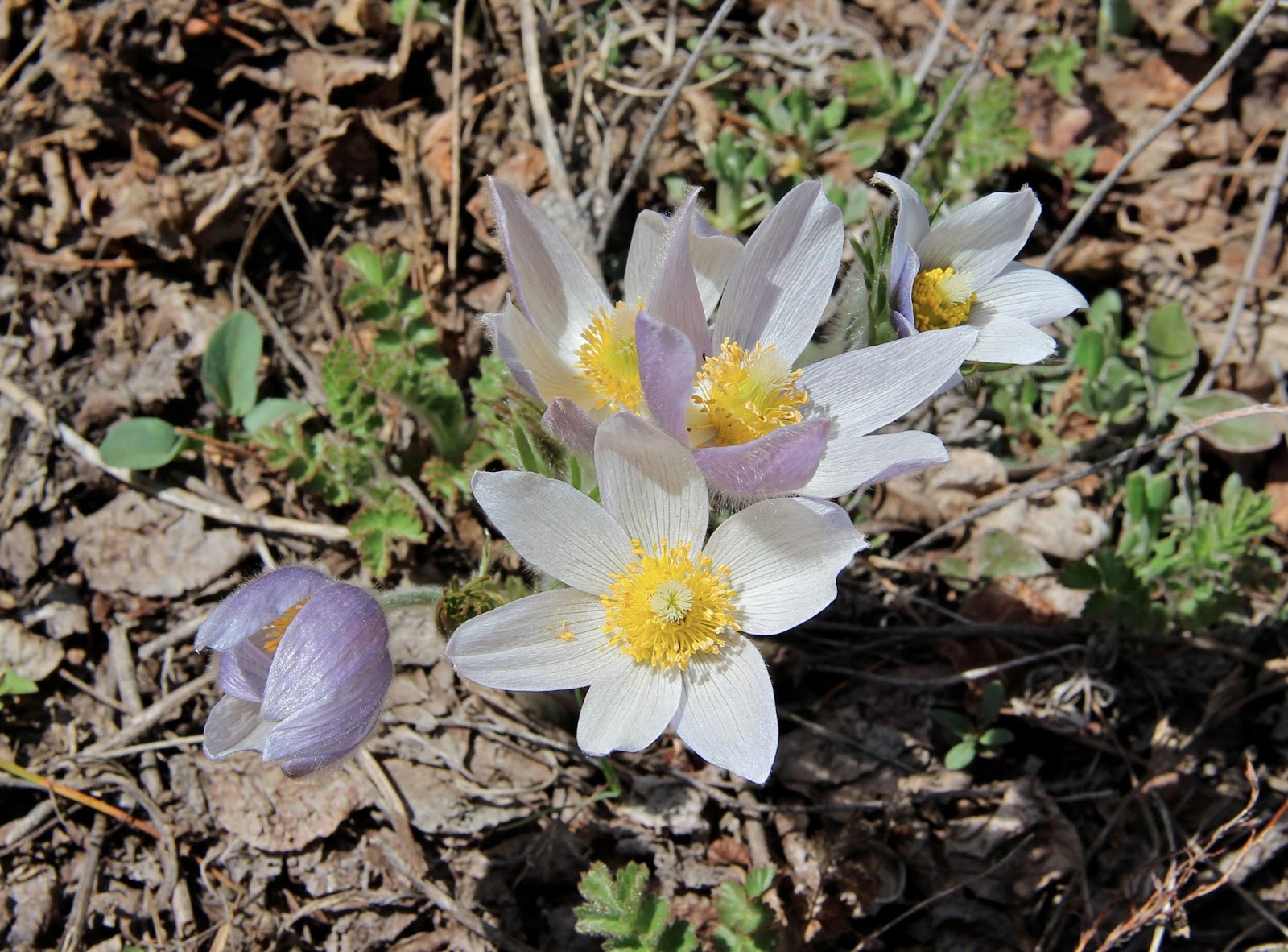
Last week as I was walking along a trail through pines and aspen, looking at patterns of light and shade, I was suddenly halted in my tracks by a radiant cluster of pasque flowers, all glowing in the morning sunshine.  “Good morning, good morning!” they called sweetly.
You doubt me?  I assure you this is what I heard, though I had to listen very carefully because pasque flowers are shy -- that’s why they often turn their heads and always whisper.  But once upon a time, long ago, things were different ...
“In the long ago, whenever any of the people happened to pass by where these flowers were blooming they tried to show the friendliness which they felt for human beings by nodding their heads in the chilly spring wind, showing their smiling faces and saying, “Good morning! Good morning!”  But the people passed them unheeding.  They became abashed at this indifference, so nowadays still feeling friendly towards the people in spite of such rebuffs, they bashfully turn their heads to one side as they nod and call their kindly greetings in their sweet low voice.”  (Dakota story, from Gilmore 1922)
Just starting to bloom, these pasque flowers bashfully turn their heads.
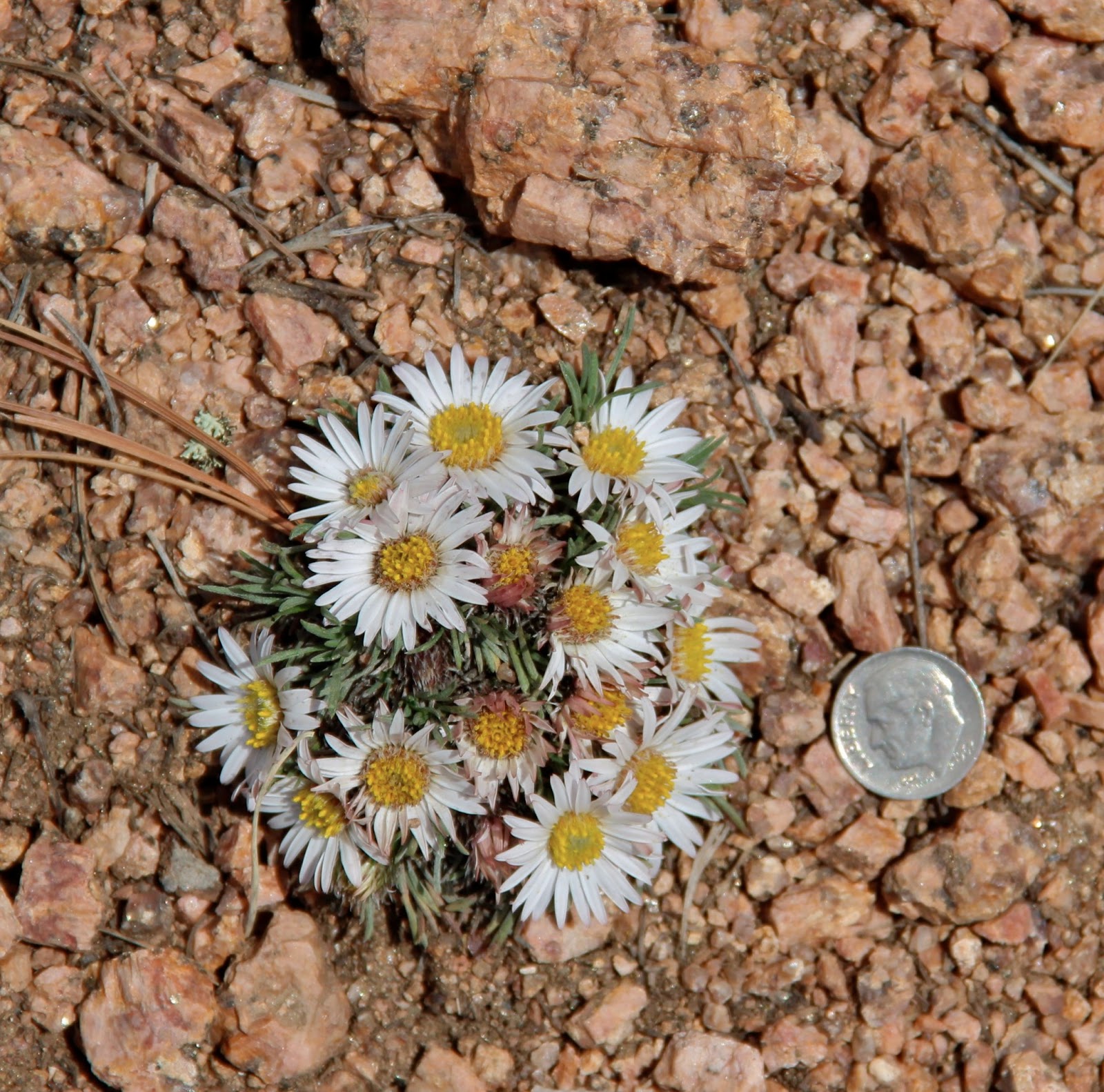
How anyone could walk by pasque flowers "unheeding" is beyond me.  In fact most Wyoming folks are thrilled to find them -- they bring us great joy!  They're among the first plants to bloom in spring (May in the mountains), along with Easter daisies and sagebrush buttercups.  Even better, pasque flowers are large and showy.  Some of the plants I saw were a good six inches tall.  How do they manage to grow so quickly so early in the season?
Easter daisies stay small and low-to-the-ground, even when flowering.  Coin ca 0.5 in across.
A pasque flower in full bloom hardly seems shy.  Purple sepals ca 1 in long.
The pasque flower’s trick is to form buds the previous fall, buds covered with silky hairs that help keep them warm.  The downy coats are the source of another common name -- goslinweed.  Several emerging goslings are visible at the base of the plant above.

Pasque flower, goslinweed, prairie crocus, pulsatille, hokshi-chekpa wahcha (Dakota for twin flower) and prairie smoke (more commonly used for Geum triflorum) all are names for this plant.  In school we’re taught that scientific names, though constructed from a dead language (Latin), are what we should use because they don’t have the ambiguity and confusion associated with common names.  This is not the case with the pasque flower however.  The experts remain divided.  Some call it Pulsatilla patens, others Anemone patens, and a few try to maintain the original Pulsatilla ludoviciana, though declared invalid years ago.  In any case, the pasque flower is a member of the Ranunculaceae (buttercup family) and is closely related to anemones, if not actually one itself.
Six-to-eight petal-like sepals surround numerous stamens, with numerous pistils at the very center.
Though showy, pasque flowers are but a brief flash of color in the spring sunshine.  They soon drop their sepals, and the pistils mature into seed-bearing achenes with long tails.  This is when the leaves really get going.  Most vegetative growth occurs after flowering, and leaves are present through much of the growing season, converting sunshine to energy and finally to buds (goslings) for next year.
The Pasque Flower [source no longer available; March 2016]
When Melvin Gilmore was studying the ethnobotany of Great Plains tribes in the early 1900s (see Note below), he came across another charming story about the pasque flower.  Later in the spring, when many flowers are in bloom and brightly decorated with colorful petals, the pasque flower has already gone to seed.  So it sings a song to the other flowers, hoping to share its wisdom:

“I wish to encourage the children
Of other flower nations now appearing
All over all the face of the earth;
So while they awaken from sleeping
And come up from the heart of the earth
I am standing here old and gray-headed.”

(translated from the Dakota language by A. McG. Beede; in Gilmore 1919)
It's still early spring but already seeds are ripe, each topped by a long feathery tail.

Note:  In the early 1900s, Melvin R. Gilmore interviewed elderly Plains Indians who had once gathered native plants and still knew the old names and uses.  He was determined to gather this knowledge ...
"while it may still be obtained, before the death of all the old people who alone possess it ... The old people themselves appreciate this and have expressed themselves as glad to give me all the information they could in the matters of my inquiry, in order that, as they said, future generations of their own people as well as the white people may know and understand their manner of life."
Gilmore first reported his findings as a PhD dissertation at the University of Nebraska (1914).  In 1919, it was published by the Bureau of American Ethnology.  Several years later he wrote Prairie Smoke, a wonderful compilation of Plains Indian stories and legends.


Sources (and recommended reading!)

Gilmore, M.R.  1919.  Use of plants by the Indians of the Missouri River region.  Bureau of American Ethnology.

Gilmore, M.R.  1922.  Prairie smoke, a collection of lore of the prairies (2nd ed., revised). Bismark, ND.  Available online at the Project Gutenberg.

Ode, D.J.  2006.  Dakota flora, a seasonal sampler.  Pierre:  SD State Historical Society Press.