Showing posts with label Accretionary Wedge blog carnival. Show all posts

Friday, January 3, 2014

A Carnival of Rocks and Plants

Tors of Sherman granite with spring wildflowers.  This was May 2012; for now we can only dream.
In December we had a cross-cultural carnival for geologists (The Accretionary Wedge) and botanists (Berry Go Round).  Sadly, attendance was meager.  Perhaps it was the holidays -- certainly the case for me, that’s why this summary is a bit late.  Hopefully it wasn’t the topic.  In any case quality made up for quantity, for one of my top favorite natural phenomena received the most attention -- substrate specificity in plants!

Geotripper describes the situation that caused me to fall in love with plants addicted to rocks -- endemics on serpentine, rare plants on rare rock.  What’s an endemic?  What’s serpentine?  He explains both, with great photos.

The Life-long Scholar also posted about plants and serpentine, specifically ferns that may be sufficiently addicted to serpentine to serve as clues to geologic structures otherwise hidden by all that pesky vegetation.

My current favorite edaphic endemics are the subject of my post about calciphilic plants, those that seem be restricted to limestone or dolomite.  I’m not as lucky as students of the serpentine flora.  Even though there’s a lot more limestone and limestone-loving plants in the world, literature and knowledge are sparse compared with serpentine.
Serpentine ecology has literature to die for! (click on image to see just a few examples)
Colorado Lichens (and Friends) writes about a “plant” named for its habitat:  Rock Tripe.  This group of lichens includes a species that may have set the course of our county (USA)!   They’re certainly photogenic in any case.  I’m glad to have learned about this site “speaking of lichens mostly, sometimes mosses and other cryptogams.”  In addition to blog posts, it has lots of information about lichens, something I’d like to learn more about.  I was especially happy to find a tribute to substrate specificity:  Lichens and Rocks, a post in progress.

Lockwood of Outside the Interzone posted a good example of the curious and puzzling patterns of discontinuous distribution that plants present to us.  And we can’t resist asking ... why?!  In this case, why are there trees on only one slope of the crater?

Lockwood also contributed a post about amazing root systems of large spruce trees now exposed on a beach in Oregon.  These massive roots are all that’s left of the trees.  Geology, specifically plate tectonics, is to blame!
Plant bloggers at Berry Go Round were not restricted to topic, as the BGR carnival generally does not limit contributions beyond being botanical (though not gardening).  So in the next posts, we have a nice diversity of topics.

In Appreciating English Ivy, Tim at Notes of Nature discusses whether a plant is “good” or “bad” and when.  As much as some folks hate this ivy, it may well be a keystone species.  This is a thought-provoking post that caused my mind to wander beyond ivy (photo below).
We hate eucalyptus trees for replacing stands of native California live oak, but love them for providing habitat for monarch butterflies.  Photo by Benson Ricks, from Pismo Beach Monarch Butterfly Grove.
Dave Coulter at OSAGE + ORANGE brings up Yggdrasil.  Don’t know “Yggy”?  It’s a giant world tree, an interesting story in itself, and Dave also points out there may well be a connection to ash trees!
The Norns spin the threads of fate at the foot of Yggdrasil.
For my BGR contribution, I submitted the final post in a short series on autumn tree strategies.  Autumn seems so very long ago now!
Windrows of snow behind dead stems of bunchgrass, Laramie Basin.

To round out this summary, here are some interesting plant posts I found recently.   They’re a bit heavy on photos, but then live plants are what I crave this time of year!

Nature of a Man shared wonderful photos of California plants in the field including some serpentine species.  The photos are beautiful and natural enough that I almost feel like I’m there ... almost.

A Digital Botanic Garden posted exquisite photos of a beautiful legume, the broad or faba bean.

In case you haven’t already met, here’s a nice introduction to the Malpighiales, at Catalog of Organisms.

Floral odor and heat are how some cycads control pollinators -- telling them not just when to come but also when to leave.

Do you know the irresistible and popular titan arums?  Have a look at this one that bloomed in August 2012.  As its proud parents (US Department of Botany and US National Herbarium) explain, “its irregular flowering times, large inflorescence and foul odor still create a fascinating burst of fecundity.”  There's also a fun time-lapse video of the arum and its fans.

Favorites of mine, for their elegant flowers, are the milkweeds, featured at Through Handlens and Binoculars (with links to earlier posts).

Denver Botanic Gardens explains the Ikebana tradition of flower arranging in Japan.

Plants are not always nice, but for a good reason.  Defense is critical in a multitude of situations.  AoB Blog provides an interesting summary post and a link to Defence on demand: mechanisms behind optimal defence patterns

Also from AoB Blog -- does green always mean photosynthetic?  We know it’s not just leaves that photosynthesize, but are all green plant structures photosynthetic?
Quaking aspen get an early start.  Before leaves appear, the bark is photosynthesizing and flowers bloom.

Finally ... to all nature bloggers, I wish you the best in 2014.  And keep blogging!
Notes of Nature kindly provides monthly desktop calendars.  I especially like January 2014.
UPDATE (1/23/14)
Back in early January, Short Geologist at Accidental Remediation pointed out "If you are trying to locate pockets of soil deep enough to get a good non-surface soil sample, and you are ass-deep in boulders and cobbles and outcroppings," you might want to pay attention to the plants.  See plants and rocks for more.

Friday, December 27, 2013

Die Kalkfrage (the limestone question)

Limestone and dolomite in the Salt River Range of western Wyoming.  Photo by Hollis Marriott.
Shultz’s milkvetch (Astragalus shultziorum) grows in abundance on calcareous scree and rock outcrops in the Salt River Range (above), but overall it's rare.  It's restricted to several mountain ranges in western Wyoming and adjacent Idaho, and specifically to sites underlain by limestone or dolomite (images courtesy WYNDD).
Shultz's milkvetch, by Walter Fertig.
Distribution of Astragalus shultziorum in Wyoming.
In Wyoming, we have at least twenty species like Shultz's milkvetch -- restricted to limestone or dolomite.  Why?  What’s different about these plants?  This is the “limestone question" which has intrigued and puzzled botanists for more than 200 years. We call these species calciphiles or limestone lovers, though we really don’t know what we’re talking about (more on that later).  They’re endemics, meaning restricted to a limited area, and they're edaphic endemics as they occur only on specific soil/rock types.  Calciphiles are edaphic endemics that grow only on calcareous sites ... or so it appears.

It’s impossible to be a rare plant botanist in Wyoming and not be enchanted by our calciphilic plants.  They're often found in spectacular places, and the association with specific rock types is fascinating.
Shoshonea in foreground, on rocky calcaerous soil on Bald Ridge along the east flank of the Absaroka Mountains.  Photo by Hollis Marriott, courtesy WYNDD.
Shoshonea (Shoshonea pulvinata) in Wyoming.  It's known from sites in south central Montana also.
Limey home of Dorn's twinpod; photo by Walt Fertig, courtesy WYNDD.
In the photo above, Dorn’s twinpod (Physaria dornii) grows on gravelly slopes of Twin Creek limestone with mountain mahogany.  This twinpod is a narrow endemic limited to a few areas in central west and southwest Wyoming.  In the northern part of its range it grows on limestone soils.  Further south it does just fine on sandy-shale soils.  Are these genetically-distinct ecotypes?

Below, Cary’s beardtongue is one of the half dozen or so calciphilic endemics of the Bighorn Mountains, where there's lots of limestone and dolomite.
Penstemon caryi; photo by Andrew Kratz.
Why are we blessed with so many calciphiles?  It’s because limestone and dolomite are exposed in most mountain ranges in the state.  During much of the Paleozoic Era 570 to 245 million years ago, Wyoming was underwater.  Sand, silt and most importantly, carbonate sediments were deposited on the sea floor.  Time passed, the sediments were buried and turned to rock, and then starting about 70 million years ago, mountains were uplifted and erosion exposed outcrops of calcareous rock.
Above, simplified geologic map of Wyoming.  Purple and pale blue areas include exposures of Paleozoic limestone and dolomite.  Below, cross-section through Wyoming mountain ranges;  Paleozoic rocks are pale blue.  Click on images to view details; both are from Roberts 1989.
The map above shows the surface geology of the Bighorn Mountains in north central Wyoming.  The purple and light blue polygons include extensive exposures of limestone and dolomite.  Below, distribution of three endemic plant species reflects distribution of calcareous rock outcrops and soils.
Distribution of William's waferparsnip (Cynmopterus williamsii), Cary's beardtongue (Penstemon caryi) and Hapeman's sullivantia (Sullivantia hapemanii) in the Bighorn Mountains.  All are endemic to limestone.
Hapeman’s sullivantia (Hapemania sullivantii) is an unusual Wyoming calciphile.  It grows in moist-to-wet habitat, while most of our limestone endemics occur on dry sites.  Photo by Bonnie Heidel, courtesy WYNDD.
The limestone question pops up in many parts of the world.  It's been studied extensively in Europe, starting with botanist and plant physiologist Franz Unger.  In 1836 he published a paper contrasting the distinctive floras of limestone vs. slate regions in the Alps:  Über den Einfluß des Bodens auf die Verteilung der Gewächse (On the influence of soil on the distribution of plants).  Unger viewed the mineral composition of the rock as the main determinant of substrate-specific plant distribution, sometimes called the Chemical Soil Theory.
The Dolomites in northeastern Italy.  With so much calcareous habitat it must be a wonderful place!  Photo by Ken Driese (The Booby Hatcher), used with permission.
Dolomite bellflower (Campanula morettiana), one of many endemics in the Dolomites.
From Dolomiti Bellunisi National Park.
Cedar glade on limestone in Tennessee.  The cedars are Juniperus virginiana.  Source.
Limestone areas often are rich in endemic plant species.  For example, in the central eastern USA, cedar glades develop in areas of shallow rocky calcareous soils and exposed bedrock (above).  The flora of these glades includes 41 endemic species! (Kruckeberg 2002).

At least a dozen calciphilic plants are known to be endemic to Mount Olympus, Greece (Kruckeberg 2002).
Mytikas, highest peak of Mount Olympus (source).
The Burren in County Clare, Ireland, is one of my dream destinations.  It’s famous for its amazing flora, including many limestone-lovers.
Plants thrive in grikes (solution fissures) in limestone pavement in the Burren.  Source.

After studying the limestone question for 200 years, what have we learned?  It’s complicated!  Just look at the terminology:
basiphile vs. acidophile -- plants adapted to basic vs. acidic soils.  For a long time it was assumed that the differing pH of soils derived from calcareous rocks (slightly basic) vs. silicic rocks (slightly acidic) explained plant distributions.  It turned out to be not so simple ... in fact not even close.
calphile vs. calciphobe -- plants requiring (loving) vs. unable to grow on (fearing) calcareous substrates.  This too is an oversimplification.  Many limestone lovers will grow just fine on non-calcareous soil if there’s no competition.  Apparently in the wild they’re restricted to limestone because the competition can’t grow there.
calcicole vs. calcifuge -- plants that grow vs. do not grow in calcareous habitat in the wild.  This non-committal approach is good because for most species we have no answer to the limestone question.  But we’re not totally ignorant ... we’ve learned that plants deal with the challenges of limestone and dolomite in diverse ways.
Limestone is mainly calcium carbonate; so is dolomite, but with magnesium mixed in.  It’s not surprising then that one problem with calcareous habitat is too much calcium.  Plants need calcium but an overabundance disrupts critical processes.  Several strategies for dealing with excess calcium are known.  Some plants are able to maintain high concentrations of bound calcium in their sap without altering the concentration inside cells.  These are calciotrophic calcicoles.  There also are calciophobic calcicoles which precipitate out excess calcium and store it.  Other plants secrete calcium carbonate via glands.  The table below shows plant families in which some species are calcicoles, with strategies.
Based on information from Kinzel 1983; click on table to view.
It may be that some plants tolerate limestone with the help of microbes or mycorrhizal fungi associated with their roots.  Finally, a plant’s apparent love of limestone may have nothing to do with calcium.  White and Broadley (2003) suggest that it is “insensitivity to iron and phosphorous deficiencies that determines the flora of calcareous soils.”  And so the debate rages.

Though we're blessed with many calcicoles in Wyoming, the limestone question -- why and how they grow where they do -- has not been answered for any as far as I know.  And so we arrive back where we began -- fascinated and puzzled, and hopefully a bit wiser for the journey.
Above and below, Payson’s bladderpod on calcareous soils in the Salt River Range.  Is it a limestone lover?  a calcium addict?  a calciophobic calcicole?  We can only wonder.
Photos of Lesquerella paysonii and habitat by Hollis Marriott, courtesy WYNDD.

This post is my contribution to the December Accretionary Wedge (#63) -- Plants and Rocks (or Rocks and Plants).


Sources (in addition to links in post)

Kinzel, H.  1983.  Influence of limestone, silicates and soil pH on vegetation.  in Lange et al., eds.  Physiological plant ecology III.  Springer-Verlag.

Kruckeberg, AR.  2002.  Geology and plant life.  The effects of landforms and rock types on plants.  Seattle:  Univ. WA Press.

Roberts, S.  1989.  Wyoming geomaps.  Laramie:  Geol. Surv. WY.

White, PJ and Broadley, MR.  2003.  Calcium in plants, review article.  Ann. Bot. 92:487-511.

Saturday, December 21, 2013

Berry Go Round meets the Accretionary Wedge

California coastal chaparral on Point Sal ophiolite, Point Sal State Park.
REMINDER!
Deadlines for December’s Accretion Wedge and Berry Go Round blog carnivals aren’t far off.  Take advantage of this month’s bargain -- two for the price of one!!  For AW #63 the topic is Plants and Rocks (or Rocks and Plants).  Geobloggers, this means you can submit your post to  the Berry Go Round as well.  The BGR is wide open -- submit your latest post(s) about plants.  If there’s a bit of rock or landscape involved, consider joining the Accretionary Wedge as well.  For more information, see:

AW #63: Plants and Rocks, or Rocks and Plants (deadline December 31)
AND
What do you know about plants? (BGR) (deadline December 26 or 31, see post)

Wednesday, December 4, 2013

AW #63: Plants and Rocks, or Rocks and Plants

Photos courtesy Arthur Kruckeberg and Dan Poelma.
I’m hosting December’s Berry Go Round, a carnival for plant bloggers.  In my solicitation for posts I tried to encourage geo-bloggers to participate, as botany and geology often interact or are linked in some way.  Then I noticed that the Accretionary Wedge #63 geo-carnival was host-less.  I thought ... why not both?  My topic, Plants and Rocks or vice versa, was accepted making this the Bargain of the Year!  You can submit your AW contribution to the December BGR too.

To submit a post to the Accretionary Wedge, provide a link in a Comment below or tweet to @plantsandrocks.  UPDATE:  Deadline is the end of the month.  To join the December BGR, see the solicitation post for details.

Plants on Rocks 1
Cary's beardtongue grows only on calcareous sites in the Bighorn Mountains.  Photo by Andrew Kratz.
Plants on Rocks 2
Grassland - forest mosaic determined by bedrock; Devils Tower, Wyoming.
Rocks from Plants 1
Petrified Miocene logs, eastern Washington.
Rocks from Plants 2
Mining the remains of sub-tropical trees in the Powder River Basin, Wyoming.
Plants and rocks make lovely photos ...
Laramie columbine on Laramie granite.
... as do rocks and plants.
Precambrian stromatolites decorated with alpine wildflowers.

Thursday, September 19, 2013

Of Mosses and Mountains II and AW #60

The Apennines -- home to momentous discoveries in geology.
As mentioned earlier, my summer reading included two outstanding books about natural history.  The first, Gathering Moss by Robin Kimmerer (reviewed here), is about the miniature fairy-tale world of mosses.  The second concerns the other extreme -- a world at an almost-incomprehensible scale where landscapes are as ephemeral as patches of moss.  This is The Mountains of Saint Francis, by Walter Alvarez (W.W. Norton, 2008; also recommended by Rapid Uplift and About.com Geology).

As hinted at in the subtitle -- Discovering the geologic events that shaped our earth -- Alvarez uses the Apennines of Italy as a venue for describing great discoveries in geology.  He tells of the brilliance of the discoverers, the far-reaching effects of their discoveries, and the generally reluctant acceptance by colleagues.

How nice that the topic for this month’s Accretionary Wedge happens to be Momentous Discoveries in Geology!  Thanks to Matt at Geosphere for his timely choice :-)
“The discovery you choose does not have to be universally recognized as momentous but should be in your opinion. It could be something that we take for granted every day, but is in actuality part of the underpinnings of our science.”
After reading The Mountains of Saint Francis, my choice is the very basic realization that the Earth changes at a scale well beyond that of our lifetimes.  We might see a volcano pour out massive amounts of ash, or suffer through a destructive earthquake, but these are just minor events.  Consider that mountain ranges are uplifted and then worn away, and that continents move around, collide, split and even sink, coming apart in the process. Humans can only experience these kinds of changes with their imaginations, and even that wasn't always possible.

Who was it that “discovered” that the Earth has a history well beyond what is witnessed by humans?  Alvarez credits Nicolas Steno (1638-1686), often considered the founder of geology.  So the Earth changes ... I certainly take this for granted, it seems so obvious! But in Steno’s day it wasn’t easy to convince people that seemingly abiding landscapes are ephemeral.
Source.
Fossils were the key to Steno’s “discovery”, allowing him to argue convincingly that the hills around Tuscany once were sediments on the ocean floor, even though no human had seen nor recorded such a spectacular change.  At the time, fossils were considered growths within rocks in spite of obvious similarities to living organisms.  Steno was not the first to propose that fossils were once alive, but his careful studies and convincing arguments led to general acceptance.  He saw the problem as one of explaining “a solid body naturally contained within a solid” (De solido intra solidum naturaliter contento), and noted that:
If a fossil had grown within a rock it would distort or crack the rock, which was never the case.
Many fossils appeared to be falling apart rather than growing; in fact discrete fossils sometimes fit together perfectly.
Fossils were never distorted in shape, contrary to what would happen if growing in hard rock (like tree roots).
Fossil shells were sometimes found in clusters, arranged just as they are in the ocean.
Steno reasoned that rocks containing fossils and other solids had once been fluid, and had hardened around those solid objects.  Thus seashells fossilized in the mountains had once lived in the ocean, i.e. the mountains had not always been there.  The Earth has undergone huge changes; it has a history, which geologists have been working to unravel ever since.
"One sins against the majesty of God by being unwilling to look into nature's own works and contenting oneself with reading others" said Bishop Steno.
Steno’s mind in action must have been awesome to behold.  From his study of fossils, he went on to explain layered rocks (principle of original horizontality) and how they can provide powerful insight into the history of the Earth (law of superposition).  No wonder Steno is considered the Father of Stratigraphy.

Obviously Steno was an open-minded and visionary thinker.  And I suspect he wasn't afraid of the unknown ... that he did not feel obligated to fit everything into existing stories, which of course would have limited his amazing thinking.
“Fair is what we see, Fairer what we have perceived, Fairest what is still in veil.”
Modified from source.

Sunday, August 25, 2013

Recommended geo-guides ... and more needed soon

Road trip gear:  the library.
This month’s Accretionary Wedge #59 features geologic field guides, a subject near and dear to my heart as I take vacations designed around geo-destinations (botany/ecology too).  Thanks to Mika of GeoMika for hosting and picking such a great topic.

I like destination-based books, especially the Geology Underfoot series.  These are collections of “vignettes” about selected sites, with background and explanations, access info, tour routes, specific things to see, etc.  The geology is pretty basic but always interesting.  I sometimes choose destinations from these guides, and then search for more information before I go.
Geology underfoot at Cathedral Gorge State Park in Nevada
There are two books about the geology of the western US that I’ve read and referred to again and again:  Frank DeCourten’s The Broken Land and Robert Fillmore’s Geological Evolution of the Colorado Plateau.  Both treat their subjects in depth, and I’ve learned a lot about geology in general from them.  DeCourten’s has a bonus -- intriguing essays introducing each chapter.  What is it that is so exciting about geology?  Why are we drawn to these stories?   Try to imagine visiting these paleo-environments that we’ve managed to reconstruct from rocks!
Looking east across the broken land.
I recently found another useful guide -- Roadside Geology of Nebraska by Harmon and Maher.  It's a roadside guide, but also has in-depth site-based sections.  I was very happy with it during a recent visit to the Toadstool Rocks.
Fallen toadstools.
One of my most memorable geo-vacations was planned with online resources.  I knew very little about northern New Mexico, but hit a gold mine on the web.  The New Mexico Bureau Geology and Mineral Resources maintains a Virtual Geologic Tour of New Mexico with destinations scattered throughout the state.  The virtual guides for the northern part of the state are now available as a book -- Geology of Northern New Mexico’s Parks, Monuments, and Public Lands.
The Mt. Taylor volcano sits on the Jemez Lineament in northwest New Mexico; from NMBGMR.
The Utah Geological Survey maintains an equally useful website:  Geosights.

And finally ...
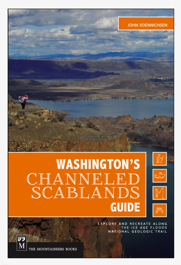
This Accretionary Wedge is timely as a geo-trip is imminent.  A friend needs a ride to Seattle and it seems only logical to get there by way of Glacial Lake Missoula and the paths of its jökulhlaups.  I’m excited to see destruction wrought by cataclysmic ice age floods -- scablands, coulees, giant gravel bars, fluvial dunes, scour holes and more.  Maybe there will be a relevant guide or two among the AW submissions.  Do you have recommendations?
Boulder thought to have been transported ca 10 km by floodwater ... now that's cataclysmic!
Current reads:  David Alt's book about the humongous Pleistocene floods; John Soennichsen's guide to the scablands; V. R. Baker's "The channeled scabland:  a retrospective" (Ann. Rev. Earth Planet. Sci. 2009.  37:393-411.)