Showing posts with label Townsendia. Show all posts

Monday, March 13, 2023

Tree Following in March ... almost spring!

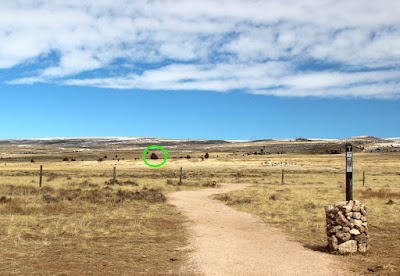
Eastern Laramie Plains, Laramie Mountains in distance, my junipers circled.

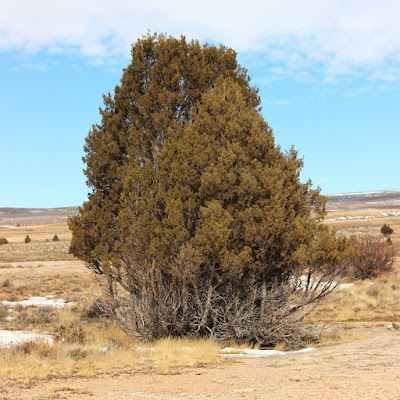
Mid March is here and spring is approaching, even in Laramie at 7200 ft elevation. It's time to visit the junipers I'm following this year. As usual, we left the trailhead via Trail 1 and soon veered off cross-country on gently-sloping limestone.
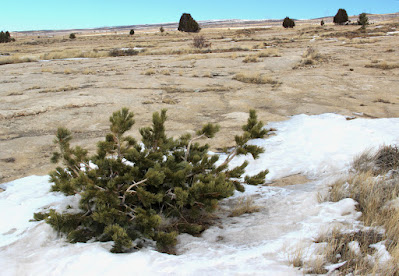
This Limber Pine near my junipers has a lot of character! (not all pines aspire to be trees :)
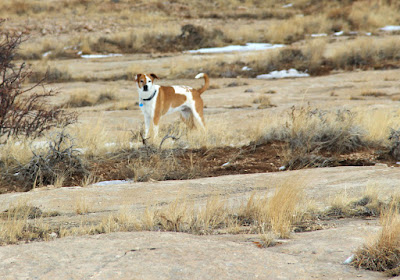
The dog paws in the center of the photo below belong to my field assistant, who found a patch of snow to squirm around on upside down—to scratch her back I guess.
This African hunting dog (50% Basenji) loves snow.
It was a cool but mostly sunny day with just a light breeze. I was able to photograph the junipers in some detail.
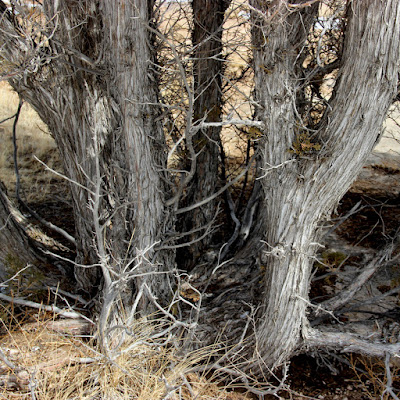
My Rocky Mountain Junipers—the many stems seem odd. Other trees in the area are similar.
A closer look at the trunk situation.
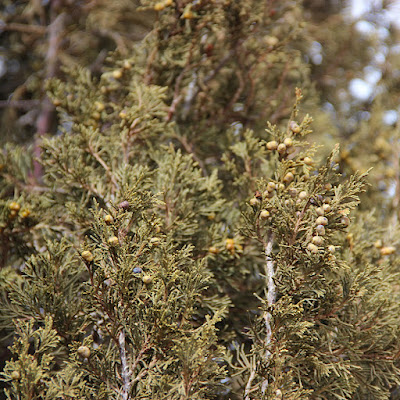
Juniper berries were more common on the east (leeward) side—mostly yellow, a few blue. 
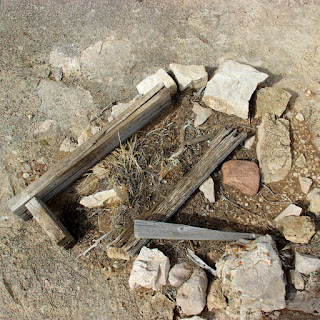
The "archeological site" I mentioned last month revealed its age—not old at all! One of the boards was lying atop last year's grass stems. Apparently someone besides me likes this site too.
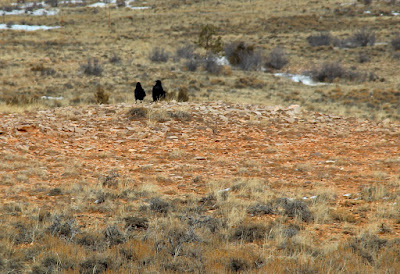
This time we continued eastward up the limestone slope "to see what we could see". From the not-so-high point I spotted two American Crows squawking from a similar high point nearby. Crows here are used to people and dogs. These two seemed interested in us actually.
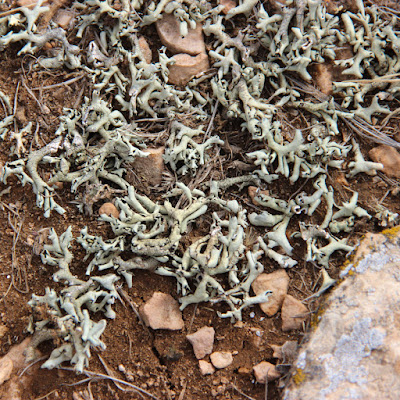
Much of the snow that was here last month had melted. But the ground was still moist and contrasted nicely with the lichens that are so common. I was sure I would find this lichen (right?) online, but not. So I posted it to iNaturalist hoping for an identification. If you recognize it, please add a comment.
I hoped to find a few of our earliest wildflowers. And I did ... but not in bloom just yet. Easter Daisies were locally common on sparsely vegetated soil, their favorite habitat. I bet they will be in full flower next month.
Easter Daisies (Townsendia) are common here.
Plants are ca. 2–4 cm across.
Ready to bloom!

This is my contribution to the March gathering of tree followers kindly hosted by the Squirrelbasket (click on link to learn more about what we do). And read more news about our followed trees.

Tuesday, April 26, 2016

Citizen Scientists Awake—We Have Wildflowers!


Laramie botanists are emerging from hibernation, hungry and irritable, in critical need of floral sustenance. But while other plant lovers are gaily posting colorful photos of spring flowers and lush foliage, we're desperately searching for any color at all.
NOAA’s extended forecast; the little pictures say it all.
I’m exaggerating, but barely. Wildflowers are just now appearing, and to see them we have to get out in between snow storms. Last Friday was sunny, so I grabbed my camera and drove up into the Laramie Mountains. Fortunately all the heavy wet snow from a few days before was mostly gone. I was intent on adding observations to my Plants of the Southern Laramie Mountains project in iNaturalist, which has lain dormant since last fall.

I didn't have to walk far to be rewarded. Pasque flowers (Pulsatilla or Anemone patens ssp. multifida) were common, as they usually are this time of year—in the field and on Facebook! But then who wouldn't be excited to come across large showy flowers when everything else is mostly brown and gray.

I found Oregon grape (officially creeping barberry, Mahonia repens) at the base of large granite boulders on a south-facing slope. Neat discovery—I didn’t know it bloomed so early. With flowers it's a good addition to my iNat project.

While on the ground photographing Oregon grape, I spotted spring beauty (Claytonia lanceolata). It is a beauty, but you have to look close as the flowers are only about a centimeter across.

In a sunny opening in the forest, three goslins caught my eye—luckily. I don't usually see them. Their downy brown and gold coats blend well with dead vegetation and litter.
What are goslins? The purplish patch above is a hint (click on image for a better view). Goslinweed is another name for pasque flower, because the buds look like goslings.
Source.

I wandered across a gentle south-facing slope with scattered low sagebrush. I was searching for Easter daisies, but brilliant yellow spots stopped me—sagebrush buttercups (Ranunuculus glaberrimus var. ellipticus). They're usually the first spring wildflowers I see in the Laramie Mountains, and are bright beyond bright in the dull landscapes.

Nearby were the coveted Easter daisies (Townsendia hookeri). Officially they’re called Hooker’s Townsend daisies, which raises the question: "Just exactly whose daisy is this?" In 1834, English botanist William Hooker named the genus for Pennsylvanian David Townsend, a civic-minded banker and respected amateur botanist. In 1957, American botanist John Beaman named the species for William Hooker.
And it gets more complicated. (Readers who aren't taxonomy geeks may want to skip this paragraph.) The Encyclopedia of Life calls T. hookerii “Nuttall’s Townsend daisy”—which lured me into further research. Strictly speaking, Nuttall's Townsend daisy is T. nuttallii. But T. nuttallii is usually lumped in with T. hookeri. Not here in Wyoming however. In fact one of our botanists, Robert Dorn, named it. T. nuttallii is restricted to limestone areas, and hasn't been reported from the Laramie Mountains. So I won’t worry whether the leaves are linear-oblanceolate (vs. linear), and whether the bristles of the pappus are of two lengths. This post illustrates vividly (nice photos) the challenges of our townsendias.

I collected a plant to add to my native xeric plants bed, next to what I believe are stemless Townsend daisies (T. exscapa). In 2013 I rescued them from a prairie in advance of road construction. T. hookeri and T. exscapa are hard to tell apart; the Flora of North America separates them based only on size of various floral parts—unfortunately. Distinctive characters are so much easier and reassuring!
A gasket scraper is an effective collecting tool for small compact plants in rocky soil.
Townsendia exscapa transplanted in 2013. They have thrived in the garden (next photo).
Hopefully these are two species, and hopefully I'll get a feel for their differences. Already I've seen a difference in “behavior.” When winter returned two days ago, the new arrival from the mountains duly opened its flowers in the morning, but the prairie daisies stayed shut all day.
Left, Easter daisy from Laramie Mountains (8000 feet elevation); right, Easter daisy from Laramie Valley (7000 feet). Photo was taken mid-afternoon on a cold gray day.

Yesterday was clear, and all the Easter daisies were singing in the sunshine.
But today ...
... only Frog Jolson keeps the music alive:
Sunday, January 12, 2014

Daisies in Waiting

Easter daisies in foreground, to right of bunny tracks.
The Easter daisies are waiting ... waiting for spring.  It may be January, but these guys are ready to go!

Just look:
January 12, 2014
They keep green leaves all winter ...
and already have flower buds, which formed last fall ...
so with the first sign of spring, sometime around Easter ...
they will burst into bloom when the other prairie plants are just starting to grow.
March 30, 2012.  "Flowers" (heads) are about an inch across.
Their scientific name is Townsendia, and some people call them that -- townsendias.  The Federal government calls them Townsend daisies (USDA Plants Database).  There are at least 25 species, all native to western North America.
Last May I rescued several Easter daisy plants from a grassland scheduled to become a road, and put them in a raised bed in the backyard.  I quit watering them after only a week or so, and they did just fine.  They're true xerophytes.  Meanwhile, there's still no sign of road construction.  Maybe I’ll transplant more townsendias this year.
May 30, 2013.
Some townsendias, mine for example, are tough to identify.  So I collected a voucher specimen, took it to the Rocky Mountain Herbarium at the University of Wyoming, and compared it with descriptions in the literature and specimens in the collection.  It is Townsendia hookeri, Hooker’s Easter daisy.
Compiled from Flora of North America.
Flowers of T. hookeri (above, left) are smaller than those T. exscapa (right), with which it’s often confused.  Technically these are heads not flowers.  Townsendias are composites (Asteraceae); what looks like a single flower is actually a head composed of many tiny flowers or florets.
Hooker's Easter daisy heads, each with yellow disk flowers surrounded by white ray flowers.
UPDATE:  Cindy Reed of the Great Plains Native Plant Society provided the photo below of Townsendia exscapa.  These two townsendias are easily confused when not seen together, i.e. based on descriptions only.  When open, T. exscapa has longer more loosely-arranged ray flowers.  In T. hookeri, the flower clusters are tighter, and leaves are narrower and more crowded, "presenting a finer-textured tuft" (Claude Barr).  They were considered a single species until J.H. Beaman split them in 1957 (I agree with Beaman).
Townsendia exscapa, the Easter daisy found by Richardson and named in honor of D. Townsend by Hooker.  Photo by Cindy Reed.
Townsendia hookeri, for comparison.
I mounted my voucher specimen of last week.  Soon it will be added to the 825,000 specimens already in the Rocky Mountain Herbarium.
I’ve kept an eye on my Easter daisies as I walk by them every day, and I was amazed to discover that the little cushion plants over-winter with evergreen leaves and fully-formed flower buds.  This is Wyoming and 7200 ft elevation ... how do they keep from freezing?! At least they’re low to the ground and out of the wind, and often protected by snow.
“The flower buds remain green against any odds of winter weather and hurry toward bringing out every blossom within a few days” wrote Claude Barr, the great native plants gardener of the Great Plains (in Jewels of the Plains, 1983, University of Minnesota Press).
Indeed, Easter daisies bloom before other plants have grown much at all, and thus can enjoy whatever sunshine spring offers.  They’re buried with each spring blizzard, and then when the snow melts, they continue as before.
Easter daisies open as the morning warms.  March 30, 2012.
There are many creatures named “Townsend” in this part of the world, including a solitaire (bird), ground squirrel, chipmunk, mole, vole, jack rabbit, and of course daisies. Most were named for John Kirk Townsend, one of the great 19th-century naturalists of North America, but John Kirk is not the Townsend of Easter daisy fame, though you will occasionally read otherwise.  Townsendias were named for David Townsend, a prominent citizen of West Chester, Pennsylvania -- a banker, County Commissioner and enthusiastic botanist.  He neither discovered nor named Townsendia, and it’s not clear that he ever saw one in the wild.  The first collection on record was made by John Richardson in Saskatchewan.  He called it Aster exscapa.  When W.J. Hooker of the Royal Botanic Gardens reviewed the specimen, he decided it was sufficiently distinct to warrant its own genus, which he named in honor of Townsend:
“I have named the genus in compliment to David Townsend, Esq. of West Chester, Pennsylvania who having imbibed the most ardent love of Botany from his friend and instructor Dr. Darlington of the same city, has devoted his leisure hours to the science with eminent success.” (Hooker, W.J. 1840.  Flora Boreali-Americana: or, the Botany of the Northern Parts of British America, Volume 2)
W.J. Hooker himself was honored when J.H. Beaman described and named Townsendia hookeri in 1957, based on a specimen from Mt. Vernon Canyon in Jefferson County, Colorado:
“To the layman, T. hookeri is perhaps as well known as any species of Townsendia.  In Colorado it is abundant at the base of the Front Range and is one of the first flowers of the year; hence, its name Easter Daisy.”
An early spring bouquet.
Those lucky enough to catch Easter daisies in full flower adore them.  Though low to the ground, they’re spectacular against the dull browns and grays of an early spring grassland.  In Dakota Flora, Dave Ode suggests they would be the leprechauns’ favorite flowers if they grew in Ireland!  I have to agree -- the little plants with their large clusters of bright blooms are enchanting.  Claude Barr must have loved them too, judging by what he wrote:
“Wintering as a completely evergreen bun of narrow leaves close to the ground, and guarding its quota of autumn-set buds, Townsendia joyously responds to the gentle light and warmth of early spring with wide disks and short rays of soft gold and glowing light pink.  Fittingly, it is called ‘Easter-daisy’ ...” 
South Dakota rancher Claude Barr, "eminent plantsman of the plains" (Great Plains Native Plant Society)
Spring's still a long way off ... best to put back their cover of snow.