Showing posts with label American West botany. Show all posts

Monday, August 13, 2018

Boxelder—the Odd Maple


The boxelder I’m following this year, the one that grows in a nook formed by warehouse walls, has changed only subtly since last month’s report. It has more leaves—not that I’ve counted them or measured their cover, but I can see new ones emerging, even though the first signs of summer’s end have appeared. Must be an optimistic tree.
The sand dock along the warehouse wall is done storing energy underground, and is now a brown tangle of dead leaves (Canada thistle sticking up through).
Boxelder’s oppositeness—stems as well as leaves.
Fresh new leaves … in September!
The miniature leaves emerging at the tips of the branchlets had interesting forms, surprising actually. But in the morning shade it was impossible to capture them in focus, so I took a branchlet home.
Interesting! These two young leaves look deeply incised and pinnately-lobed (keep this in mind for the trick question coming up soon).

Q: "How many leaves in the next photo?"
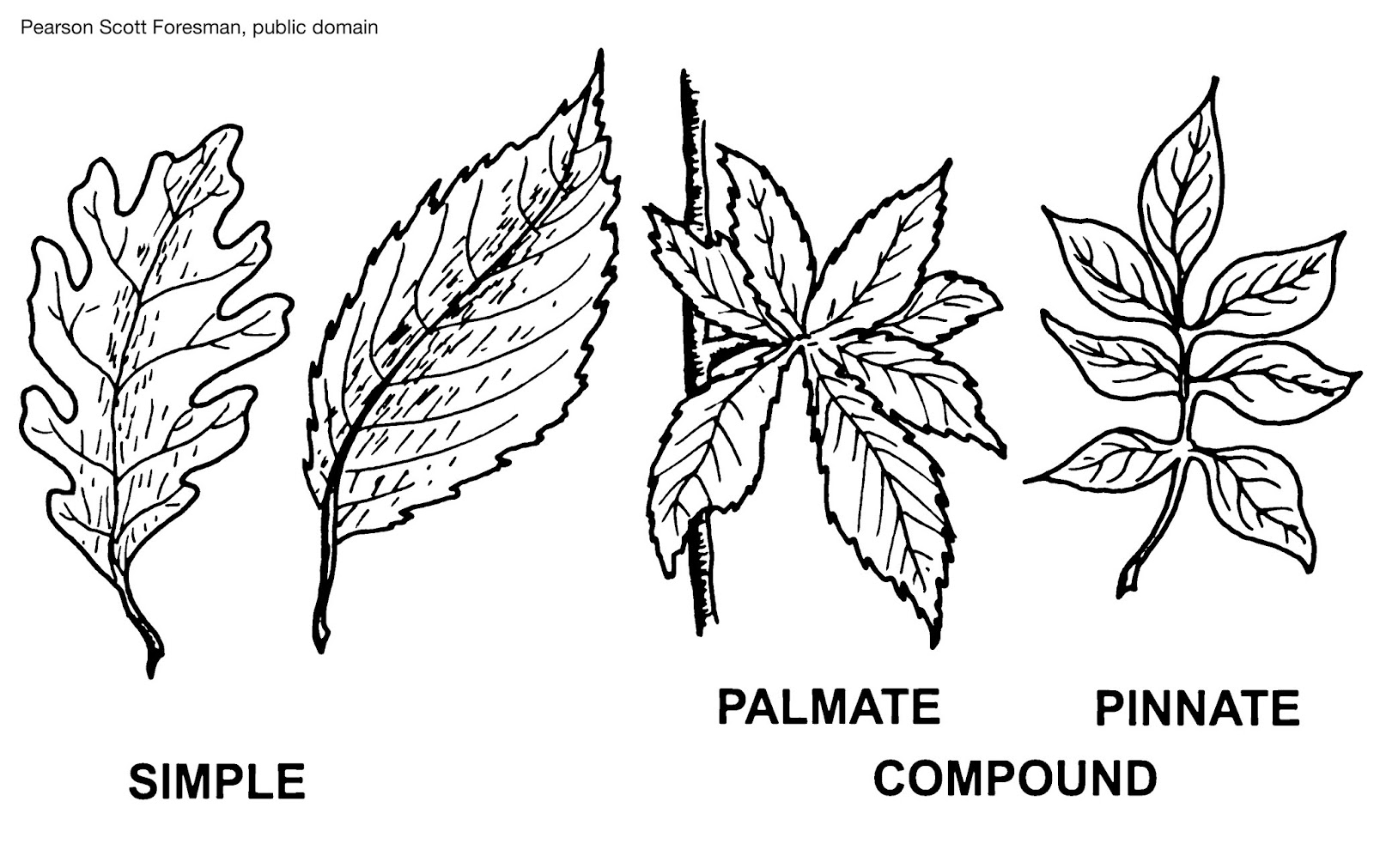
A: "Just one." This is a little trick we ranger naturalists would use on nature walks. Most people would answer five. Then we explained how actually this is a single leaf, i.e., from one bud, and that it split into leaflets as it grew. At least one former ranger I know took it a step further, overlapping the leaflets to show that the boxelder is indeed a maple, a member of the genus Acer.

Even so, doesn’t it seem a bit odd that boxelder ended up in the genus Acer—that a tree with compound leaves was thrown into a group of simple-leaved brethren (1), especially given the proclivity of taxonomists for splitting? If you agree that this is odd, you’re not alone. In fact, you’re in the company of some of the most esteemed pioneering North American botanists.
The boxelder is native to North America, but by the mid 1700s, it had become common in Europe as well:
“ … it is in great request for adorning pleasure grounds, on account of the rapidity of its growth, and the beauty of its foliage, whose bright green forms an agreeable contrast with the surrounding trees.” (Michaux & Hillhorn 1819)
So it's not surprising that Carl Linneaus included the boxelder in the first edition of his Species Plantarum (1753), in which he formally introduced our binomial system of nomenclature. He assigned the scientific name in use today: Acer negundo (the complete name has “L.” appended to it because Linneaus is the authority). Why did he place boxelder in the genus Acer? Probably because it has the same distinctive fruit as maples: two-winged two-seeded samaras that spin in the wind (aka wingnut, helicopter, whirlybird, whirligig and spinning jenny).
Acer negundo L. (Michaux & Hillhouse 1819); samaras (keys) lower left.
When Andre Michaux published the first North American sylva in 1810 (2), boxelder was Acer negundo, following Linneaus’s lead. And so it remained for some thirty years, during which time Thomas Nuttall published periodic updates, adding new species that he and others discovered.

But by the time of Nuttall’s 1849 edition, boxelder had moved up in status (see p 90). It was in its own genus, Negundo, the boxelders, which included two species and a rumored third. The common boxelder became Negundo aceroides. N. californicum was the California boxelder, discovered by David Douglas, a Scottish botanist and major contributor to the North American flora. “It is remarkable for the almost tomentose pubescence of its leaves” (densely fine hairy), most of which had just three leaflets. Even the samaras were pubescent. Nuttall also mentioned a possible third species, christened N. mexicanum by Swiss botanist Augustin Pyramus de Candolle (3), but declined to recognize it until more material was available for study.
California boxelder, Negundo californicum (Nuttall et al. 1865).
I had hoped to find out why the boxelders were segregated into their own genus. But I wasn't able to solve that mystery. The Plant List considers Negundo aceroides an unresolved name, attributable to either John Torrey or Conrad Moench. Some sources hold Nuttall accountable as well. In any case, Torrey and Asa Gray, two of our great botanical luminaries, included it and N. californicum in their North American flora, published 1838-1840 (pp 49-50).

But Negundo turned out to be a passing fancy. At some point, boxelders were lumped back in with the maples. However, the California and Mexican boxelders were not abandoned—they’re now varieties. In fact, seven varieties of Acer negundo are recognized; the distributions of all but var. mexicanum are shown here (source):

My boxelder is Acer negundo var. violaceum, because its branchlets are glabrous (no hair) with a glaucous bloom—hence the bluish-green stem in the photo below.

Notes

(1) Boxelder is not the only odd maple. The great majority have simple lobed leaves, but there are several with either compound or simple unlobed leaves (details here).

(2) A sylva is all the trees growing in a specific region; also “silva”.

(3) Negundo mexicanum may have been based on material collected by botanist Jean-Louis Berlandier, a student of DeCandolle, who joined a Mexican scientific expedition in the late 1820s at the recommendation of his mentor (source).

Sources

Biodiversity Heritage Library Flickr Album for The North American sylva v.2 (1865).

Constantino, G. 2018 (March 29). Exploring the First American Silva. Biodiversity Heritage Library Blog.

Michaux, FA, and Hillhouse, AL. 1819. The North American sylva, or A description of the forest trees of the United States, Canada and Nova Scotia; considered particularly with respect to their use in the Arts , and their introduction into Commerce [English translation]. Paris, printed by C. D’Hautel. Available online at Biodiversity Heritage Library.

Nuttall, T, Michaux, FA, and Smith, JJ. 1865. The North American sylva; or, A description of the forest trees of the United States, Canada and Nova Scotia. Considered particularly with respect to their use in the arts and their introduction into commerce, v. 2. Philadelphia, Rice, Rutter & co. Available online at Biodiversity Heritage Library.

For more news about trees from various parts of the world, visit the monthly tree-follower gathering kindly hosted by The Squirrelbasket. New members always welcome!


Monday, August 6, 2018

From Art Nouveau to Wildflowers

Margaret Armstrong often used plant motifs, in this case the Coast Range Mariposa Lily (1); source.

By 1913, American graphic artist Margaret Armstrong had all but abandoned her successful career in cover design. It's true that Art Nouveau, whose flowing undulating lines she found so inspiring, was falling out of fashion, and that cheaper printed paper dust jackets were replacing decorative covers. But these trends were largely coincidental. Armstrong gave up her career for a very different reason. She was writing a book about her passion—the wildflowers of the American West.
Armstrong family c. 1910s; Margaret lower right (source).
Margaret Neilson Armstrong was born in New York in 1867 to a wealthy and artistic family. Her father, a diplomat, studied oil painting while in Italy, and also worked in stained glass, as did her sister Helen. Margaret started her career as a graphic designer in the 1880s, and by 1890 was specializing in book covers and bindings. She produced covers in her popular distinctive style for at least 270 books, including works by well-known authors such as Washington Irving, Henry Thoreau, Henry Van Dyke and John Greenleaf Whittier, as well as the popular botany books of Francis Theodora Parsons (aka Mrs. William Starr Dana).
Armstrong marked her covers with the monogram “MA” (upper right corner). Winding banner reads: "New leaf, new life, the days of frost are o’er" (source).
By 1908, Armstrong’s output began to decrease noticeably as she devoted more and more time to her passion for plants. This wasn't terribly surprising to those who knew her, for she had been an enthusiastic naturalist since childhood (2). Things got exciting in 1911, when Armstrong (then in her mid-forties) and three gal friends toured the American West, seeking adventure as well as plants. They rode horses down into the Grand Canyon, and crossed the Victoria Glacier above Lake Louise to climb to the Mitre Col (see her 1912 article). While they weren’t the first women to accomplish these things (3), they were operating far outside the norm, and enjoyed themselves immensely for it.
“We found the rope very much in our way, but we saw the necessity of it when we came to a crevasse: a wonderful, shining, blue-green crack, its walls fringed with icicles, cleft in the bosom of the glacier. It was a long, dizzy step across …”

Armstrong continued to travel the western United States—studying, sketching and collecting wildflowers. None of the existing field guides adequately covered the area west of the Rocky Mountains (4), and she was eager to produce one herself. But as she noted, “the field is vast, including within its limits all sorts of climate and soil, producing thousands of flowers, infinite in variety and wonderful in beauty, their environment often as different as that of Heine's Pine and Palm” (quotes here and below are from Armstrong's Field Book). Out of this multitude, she chose some 550 of the more common species for her book—from Washington, Oregon, Idaho, California, Nevada, Utah and Arizona.
Field Book of Western Wild Flowers was published in 1915 (available online here). At first glance it might appear academic. It's organized by family, and includes a technical family key, genus as well as species descriptions, and a glossary of technical terms. Both common and scientific (Latin) names are used, the latter following accepted nomenclature of the time (5). Species descriptions address all relevant characters.

Yet Armstrong intended the guide to be “mainly for the general public.” Toward that end, it was “fully illustrated” with 500 line drawings and 48 color paintings, all done by Armstrong from live specimens. And she didn’t restrict herself to dry technical descriptions. She added vignettes about the beauty, oddness, enchantment, and even danger that one might encounter in meeting these wildflowers.

Let's look at some of her chosen subjects (images from BHL Western Wild Flowers Flickr album unless noted):

White Evening Primrose, Pachylophus marginatus, is today’s Oenothera cespitosa. “There is a patch of these wonderful flowers in the Grand Canyon on Bright Angel trail, halfway between the rim and the plateau, where in a shaded spot beside a great rock the pure blossoms seem to shed a moonlight radiance.”

Yellow Avalanche Lily, Erythronium grandiflorum, was also called Dogtooth Violet in Armstrong’s day. “A patch of these flowers bordering the edge of a glacier, as if planted in a garden-bed, is a sight never to be forgotten. Pushing their bright leaves right through the snow they gayly swing their golden censers in the face of winter and seem the very incarnation of spring.”
Erythronium grandiflorum pushing "right through the snow" (source).

Armstrong's Bi-colored or Parti-colored Lupine, Lupinus stiversii, is now called Harlequin Lupine. “One of the prettiest and most conspicuous kinds [of lupines], for its coloring is unusual … fragrant flowers, over half an inch long, with rose-colored wings and a yellow standard, changing to orange in fading. The combination of pink, orange, and yellow is very striking.”
Lupinus stiversii (source).

Pride of California, Lathyrus splendens, “has such glorious flowers, so superb in color and form, that it is by far the handsomest of its kind and not to be mistaken for any other.” (Metropolitan Museum of Art)

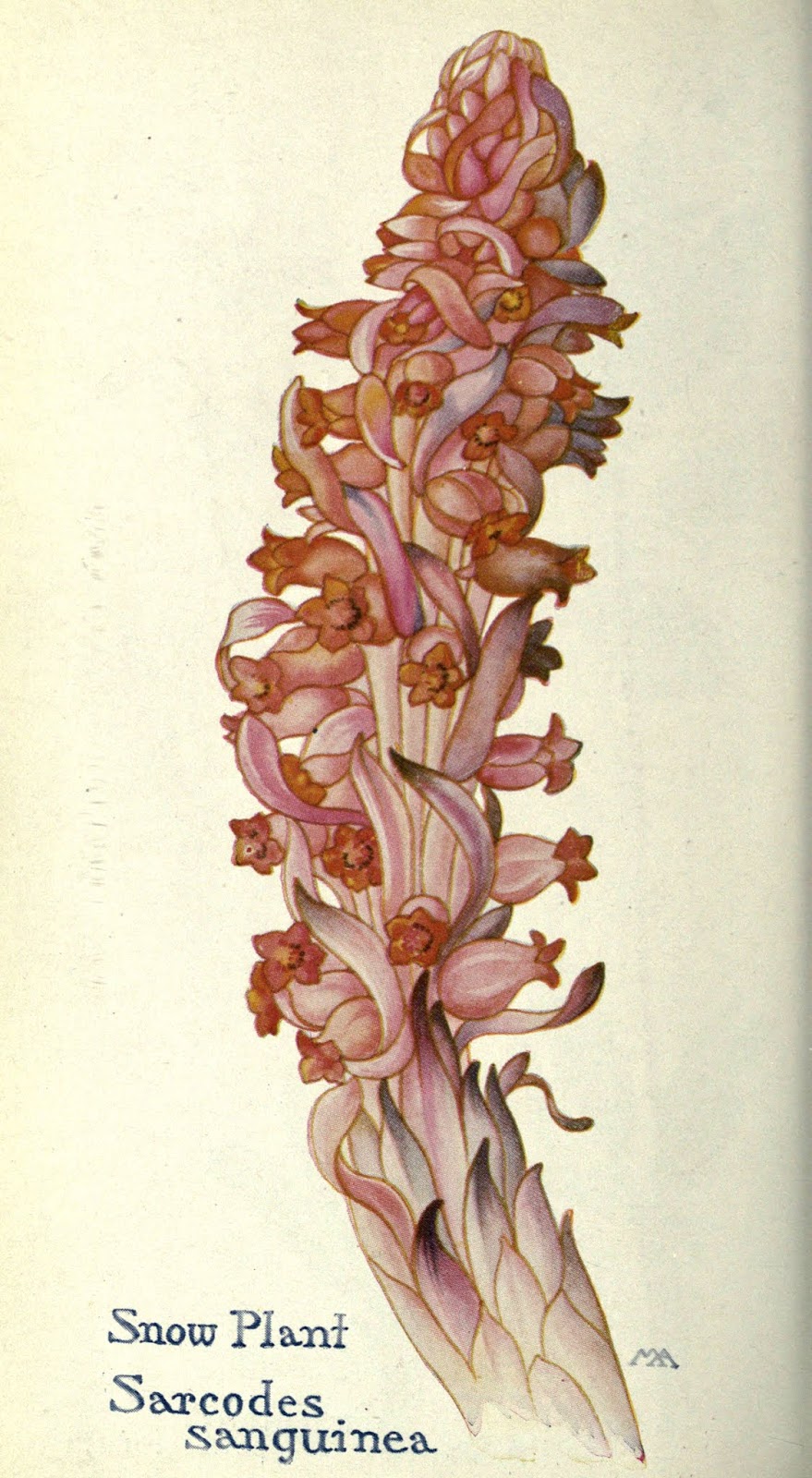
Snow Plant, Sarcodes sanguinea, is “a strange plant, widely celebrated for its peculiar beauty … The plants are shaded with red all over, from flesh color, to rose, carmine, and blood-red, and are translucent in texture, so that when a shaft of sunlight strikes them they glow with wonderful brilliance, almost as if lighted from within. …They are pointed out to tourists by Yosemite stage drivers, but the government forbids their being picked, for fear of extermination.”

Indian Pipe, Monotropa uniflora, is “all translucent white, beautiful but unnatural, glimmering in the dark heart of the forest like a pallid ghost, mournfully changing to gray and black as it fades” (source).
Monotropa uniflora (source).

Armstrong was quite impressed by this cholla, Opuntia fulgida—now called jumping or chain fruit cholla, Cylindropuntia fulgida. “A horrible shrub, or dwarf tree … The distant effect of this plant is a pale, fuzzy mass, attractive in color, giving no hint of its treacherous character more like a wild beast than a plant! The joints suggest a very ferocious chestnut-burr and break off at a touch, thrusting their spines deeply into the flesh of the unwary passer-by, so that the Indian story, that this plant flings its darts at wayfarers from a distance, might almost as well be true, and the barbs making the extraction difficult and painful.” (source).
Cylindropuntia fulgida (source).

I learned of Margaret Armstrong and her wildflower book only recently, by way of Flickr where the color plates have been uploaded by Biodiversity Heritage Library. They’re available for download, are copyright-free, and have been tagged (partly by yours truly) so that they will come up in searches (scientific name, common name, artist name and more). If you’re looking for a fascinating citizen science opportunity, checkout BHL on Flickr for more information.

Notes

(1) The Coast Range Mariposa Lily, Calochortus vestae, was C. luteus var. oculatus in Armstrong’s day. She considered mariposa lilies to be the most characteristic flowers of the West. “They grow freely all through the West, as far north as British America, and down into Mexico, but they never get east of Nebraska, so these gay and graceful flowers may be considered the peculiar property of the West.” C. vestae was “one of the most beautiful of all the Mariposas.”

(2) Armstrong had no formal training in botany.

(3) Armstrong and her companions are sometimes referred to as the first white women to reach the bottom of the Grand Canyon. But from her account of the trip, it’s clear that others had gone before. She included a story told by their guide of a female tourist who refused to ride back up to the rim, and had to be hauled out on a litter.

(4) In her Preface, Armstrong states that hers “is the only fully illustrated book of western flowers, except Miss Parsons's charming book, which is for California only” (Wild Flowers of California by Mary Elizabeth Parsons, 1900). She doesn’t mention Rocky Mountain Flowers by Frederic and Edith Clements, published in 1914—possibly too late to be noted in her book. In any case, Armstrong didn't include species found only in the Rockies.

(5) Armstrong recruited a small army of botanical experts for help with identification and nomenclature. In her acknowledgements, she noted that “Professor J. J. Thornber, of the University of Arizona, is responsible for the botanical accuracy of the text and his knowledge and patient skill have made the book possible.” She thanked eight experts on the flora of the western United States for “most valuable assistance in the determination of a very large number of specimens …” and eight others for advice and assistance (including luminaries such as Alice Eastwood, WL Jepson, Marcus Jones and NL Britton).

Sources

Armstrong, Margaret. 1912. “Canyon and Glacier” in The Overland Monthly ser. 2 v. 59. Available here courtesy HathiTrust.

Armstrong, Margaret. 1915. Field book of western wild flowers. London,C. [sic] P. Putnam's Sons. Available here courtesy Biodiversity Heritage Library.


Wednesday, March 21, 2018

Tagging Edith Clements’s Art

“If it succeeds in opening the eyes of the passer-by to an appreciation of the flowers by the way, or in further stimulating an already awakened interest, it will have served its purpose.” Edith S. Clements, March 30, 1915


I wish I could tell Dr. Clements what I’ve been doing. Given her desire to share the joy of wildflowers, I think she would be pleased. She’s been dead for 47 years now, but if she lingers in spirit, I bet she’s not the least bit upset that I’ve been tagging her paintings.

I should explain … I do not scribble graffiti across them. Rather I mark them subtly with names in Latin and English, visible only in response a cursor. I’m a citizen scientist, part of a crowd sourced to tag (label) Flickr photos uploaded by the Biodiversity Heritage Library. It’s a symbiotic relationship. I supply tags, and BHL indulges my interest in scientific explorers of the American West, in this case, Edith Schwartz Clements.

Edith was one half of Clements and Clements, the other being her husband, Frederic. They met as students at the University of Nebraska, Lincoln. Both graduated in 1898—Frederic with a doctorate in botany, Edith with a bachelor’s degree in German. She then went on to obtain a doctorate in botany while minoring in Germanic philology and geology.

Edith and Frederic married in 1899, starting a long life of botanical collaboration in the American West. They would become known as pioneering plant ecologists, ardent proponents of ecological succession, and plant communities associated with specific habitats—controversial concepts then as well as now.
The Clementses in the field; note ghostly third person mid photo (American Heritage Center).
Their botanical interests extended beyond research. Edith, especially, wanted to raise awareness of and appreciation for native plants. Toward this end, they published plant identification guides aimed at both professional field botanists and plant lovers in general (1). The first was Rocky Mountain Flowers; an illustrated guide for plant-lovers and plant-users (1914, 2nd ed. 1920). The format is familiar to today’s botanists: a key to plant families; then within each family a description followed by a key to genera; and within each genus a description followed by a key to species. But there’s more. Hoping to make the book more useful and appealing, the Clementses included illustrations. The result is remarkable. With each color plate, the dull botanical text gives way to exuberant life.
A multitude of gentians.
Members of the snapdragon, bladderwort and broomrape families.
The color plates are both functional and artistic, with plant parts accurately portrayed, and multiple species beautifully arranged.
Orchids and irises.
Line drawings were used where color would be a waste of effort and cost, e.g., for the goosefoot family with its small inconspicuous flowers.
The goosefoot family (Chenopodiaceae, now part of Amaranthaceae).
In the bottom right corner of each plate (click on images to view) is the name of the artist—Edith S. Clements. Her role as illustrator is not mentioned elsewhere in the book. Were the Clementses concerned that Frederick would be considered the author, and Edith relegated to illustrator?

Edith obviously was a skilled artist (2), but I’ve yet to find anything about her training. Perhaps drawing and painting came naturally. In her memoir, Adventures in Ecology: half a million miles, from mud to macadam, she occasionally mentions botanical illustration, but gives no details as to how she started.
“Nor did it take long [after marriage] to discover that my skill with pencil and brush could be turned to good account in laboratory studies of plant life …”
Photo provided by Jon Obert (pers. comm.).

A year after the first edition of Rocky Mountain Flowers appeared, the 25 color plates—175 “of the most beautiful and striking flowers of the mountains and plains of the West”—were published as Flowers of Mountain and Plain (1915), with Edith as author. This book was “intended primarily for travelers and flower lovers who wish a short cut to recognizing flowers seen on excursions or from car windows. It may also serve as a souvenir of pleasant summer days or vacation trips.”

The format was simple: colored plates and corresponding lists of plant names. Five years later, an enlarged second edition was released, with species descriptions added.
Primrose, Primula Parryi (Plate 16, fig. 3) The red-purple blossoms of this Primrose grow in large, loose clusters on stems 6 in.-2 ft. tall. The plants are strong-scented and are found hidden away in alpine rock-clefts or along subalpine torrents at 9000-14000 ft. They bloom in early and midsummer and have a fragrance very like musk. The flowers are large and resemble those of the cultivated primroses.
Members of the primrose, wintergreen and heath families; Parry’s primrose upper left.

I discovered Flowers of Mountain and Plain while browsing the Flickr photostream of the Biodiversity Heritage Library. BHL is a consortium of the world’s leading natural history libraries, which have been digitizing their public domain holdings documenting the world’s biological diversity. The collection includes many old books and journals often difficult to access in the non-digital world. This is a fantastic resource given my interest in scientific exploration of the American West.

BHL holdings can be searched, which is extremely useful. But this generally applies only to text. The wealth of illustrations—works of art in many cases—are not always easy to discover within a particular volume. To facilitate access, and to raise awareness of what BHL offers, illustrations are being uploaded to Flickr. The BHL photostream now includes more than 120,000 images, emphasizing “historic illustrations created through traditional printing techniques.” All are available for free download and re-use.

However, photos alone won’t solve the access problem. Users still need a way to find what they want among many thousands of images. To help, BHL has created themed collections, and has turned to crowdsourcing, enlisting citizen scientists to tag (label) images with names and more.
“Ever wanted to take a break and scan through some of the cool images of flora and fauna in the BHL collection? With the BHL Flickr account, you can! … By volunteering to help us tag images, you'll be helping to transform biodiversity research.” (more at BHL on Flickr and this tutorial).
Tagging BHL plant illustrations generally is straight-forward. For the species featured, find the scientific name, perhaps on the plate itself or in the associated text, and add it as a tag; add one for common name if known; add one or more tags for geographic information; and so forth (3). Edith Clements’s illustrations provide an extra challenge because each plate includes multiple species. But BHL has an easy way around this. First, mark a single plant with a box, then add tags to the box. All tagging steps are clearly explained in the tutorial.
When the cursor moves over a box, tags are revealed—in this case for the Silvery Lupine.


If Edith Clements were with us today, I’m sure she would be thrilled that BHL has put her paintings online, and is recruiting citizen scientists to tag them (4). What a wonderful convergence of missions past and present! Clements was determined to share with the general public the beautiful and fascinating diversity of native plants, and BHL and its volunteer taggers are doing just that. As a grant reviewer noted: “They wish to realize (using contemporary technologies and media) what these 18th to early 20th century naturalists originally intended – a searchable, visual inventory of all things in the natural world, here in the form of botanic illustrations.”

Rocky Mountain bee plant, Cleome (Peritoma) serrulata.


Notes

(1) In addition to books mentioned here, the Clementses authored Flowers of Coast and Sierra (Edith, 1928) and Flower Families and Ancestors (Edith and Fredric, 1928).

(2) National Geographic published two articles featuring Edith Clement’s wildflower paintings and descriptions, a testament to her skill: “Wild Flowers of the West” (May 1927) and “Flower Pageant of the Midwest” (August 1939).

(3) BHL encourages taggers to use machine tags where applicable: “… a machine tag is a tag with special formatting to allow it to be read by computers.” With machine tags, BHL Flickr photos can be harvested and used by other biodiversity databases, for example the Encyclopedia of Life. More information available here and in the BHL tagging tutorial.

(4) BHL needs biodiversity taggers! No experience required—taggers range from fledgling citizen scientists to professionals. The collections include all kinds of organisms, so you can work on your favorite critters. For more information, see this BHL post about tagging.

Sources

Thanks to Jon Obert for detailed biographical information about Edith Clements (summarized in blog post listed below). Thanks also to Grace Costantino, Biodiversity Heritage Library Outreach and Communication Manager, for answers and explanations regarding BHL’s Flickr project.

Clements, Edith S. 1920 (2nd ed., enl.). Flowers of mountain and plain. New York: H.W. Wilson Co.
BHL: http://www.biodiversitylibrary.org/bibliography/62285#/summary
BHL Flickr: https://www.flickr.com/photos/biodivlibrary/sets/72157632108046380/

Clements, Edith S. c1960. Adventures in ecology: half a million miles: from mud to macadam. New York: Pageant Press. Free online, HathiTrust Digital Library, https://catalog.hathitrust.org/Record/001493487

Clements, Frederic E., and Clements, Edith S. 1920 (c1914). Rocky Mountain flowers: an illustrated guide for plant-lovers and plant-users. New York: H. W. Wilson.
BHL: https://www.biodiversitylibrary.org/bibliography/62488#/summary
BHL Flickr: https://www.flickr.com/photos/biodivlibrary/albums/72157627850875157

Oberg, Jon H. 2013 (May). Nebraska Hall of Fame, Part II: Edith Schwartz Clements. Three Capitals, http://viewfromthreecapitals.blogspot.com/2013/05/nebraska-hall-of-fame-part-ii-edith.html

Rehbein, A. 2017. How do you solve a problem like illustrations? NDSR at BHL. https://ndsrbhl.wordpress.com/2017/03/27/how-do-you-solve-a-problem-like-illustrations/