Showing posts with label Nuttall. Show all posts

Sunday, December 8, 2024

Osage Orange—God's Gift to the Prairie Farmer

"this curious fruit, which, when first discovered lying neglected beneath the tree, led the voyagers to fear and report it as a poison" wrote Thomas Nuttall (1842). Pete unseth photo.
In March of 1804, Meriwether Lewis, co-captain with William Clark of the Corps of Discovery, stopped at the home of trader Pierre Chouteau in St. Louis (Missouri Territory). The Chouteau brothers were supplying their expedition, which would depart in May, but this visit was for another matter. Lewis wanted to see Chouteau's garden.

President Thomas Jefferson had appointed Lewis expedition botanist. He was to study and record "the soil & face of the country, it's growth & vegetable productions, especially those not of the U.S. and the dates at which particular plants put forth or lose their flower, or leaf" (source). Given this assignment, there was good reason to visit Chouteau. The trader had lived in Louisiana Territory since birth, knew the Osage Indians well, and was familiar with their use of native plants, some of which he had planted in his garden.

Pierre Chouteau; Missouri Historical Society.
Lewis took cuttings from Chouteau's trees, and sent them to Jefferson, with a letter of explanation:

"I send you herewith inclosed, some slips of the Osages Plums, and Apples. I fear the season is too far advanced for their success. Had I earlyer learnt that these fruits were in the neighbourhood, they would have been forwarded at a more proper time ... I obtained the cuttings, now sent you, from the garden of Mr. Peter Choteau (1), who resided the greater portion of his time for many years with the Osage nation ..."

In his letter Lewis also explained the value of the Osage Apple (today's Osage Orange), presumably learned from Chouteau. "So much do the savages esteem the wood of this tree for the purpose of making their bows, that they travel many hundred miles in quest of it." Decades later, the tree would be highly esteemed by farmers as well—on the great sea of grass to the west.

In 1810 or thereabouts, another botanist visited Pierre Chouteau's garden. Thomas Nuttall, recently arrived from England, took a particular interest in the Osage Apple, which had not yet been introduced to science. He published the new species in 1818, naming it Maclura aurantiaca to honor his friend, geologist William Maclure; aurantiaca means orange, referring to the color of the wood. In 1906, this was replaced with the currently accepted name, Maclura pomifera (2).
"The wood is very heavy and of a Saffron yellow ..." wrote Nuttall (1818). Fernando Lopez Anido photo.
Nuttall's description was incomplete. For one thing, he hadn't seen any male flowers (Maclura flowers are unisexual; trees have either male or female flowers). This did not keep him from publishing, for the female flowers, and especially the fruit, are what make the species so distinctive.

Nuttall noted that Maclura's female flowers are arranged in dense globose clusters. Though tiny, each one has a style nearly an inch long. At maturity the 1-seeded fruits of the many flowers in a cluster coalesce into a "compound berry" (now known as a multiple fruit) containing "pulp nearly as succulent as that of an orange, sweetish and perhaps agreeable when fully ripe" (Nuttall also lacked information concerning edibility).

Maclura's female inflorescence of numerous tiny flowers, each with a long narrow style. H. Zell photo.
The Osage Orange is a multiple fruit (Nuttall's compound berry). H. Zell photo.
Multiple seedlings from a multiple fruit. Cbarlow photo.
Thirty years later, Nuttall, by then an acknowledged expert on the North American flora, was engaged in a monumental project—three supplemental volumes to François-André Michaux's North American Sylva (forest trees). Among the added species was Osage Orange. It appeared in the first volume, with a lengthy description and two beautiful plates.
Osage Orange, also called Bois d'Arc meaning Bow Wood (3): branch of a male plant on right, note the stout thorns; female flowers with long styles lower left; source.
Osage Orange; cross-section showing flowers united to form a multiple fruit; source.
Nuttall now had better information about edibility: "The fruit, when ripe, is succulent, has a sweetish but insipid taste, and is somewhat acrid. As far as we know, it is not eaten by any animal" (4). Also of interest (and timely) was an item in his description of the wood: "Another important use of the Maclura ... is that of forming live fences or hedges, for which purpose it is well adapted, as it bears cutting, grows close, and is very thorny."

OSAGE ORANGE—Can any one tell us more of this tree? We are desirous of having our columns made the vehicle for communicating information of any material that may be made valuable for hedging. This tree ... seems well adapted for that purpose; and if any has been used in Missouri or elsewhere, it would be a great favor to have an account of it furnished us. The Prairie Farmer, Vol. 1 No. 1, January 1, 1841.
While Nuttall was finishing his first volume, John A. Wright, a real estate speculator in the muddy young town of Chicago, was pursuing his dream. He wanted to help farmers who were struggling on the great sea of grass stretching a thousand miles to the west—"an open plain, so barren of timber, so huge of expanse as to bewilder, often frighten, them." The accumulated wisdom of settlers in wooded country to the east was of little use. Instead of clearing trees, prairie farmers toiled to break thick tough sod. And in the absence of trees, wood had to be imported at great expense (Lewis 1941).
No trees? Use sod! Soddy (sod house) in 1901; photographer unknown.
The need for helpful information was dire. Toward this end, Wright drummed up financial support for a non-partisan apolitical newspaper specifically for farmers. Though he had never farmed himself, he agreed to be the editor. On January 1, 1841, the first issue of The Union Agriculturalist and Western Prairie Farmer (soon shortened to The Prairie Farmer) was published (5).

On the front page, Wright appealed to readers for help:
TO THE PRACTICAL FARMER—Upon you we must rely for the matter that is to make this paper interesting and valuable. ... What we wish is this—as soon as any one obtains any valuable agricultural information, a recipe, a plan, or any other matter that would be adapted to our paper, that he would sit down immediately and communicate it. In this manner communications will be more to the point than if writers delay till they can collect several facts. ... if as soon as a farmer obtains one fact, he sends it, it will be what we want—"short and sweet."
Wright was well aware that some, perhaps many, would hesitate to contribute:
Many farmers may perhaps decline communicating their knowledge, because they may feel themselves incompetent to write for publication. To such we would say, that we most earnestly request you to send us articles, and should there be a word mis-spelt, or a sentence that might be improved by a little alteration, we will use our endeavors to make it right. What we want are facts—and perhaps a fact a farmer might possess, and which he declines sending, because he may perhaps not have enjoyed advantages of education in early life, might be of more service to the West, than all the matter we might publish in several numbers [issues].
Among Wright's passions was fencing, understandably. One of the biggest problems farmers faced was marauding wildlife and livestock. The cost of imported wooden fence was prohibitive and wire fences of the day—horizontal unarmed strands—were ineffective. So farmers tried hedges, also called living fences. Wright had read in the Hartford Silk Culturalist that Osage Orange trees made excellent hedges, and included that article in his paper. The final sentence was especially persuasive:
On the best authority, I am assured that the trees of the Osage Orange, when set at the distance of fifteen inches asunder, make the most beautiful as well as the strongest hedge fence in the world through which, neither men nor animals can pass.

Osage Orange—gift from God? JM DiTomaso photo (CC 3.0)
Osage Orange was soon a hot topic, with readers begging for information on where to buy viable seed and young plants. Fortunately Professor JB Turner of Illinois College had taken an interest. In the 1830s he had crossed "these beautiful prairies for some thousands of miles on horseback" concluding that whoever produced cheap effective fencing would go down in western history as the "greatest moral, intellectual, social and pecuniary benefactor." Perhaps in hopes of being that benefactor, Turner began a study of Osage Orange, periodically reporting his progress in The Prairie Farmer.

By 1848, Turner was convinced that "the Osage Orange is the shrub that God designed especially for the purpose of fencing the prairies." That November he announced he had plants for sale. He didn't know the exact price, but estimated a hedge 80 rods long (c. 1300 ft) would cost less than $15. By 1853 the price had dropped to $25 per mile, while a wooden fence "would cost $300 a mile and would be gone in 12 years" [due to prairie fires].

But in spite of its many advantages and perhaps divine origin, the Osage Orange hedge fell out of favor after just thirty years, a victim of innovation. JF Glidden of DeKalb, Illinois, had come up with a clever solution for wire fencing—barbs. Business took off immediately. The year after it started as a one-man operation, 70 men were producing three tons of fencing per day! (PF May 1875).

Both cheap effective wire fences and Osage Orange seeds were available in February 1875.

Note the clever design—"two No. 12 wires on one of which are wound the barbs ... they are then twisted holding the barbs immovable in their places" (May 1875).

Many hedges were removed and replaced with barbed wire. Others were simply abandoned. But Osage Orange trees did not disappear. Some were scavenged for fenceposts ...

Maclura posts are dense, strong, and resistant to rot and insects. Original source unknown.
... and Osage Orange hedges are still planted ...
Maclura hedge in Primorsko, Bulgaria; photo by Katya.
... and the legacy of the prairie farmers' blessing is still with us.
Thanks to prairie farmers, Maclura pomifera (dark green) occurs far beyond its original range (light green); from USDA, and Nelson et al. 2014 (6).

Notes

(1) Chouteau signed his letters apropos the recipient—Pierre Chouteau, Pedro Chouteau, and Peter Chouteau for French, Spanish, and English speakers.

(2) Osage Orange has a complicated nomenclatural history. It was first published in 1817 as Ioxylon pomifera by French naturalist Constantine Samuel Rafinesque, who then made a series of name changes: Toxylon pomiferum in 1818, Joxylon pomiferum in 1819. In the meantime Thomas Nuttall named it Maclura aurantica (1818). This became the accepted name perhaps because of Nuttall's greater botanical stature. In 1906 it was renamed M. pomifera, perhaps related to Rafinesque's first-published name. See Smith 1981. Further complications can be found in Reveal & Musselman.

(3) Maclura pomifera has many common names, including Osage Orange, Hedge Apple, Yellow Wood, Monkey Brains, Bow Wood, Bois d'Arc, Bodark and more.

(4) While Osage Orange pulp isn't edible, the seeds are. From Mike on Flickr: Osage orange trees are a magnet for squirrels. They typically sit on the ground at the base of the tree, or on a wide branch up in the tree to disassemble their prize, getting at the seeds. Piles of shredded hedge apples are a sure sign of squirrels in the area. The seeds are edible by people, but one must do like the squirrels, and remove the slimy husk to pick them out of the pulpy fruit.

(5) The Prairie Farmer is still being published, including a digital edition.

(6) The native range of Maclura pomifera is debated and probably irresolvable (Smith 1981).

Sources in addition to links in post

Earle, AS, and Reveal, JL. 2003. Lewis and Clark's Green World; the expedition and its plants. Farcountry Press.

Foley, WE. 1983. The Lewis and Clark Expedition's silent partners: the Chouteau Brothers of St. Louis. Missouri Historical Review 77:131–146. SHSMO

Lewis, L. 1941. Prairie Farmer, its beginnings. Prairie Farmer 11:5–17 (centennial edition). Illinois Digital Newspaper Collections.

Michaux, F-A, Nuttall, T, Hillhouse, AL, and Redouté, PJ. 1842. The North American Sylva; or, A Description of the Forest Trees of the United States, Canada, and Nova Scotia ... Vol. 1. BHL

Nelson, G, et al. 2014. Trees of Eastern North America. Princeton University Press.

Nuttall, T. 1818. The genera of North American plants and a catalogue of the species, to the year 1817 [Maclura 2:233]. BHL

Rafinesque, CS. 1817. Description of the Ioxylon pomiferum, a new genus of North American tree. American Monthly Magazine and Critical Review 2:118–119. Google Books

Reveal, JL, and Mussulman, JA. The Osage Orange; Maclura pomifera, in Discover Lewis & Clark (Lewis & Clark Trail Alliance). Accessed December 2024.

Friday, August 28, 2015

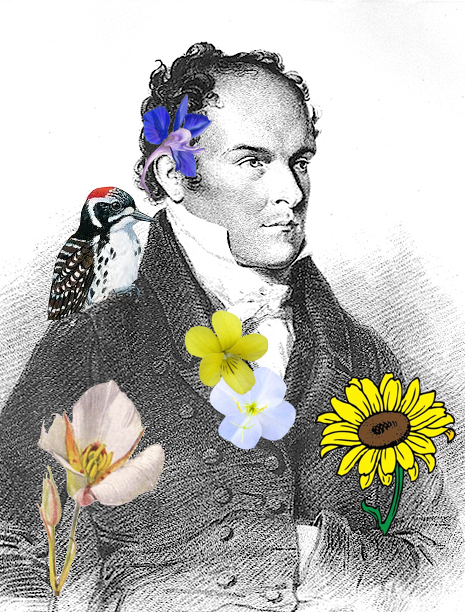
Mr. Nuttall and his violet, his lily, his larkspur, his sunflower, his evening primrose, …

Thomas Nuttall, the great 19th-century naturalist.
“The Pilgrim’s crew christened Mr. Nuttall “Old Curious” from his zeal for curiosities, and some of them said he was crazy, and that his friends let him go about and amuse himself in this way.”  William Henry Dana, Two Years before the Mast
In the 19th century—the golden era of natural history—North America was inhabited by two species of botanists.  “Plant men” thrived in the paradise that was the American West, an unexplored land where potential for discovery seemed endless.  They roamed the plains, mountains, and deserts in heat, cold and rain—sick, lost or half-starved—collecting plants.  They especially hoped for novelties, species new to science.
“We plant men climb along the water courses and tramp along the clefts looking for plants that we, and hopefully the esteemed Dr. Gray, have not seen before … When we spy a bright red mimulus that we hope is different from all the others, we kneel by it, as if in prayer, and dig it up carefully down to its very bottom root.  We carefully shake off the dirt and when possible wash it clean.  Then we put it in our container called a vasculum and sling it over our shoulder.” (unknown collectors, in Nilsson 1994)
Plant men carefully pressed and dried their collections, and sent them east to members of the second species—“closet botanists” (such as the “esteemed Dr. Gray” mentioned above).  These were experts in plant classification, usually associated with academic institutions, with the requisite education to identify plant species and recognize any new to science—even though they may never have set foot west of the Missouri River.  A novelty was cause for celebration … and a publication, in which the closet botanist described and named the new species, sometimes after the plant man who had found it.
Nuttall’s sunflower (Helianthus nuttallii), named by closet botanists John Torrey (Columbia) and Asa Gray (Harvard).  Sally & Andy Wasowski, Lady Bird Johnson Wildflower Center.

But just as plants will sometimes do, some 19th-century botanists confounded the classification.  Thomas Nuttall especially blurred the distinction between collector and expert—between plant man and closet botanist.

He came to the United States from England in 1808, at age 22, to work as a printer.  But he soon met botanist Benjamin Smith Barton of the University of Pennsylvania, who convinced Nuttall to work in his herbarium and make collecting trips west.
Nuttall’s violet (Viola nuttallii), named by Frederick Pursh, who also worked for Barton.  Source.
In 1810, Barton paid Nuttall $8 per month plus expenses to travel and collect as far as the Great Lakes.  But then, instead of returning home, he went to St. Louis, and in the spring of 1811, traveled up the Missouri River with a party of Astorians.  The voyageurs called him “le fou”—the mad one—for his single-minded preoccupation with plants.

In 1816, Nuttall went down the Ohio River and collected through Kentucky and Tennessee to the Carolinas, traveling on foot.  In 1818 and 1819, he headed down the Ohio and Mississippi to collect in today's Arkansas and Oklahoma—a journey of 5000 miles at his own expense.  He published A Journal of Travels into the Arkansas Territory in 1821.
“For nearly ten years I have travelled throughout America, principally with a view of becoming acquainted with some favourite branches of its natural history. I have had no other end in view than personal gratification, and in this I have not been deceived, for innocent amusement can never leave room for regret. To converse, as it were, with nature, to admire the wisdom and beauty of creation, has ever been, and I hope ever will be, to me a favourite pursuit.”
Nuttall's larkspur, Delphinium nuttallianum.

Naturalists of the 19th century were regarded as eccentric.  Consider the stereotypical Dr. Battius, created by James Fennimore Cooper in The Prairie.  In the midst of a skirmish, Battius caught sight of a new plant and forgot the danger at hand, oblivious “to everything but the glory of being the first to give this jewel to the catalogues of science.”

But Thomas Nuttall was exceptional, even in this context.  The most common story tells of him digging up plants with his rifle (while inspecting firearms, the expedition leader found the barrel of Nuttall’s to be full of dirt).  It seems he got lost, sick or desperately hungry on a regular basis—often saved by fortuitous encounters with other adventurers.
“Delighted with the treasures, he [Nuttall] went groping and stumbling along among a wilderness of sweets, forgetful of everything but his immediate pursuit.  The Canadian voyageurs used to make merry at his expense, regarding him as some whimsical kind of madman.”  Washington Irving, The Astorians.
Nuttall’s evening primrose (Oenothera nuttallii) greets me every morning in summer.

Nuttall took a sabbatical from field work in 1822, when Harvard University offered him a position as instructor of natural history and curator of the botanical gardens.  Because Nuttall had no formal education in botany, the university was able to replace a deceased professor at only $700 per year, quite a bargain.  There was no suitable botany textbook, so Nuttall wrote one:  Introduction to Systematic and Physiological Botany.  He also wrote a Manual of Ornithology while he was at Harvard, a compact field guide to birds (he was a self-taught and widely-recognized expert in both botany and ornithology).

As an instructor, Nuttall was well-liked, perhaps because his classes included field trips.  One of his students was William Henry Dana, quoted at the beginning of the post.  As a sailor, Dana met up with Nuttall many years later in California, on a ship bound for Boston.
Nuttall’s woodpecker (Picoides nuttallii) was named by William Gambel.  Gambel’s oak (Quercus gambelii) was named by Thomas Nuttall.  The two were good friends.  Source and source.

By 1833, Nuttall was restless.  When invited to join an expedition across the Rocky Mountains to the Columbia River and the Pacific, he abandoned Harvard.  He in turn invited his friend, John Kirk Townsend, a young ornithologist who also was eager for adventure.  Townsend kept a diary, which became Across the Rockies to the Columbia (1839).  He greatly admired Nuttall’s dedication—for example when plant specimens were soaked in a bad storm, and had to be re-dried:
“In this task he exhibits a degree of patience and perseverance which is truly astonishing; sitting on the ground, and steaming over the enormous fire, for hours together, drying the papers, and re-arranging the whole collection, specimen by specimen …  I have had constantly to admire the ardor and perfect indefatigability with which he has devoted himself to the grand objects of his tour.  No difficulty, no danger, no fatigue has ever daunted him, and he finds his rich reward in the addition of nearly a thousand new species of American plants, which he has been enabled to make to the already teeming flora of our vast continent.”
Nuttall found this sego lily in the Valley of Salt Lake (Utah).  John Torrey named it Calochortus nuttallii.  Source.

Was Thomas Nuttall mad or was he blessed?  I say blessed.  In fact ... to have that kind of passion and purpose in life is to be exceptionally blessed, especially in a paradise like the American West of the 19th century.  Nuttall agreed:
“How often have I realized the poet’s buoyant hopes amid these solitary rambles … For thousands of miles my chief converse has been in the wilderness with the spontaneous productions of nature; and the study of these objects and their contemplation has been to me a source of constant delight … privations to him [the naturalist] are cheaply purchased if he may roam over the wild domain of primeval nature”  Thomas Nuttall, autobiographical preface to The North American Sylva, 1853
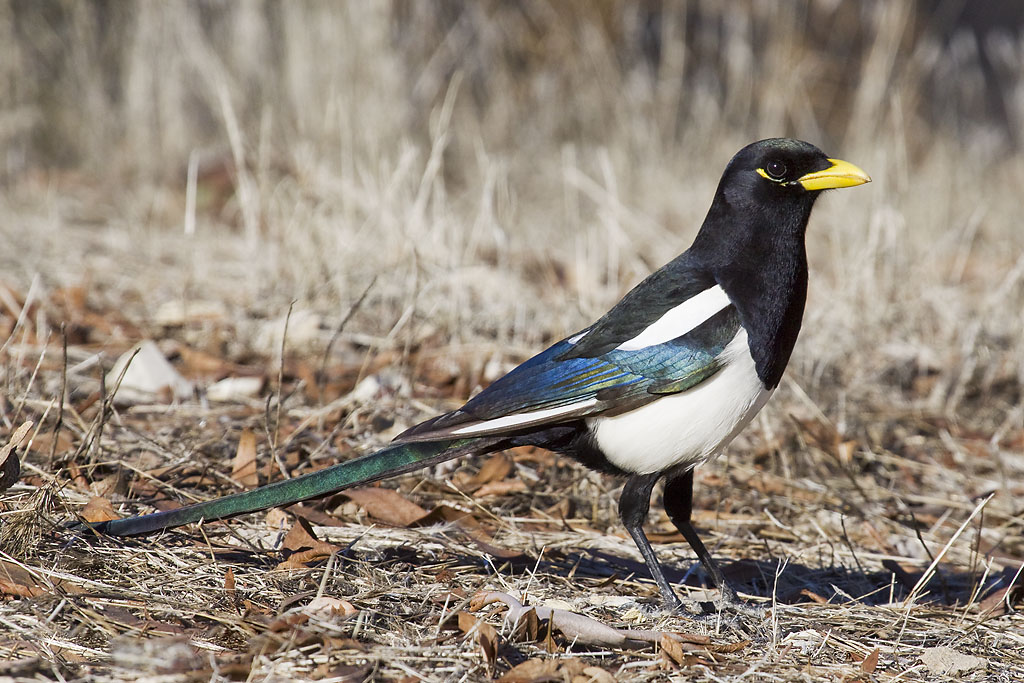
Yellow-billed magpie, named Pica nuttallii by John James Audubon:  “I have conferred on this beautiful bird the name of a most zealous, learned and enterprising naturalist, my friend Thomas Nuttall”  Source.

UPDATE:  "2461 species of plants alone that he authored or co-authored"—as Pat points out in his Comment.  An amazing contribution!  Pat also provides a link for access to most of the books mentioned above, through the Biodiversity Heritage Library ... see Comment below.


Sources (in addition to links in text)

Evans, HE.  1993.  Pioneer naturalists:  the discovery and naming of North American plants and animals.  Howard Holt & Co.

Nelson, J.  2015 (May-June).  Thomas Nuttall, brief life of a pioneering naturalist.  Harvard Magazine. 

Nilsson, KB.  1994.  A wild flower by any other name:  sketches of pioneer naturalists who named our western plants.  Yosemite Association.

Williams, RL.  2003.  “A region of astonishing beauty”—the botanical explorations of the Rocky Mountains.  Roberts Rinehart Publishers.