Showing posts with label Crataegus. Show all posts

Wednesday, November 10, 2021

Treefollowing: Wordless Wednesday (nearly)

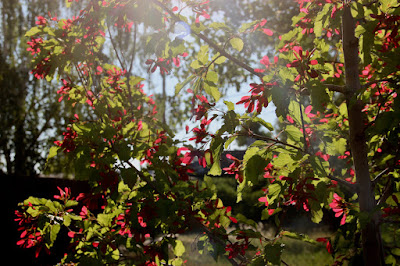
Flash the maple is thick with dried samaras.
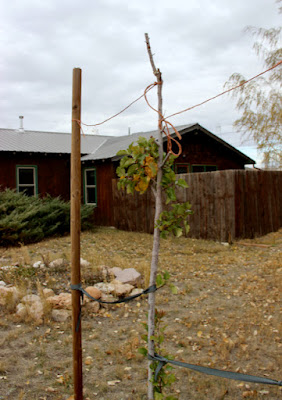
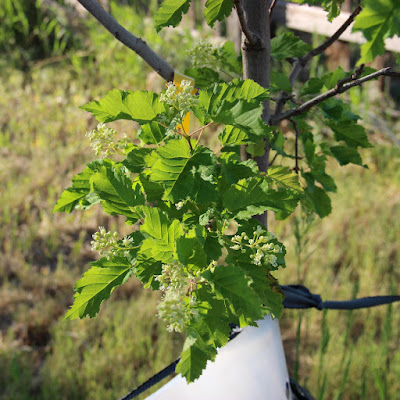
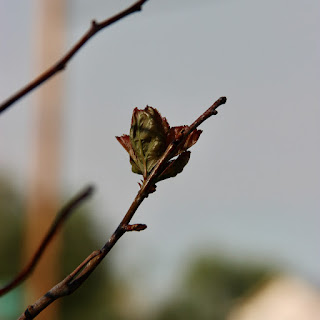
Spike the hawthorn still sports a bit of red and green.

~🍂~


Though the beech is golden
I cannot stand beside it
mute, but must say

"It is golden," while the leaves
stir and fall with a sound
that is not a name.

It is in the silence
that my hope is, and my aim.
...
The Silence by Wendell Berry


This is my brief contribution to November's gathering of Treefollowers. Consider joining us—as you can see, it doesn't have to be a lot of work. Photos would have been enough, but like Berry, I "must say".


Tuesday, October 12, 2021

Tree Following & other news from the yard

I asked my young trees, "What does the future hold?" But all I heard was wind in the leaves.
From a distance, it looked like Flash the maple and Spike the hawthorn hadn't changed much in the two weeks I was gone. However, up close I could see the growing season is winding down. Maple leaves are ragged and dry, and hawthorn leaves are beginning to turn red and yellow. Snow and cold are in the forecast this week, but by next Sunday we're to be back to 60Âș F. I bet the hawthorn will keep some green leaves, and photosynthesize for awhile longer.

Flash, the Hot Wings Tartarian Maple, has been red for months.
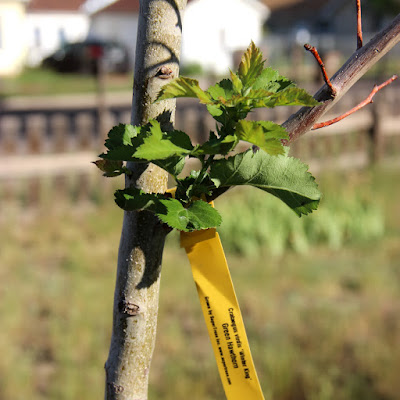
Spike, the Winter King Hawthorn, gave life another try this year. Best wishes!

Hawthorn leaves are finally starting to turn.
Other News

Laramie had hard frosts while I was gone, and my native wildflower beds are mostly brown. But there are flashes of color here and there.

Bachelor's button and an unknown-to-me orange-rayed member of the daisy family are non-native annuals common in our native wildflower mixes. They bloom the first year after planting, and a few sometimes grow from seed after that, but not for long.
This little white-flowered member of the mustard family is new to me. It started blooming in the last few weeks. I also saw it in a rocky drainage on the prairie east of town a few days ago. I hope it survives long enough to produce fruit, which are required for identifying many mustards with confidence. Or do you know it?
Flowers are about 5 mm across.
Firewheel/blanketflower/gaillardia is the toughest of the wildflowers in the yard, always blooming longest and latest. Nice color, but it's looking a bit ragged.
Protected by a fence, this black-eyed susan is very much alive, with its dark disc flowers still opening, progressing from outside in.


This is my contribution to the October gathering of treefollowers, kindly hosted by The Squirrelbasket. Want to try it? More info here. By the way, it's easy and stress-free!

Monday, September 13, 2021

Green and Red; Stipules and Suckers

In the foreground is skinny Spike, the hawthorn. Behind is Flash, the maple (red canopy).
Since my last report, there has been only a little change in the trees I'm following. Flash's canopy has become even more red, though we've had nothing close to a frost. Spike is still a skinny odd-looking "tree".

Flash has only a few green leaves. The foliage is pretty ragged all in all.
When backlit, the aging samaras (keys) are still beautiful.
For Spike, it is the young leaves that are reddish. The rest are still green.

Now, for botany nerds ...

This month, Spike brought up several botanical terms which I "know" but not really; terms I've heard and even used for decades, but when pressed to explain, can't. At least not confidently. So I asked Google, the expert on everything (we hope).

Stipule: "an outgrowth typically borne on both sides (sometimes on just one side) of the base of a leafstalk (the petiole). Stipules are considered part of the anatomy of the leaf ..."

If you like order, stipule classification is for you! There are types based on many different characteristics, such as duration, shape, size, position, modification, and more. I preferred the summary of function: "Stipules have various functions. Some stipules are not well understood or may be vestigial." This is the way I feel about many things these days.

This hawthorn has foliaceous stipules, i.e., similar to leaves. Being green, perhaps they contribute to photosynthesis—the business of making energy for the tree. I would guess Spike could use the help, having recently recovered from near death. And maybe this is why stipules are more prominent on the suckers (the next topic).

Enlarge to see stipules at base of leaves.
Suckers seem to be universally despised, according to Google. For example, "young stems sprouting from the base or from a spot on the trunk ... are called suckers, because they zap water and nutrients from the main tree. As suckers are unhealthy for trees and they are unsightly, it’s important to know how to eliminate them ..." More here.

The Wikipedia article about Plant Development is more open-minded (see Adventitious structures; Buds and shoots). "Adventitious buds [buds that develop in unusual locations on the plant] are often formed after the stem is wounded or pruned. The adventitious buds help to replace lost branches." I agree! Adventitious shoots are very helpful in this situation.


This is my September report for the monthly gathering of tree-followers kindly hosted by The Squirrelbasket. Worried about another long covid winter? Consider joining us. Tree-following is a good diversion, even in winter, and it's stress-free! More information here.

Saturday, August 14, 2021

Tree-following: Red and Green


Both trees I'm following this year are red and green, but in different ways. Last month, Flash the maple was covered in green leaves and red samaras. The samaras are still red but looking duller. And the leaves are starting to turn red. It hasn't been cold, not even close. Could this be due to heat and smoke? Or maybe just normal life for Flash.

Spike the hawthorn still has rich green leaves, while the young emerging leaves are reddish. No flowers or fruit this year, but that's fine. Having nearly died (or so it looked!), Spike is to be commended for the healthy shoots and foliage.

Fresh young hawthorn leaf, with ant.


This my contribution to the August gathering of tree-followers. Thanks to The Squirrrelbasket for hosting!

Tuesday, July 13, 2021

Christmas in July and a Surprise!

Hotwings Maple indeed!
Flash, the maple, is looking very Christmasy, with a canopy of green leaves and red samaras (aka keys or whirlybirds).

The big surprise is Spark, the hawthorn, which I thought was dead last month. It's definitely alive! It has put out shoots along the trunk, from buds likely activated by damage to the upper part of the tree (which still looks quite dead).

Leafy shoots are clearly visible at the base of the dead crown. See the one below the lower tie?

There are quite a few shoots emerging, all the way to the base.
Always a fan of the underdog, I told the city arborist that I want to keep this tree ... or maybe now a bush.
Beginnings of a bush?

This is my contribution to the July gathering of tree-followers, kindly hosted by The Squirrelbasket. More news here.

Monday, June 14, 2021

Tree-following: first the good news

When I returned from my trip, I found that in just two weeks, Flash, the maple, had gone from no leaves to all leafed out, and its flower buds were opening!

But Spike, the hawthorn, is nearly bare. It has just one sickly cluster of leaves. The City arborist is to check our trees in July, and I will get the official determination then. But I'm sure this tree is done for. Last year we were told there was no guarantee on the trees. So if I want a replacement, I will have to buy one.

This is my short just-in-time report for June. Check the latest tree following news. And consider joining us, it's interesting and fun (but sometimes there's bad news).

Sunday, March 14, 2021

Tree-following: Let it Snow!!


Two days ago, I took a few photos of Flash and Spike, the trees I'm following this year. As you can see, there's nothing left of the little bit of snow that was on the ground a month ago. It's been dry, dry, much too dry!! My too-big-to-water yard is covered in native grasses adapted to xeric conditions: western wheatgrass, alkali sacaton, prairie saltgrass. Even they are struggling after several years of drought. But they're tough. One day, their normally vigorous selves will return.

I water the young trees whenever temps rise above 40Âș F, to encourage root growth. But there are no obvious changes above ground, it's too early. So I checked their twigs to identify them using buds and scars. Of course I already know what they are. This was a chance to examine features I usually ignore.

I pulled the Winter Tree Finder out of my stack of tree-finders. These are dichotomous keys at their best—simple and fun. One got me hooked on tree id 50 years ago. With the handy twig diagram and friendly descriptions, I was able to find the various buds and scars, and make my way through the key.


For Spike, I didn't get beyond p. 4: "Sometimes a conspicuous feature ... makes identification easier." There were just two candidates with conspicuous thorns, Honey Locust (nope) and Hawthorns (yes), p 21, where I stopped because: "Hawthorns are far too numerous to cover here."
Spike the Hawthorn, with conspicuous thorns and alternate lateral buds.

With Flash, I made good use of the key, moving smoothly through the dichotomous questions. Tree a conifer or not? NOT. Leaf scars alternate or opposite? OPPOSITE. This year's twig more or less than ¼ inch wide? LESS. Leaf scars narrow, inconspicuous, with 3 bundle scars? YES. Terminal bud egg- or cone-shaped? YES. "It is a MAPLE, go to p 48" where I landed amid many maples, none of which grow here (the book covers midwestern and eastern North America).

Unfortunately, the buds and scars of the slender twigs were hard to photograph even though the wind was just a gentle breeze. I didn't dare cut twigs to photograph inside ... these young trees look like they need every twig they have. Here is my best shot, in fact, my only decent one.

Flash the Maple.

I waited until this morning to post, as I was hoping the weather forecast was correct. It was close! Now the scene is very different. The snowfall is going to be "absolutely historic" according to the weather news. If that's the case, then I must be prehistoric! But it IS a lot of snow, and quite wet. The plants and I are happy 😊 


This is my contribution to the monthly gathering of tree-followers hosted by The Squirrelbasket. More news here. Join us!