Showing posts with label plant evolution. Show all posts

Monday, July 7, 2025

The Monthly Fern: Water Clover & its odd spores

"It is worth clarifying that these plants are not clovers." (Photo by Bill Dodd).
For July, South Dakota's fern-of-the-month is the Hairy Water Clover, Marsilea vestita. Among our ferns it's quite the oddball—in habitat, behavior, leaves, and especially the spores. They suggest that one of its ancestors was the evolutionary start of seed plants!

Water Clovers grow nearly worldwide. On the order of 45 to 65 species are recognized (experts disagree on number), of which 5 are native to North America. M. vestita, the Hairy Water Clover, is the only species in South Dakota (so far). It's known from many sites across the state, in shallow water and on mud. Plants are rooted (not free-floating) and tolerate seasonably dry conditions, for example persisting after a pond has dried up. In fact, wet followed by dry can aid in reproduction and dispersal (Montana Field Guide).
Marsilea vestita is rhizomatous and colonial; in wet habitat, leaflets usually are horizontal (MWI).
M. vestita in a field; in drier habitat, leaflets often are ascending (Mary Ellen (Mel) Harte photo).
Hairy Water Clover can grow as tall as 20 cm on moist soil, or to 40 cm in water (in order to reach the surface). Leaves are dimorphic—sterile and fertile—but neither is fern-like. Sterile leaves have blades with four rounded triangular leaflets, and look a lot like four-leaf clovers! No other plant can be confused with Marsilea (1). 
Sterile leaves of Hairy Water Clover have divided blades on long slender stalks (MWI).
The sterile leaves also are unusual in behavior. Water Clovers are the only ferns known to be nyctinastic—moving with the onset of darkness. During the day leaf segments are nearly horizontal. Then as the sun sets they bend upward, forming a packet of sorts (Montana Field Guide has an account of this and other interesting features of Water Clover).

Fertile "leaves" are located near the base of sterile leaf stalks. In shape and size they resemble beans or peppercorns (source of another common name, Pepperwort). Being unusual they of course have a special name—sporocarp (= spore body); oldtimers like Linnaeus called them capsules.
Marsilea vestita. The hairy sporocarps contain 2 kinds of spores (lower right). Britton & Brown 1913.
Young sporocarps are greenish, hairy and slightly soft. With maturity they dry out, darken and become very hard. In this state they can survive for many years; the record is said to be 100. The Marsilea sporocarp is an effective unit of dispersal, often by way of waterfowl digestive tracts.

Like almost all ferns, Water Clovers have sori—clusters of sporangia which contain the spores. But the arrangement is quite different. In a typical fern, sori are located on the underside of leaves. In Marsilea, they're neatly arranged inside the sporocarp.
A typical fern; sori are clusters of sporangia, which contain dust-sized spores (2). USDA Forest Service.
Marsilea sporocarp with sori; below it, a sorus with sporangia, which release spores (no source given).
A cross-section through a Marsilea sporocarp (above) reveals an orderly but complicated interior. Inside the container-like sori are 2 kinds of sporangia. This is where things get exciting. They produce 2 kinds of spores—male and female!

Most ferns, 99% in fact, release a single type of spore—tiny, 1-celled, asexual. But not Water Clovers. They're among the 60 fern species (out of c. 10,500 total) with male microspores and female megaspores. These are heterosporous ferns; interestingly, all are aquatic (more here).

When a Marsilea microspore bursts open, many sperm (aka spermatozoids) swim off in search of an egg to fertilize—not unlike sperm of typical ferns. It's the megaspores that are so unusual. Not only are they 10 times the size of a typical fern spore, they're complex, with specialized parts.
Marsilea megaspore, c. 0.8 mm long, with 2 cells (no source given).
Shortly after leaving its sporangium, the megaspore divides to become two joined cells. The upper cell will produce an egg, which gives off chemicals to attract sperm. If a sperm successfully wriggles through the opening and reaches the egg, fertilization takes place, leading to development of an embryo and then a baby fern.

In comparison, the megaspore's basal cell is huge, and rich in carbohydrates and fats. These will sustain the developing fernling in its first days, before it can photosynthesize. In this way, a megaspore is like a seed, which supplies nutrients for its young seedling. Perhaps an ancestor of Marsilea was the evolutionary beginning of seed plants (more here).

Some readers may be wondering where the gametophytes are—those tiny independent plantlets that are the sexual stage of ferns. Good question! Water Clovers do have gametophytes, but they are minute and NOT independent (another similarity to seed plants). For more about the life cycle of heterosporous ferns, see (3) in Notes.
Simplified?

Now we finally arrive at the long-promised answer to the burning question, "How many spores would fit in a typical [empty] can of soda?"

Fern spores are truly tiny. A handful looks like a pile of dust. To show just how small they are, Robbin Moran (2021) calculated the number of average-sized spores that would fit in a typical can of soda, which has a capacity of 355 milliliters. For spore volume, he used 125,000 µm3, assuming for simplicity that a spore is a cube. What do you think? How about a ballpark estimate?
Hmmm ... 777,000?
Maybe 10 million?
According to Robbin's calculations the answer is 4,440,000,000 (4.4 billion). Yikes, that's a lot! Yes, spores are tiny indeed (4).

Notes

(1) While Water Clovers are easily recognized, distinguishing the Hairy Water Clover from others in the genus is not easy, requiring sporocarps. If you intend to document an occurrence, be sure to collect both types of leaves. See Marsilea in Flora of North America for a species key and descriptions.

(2) It seems sporangia are readily mistaken for spores, as a search for images of "fern spores" suggests. Many of the images actually are sporangia clustered in sori.

(3) In the previous Monthly Fern, I made a big deal out of the 2-stage life cycle of ferns, which involves separate tiny green sexual plantlets—gametophytes—that give birth to baby ferns. Heterosporous ferns have gametophytes, but they are minute and not independent. They develop inside the persistent spore wall, where they give rise to either sperm-producing antheridia or egg-producing archegonia (gametophytes of typical ferns usually have both). For the female gametophyte, developing inside the spore wall provides additional protection for the embryo, but there's no access to sunlight to photosynthesize food for the fernling. That's why the nutrient-rich basal cell is so important.
Life cycle of Marsilea, a heterosporous fern (labels added). See Milne Publishing for details.

(4) I couldn't find Robbin Moran's article online. If you'd like to read more about fern spores, and all of Robbin's calculations and conclusions (e.g. 4.44 billion spores taken together has a surface area nearly equal to 8.5 ping-pong tables), send me an email address and I'll send you a PDF file.

Sources (in addition to links in post)

Hooker, WJ, and Greville, RK. 1831. Figures and descriptions of ferns, principally of such as have been altogether unnoticed by botanists, or as have not yet been correctly figured. Vol. 2. BHL

Milne Publishing. Marsilea. Accessed June 2025.

Montana Field Guide. Montana Natural Heritage Program. Hairy Water Fern—Marsilea vestita.

Moran, RC. 2004. The Natural History of Ferns. Timber Press.

Moran, R. 2021. Fern Spores, Soda Cans, and Ping-Pong Tables. Fiddlehead Forum (May–Dec).

Pinson, J. About Ferns, American Fern Society.

PremaBotany (Prema Iswary). December 2018. Marsilea.

Thursday, April 21, 2022

Plants of South Dakota: the chaste Slender Lip Fern

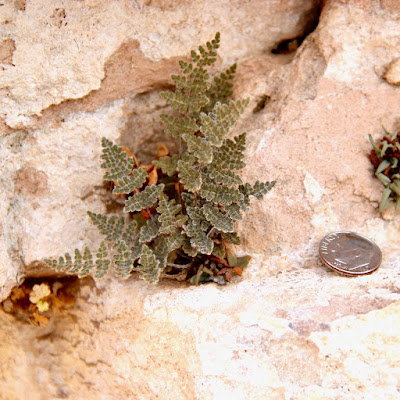
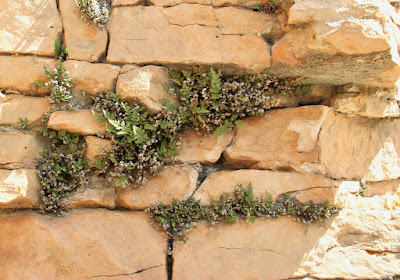
Slender lip fern, Cheilanthes feei, on limestone.
As some readers already know, I'm part of a group of botanists revising Vascular Plants of South Dakota. When the families were divvied up, my share included the ferns. After (re)learning fern features and terminology, I jumped in and was soon hooked. Why? In part because ferns really are different, and in interesting ways. But also, they're a manageable group. There are far fewer ferns than flowering plants, especially in South Dakota.

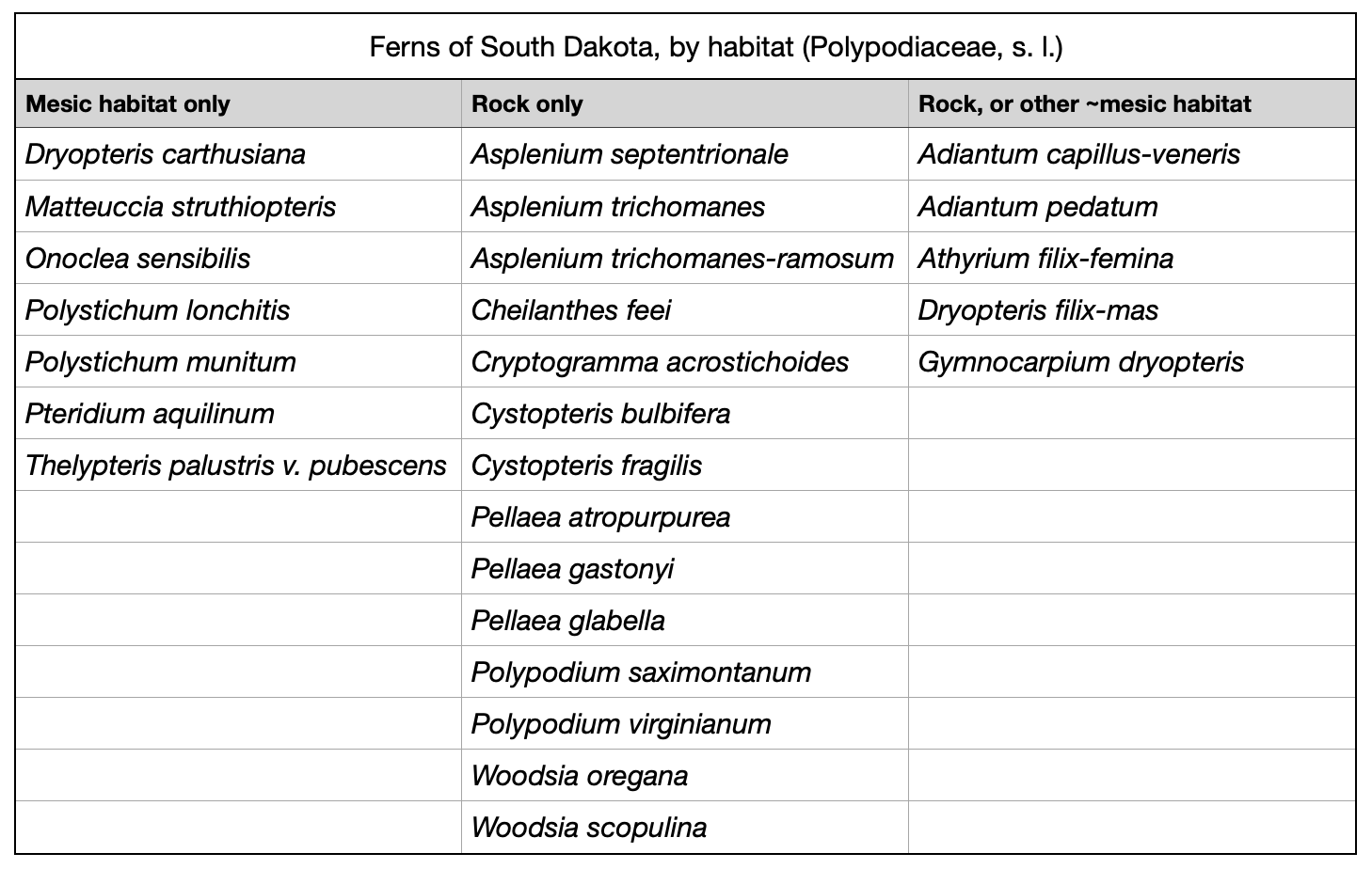
Ferns are commonly considered inhabitants of cool shady humid locations with lush green vegetation—tropical forests, temperate marshes, wooded stream banks, heavily-shaded north-facing slopes, and such. However if this were the case, South Dakota would have just seven species of ferns.

But this is not the case. There are 26 fern species in South Dakota, and the additional 19 are especially interesting. All are xerophytes, i.e., drought-tolerant. And all can grow on rock. In fact, 14 are restricted to rock. This is very different from the global situation. Worldwide, drought-tolerant ferns are in the minority.
One of the most common drought-tolerant ferns in South Dakota is the slender lip fern, Cheilanthes feei, also called Myopteris gracilis (1). It is a widespread North American species, ranging from northwest Canada to northern Mexico, and from the Pacific coast through the Midwest, with several widely disjunct populations in Kentucky, Virginia, and North Carolina.
Cheilanthes feei, Yavapai Co., AZ. Patrick Alexander photo.
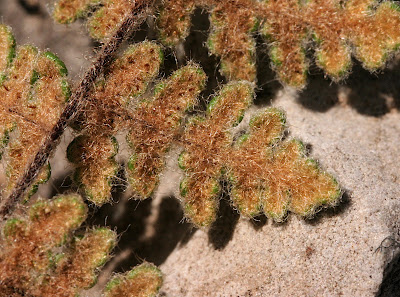
Thick covering of hairs on underside of Cheilanthes feei leaflets. Patrick Alexander photo.
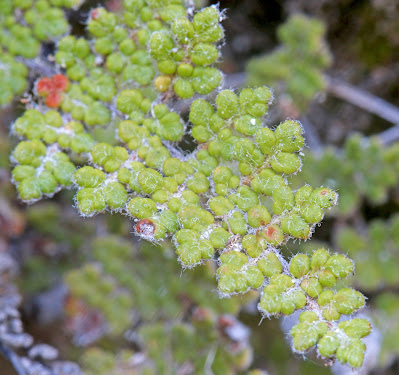
Beadlike segments are characteristic of Cheilanthes feei. Andrey Zharkikh photo.
The slender lip fern is a fine example of drought tolerance, with many traits characteristic of xerophytic ferns. To reduce water loss, undersides of leaves (fronds) are covered in hairs; upper surfaces have a thickened cuticle. If this isn't enough, the fern can dry out yet remain viable, able to rehydrate when moisture returns. But perhaps its most interesting xerophytic adaptation is abstinence. Yes, abstinence! The slender lip fern forgoes sex.

To proceed further requires review of the basic fern life cycle, the supposed "bugbear of many introductory botany students" (Moran 2004). Actually it's not that difficult if you don't have to remember all the terms and details for an exam.
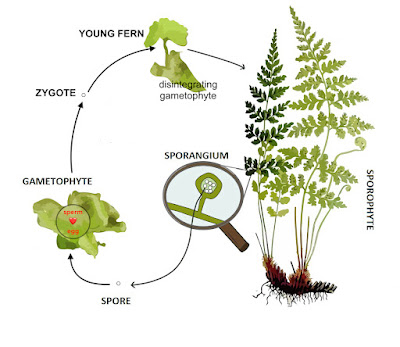
In the diagram above, note the two stages—two free-living organisms. One is the familiar leafy fern plant (right), which produces spores, making it a sporophyte. A spore germinates to produce the other stage, a tiny leafless rootless prothallus (lower left). This is a gametophyte, which produces gametes—ovules (eggs) and sperm. The prothallus is where sex happens, where a sperm swims to an ovule for fertilization (a thin film of water will suffice). From the resulting zygote grows a young leafy fern sporophyte.

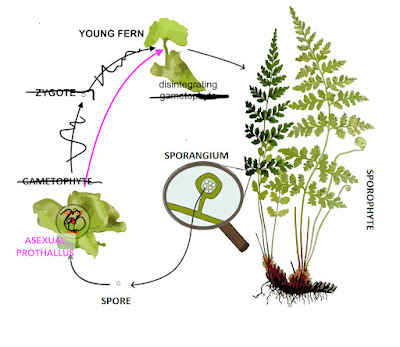
This is the common version of the fern life cycle. However, 5–10% of fern species have abandoned sex (Moran 2004). They do this by skipping gamete production and fertilization, as indicated in pink in the modified life cycle below. These ferns are said to be apogamous—without gametes. And as it happens, many of them live in dry habitats.
Apogamous ferns do produce spores, and these germinate to become prothalli. But these particular prothalli are not gametophytes. They are very small short-lived structures with no sexual organs. Instead, a baby sporophyte soon appears, sending down roots and growing leaves. If it survives, it becomes a familiar spore-producing fern. This approach has obvious advantages in dry habitat. The ephemeral prothallus doesn't have to stay moist for long. And there are no sperm needing to swim off in search of sex.

How did such a situation evolve? It's tempting to conclude that sex was abandoned in response to selection for drought tolerance. But there's another "reason" to consider. The slender lip fern, like many apogamous ferns, is triploid. Instead of the usual two sets of chromosomes (diploid), it has three, making successful sex impossible. Three sets of chromosomes can't be divvied up equally, and the resulting ovules and sperm can't properly pair (2). If sex does happen, the result is misshapen aborted spores.
For the slender lip fern, which came first—drought tolerance or apogamy?
French poet Rémy de Gourmont was of the opinion that "Of all sexual aberrations, perhaps the most peculiar is chastity" (Moran 2004). But of course he was talking about people. For the slender lip fern, chastity is the only way to go.

Notes

(1) Our standard sources—e.g., ITIS, Flora of North America, USDA PLANTS—all list Cheilanthes feei as the accepted name for the slender lip fern. However, in a revision of the genus Cheilanthes, Grusz and Windham (2013) gave it back its old name, Myriopteris gracilis (not a reclassification but nomenclatural fix).

(2) Successful sex in this context is the union of gametes (ovules and sperm) through fertilization. Gametes are products of meiosis, a form of division that creates cells each with a single set of chromosomes (haploid). Then fertilization restores the diploid state. However, the slender lip fern, being triploid, can't produce viable gametes because there's no way to equally divvy up three sets of chromosomes. If meiosis were to take place, each gamete would get one full set of chromosomes but then various ones from the third set. These random chromosomes can't match up during fertilization.

Sources

Crow, WE, et al. 2011. Narrow substrate niche of Cheilanthes lanosa, the Hairy Lip Fern, is determined by carbohydrate and lipid contents in gametophytes. American Fern Journal 10:57–69.

Diamond, H, and Swatzell, L. 2003. Cultivation of Myriopteris (formerly Cheilanthes) species (with focus on M. gracilis and M. lanosa). American Fern Society webpage.

Moran, Robbin. 2004. A Natural History of Ferns. Timber Press.

Tuesday, February 25, 2014

Plant Revenge -- or is it?

So-called “fragile” prickly pear (Opuntia fragilis) takes revenge on an unsuspecting botanist.
As part of my work, I routinely dig up plants and press them flat.  So sometimes when I’m struggling to remove plant parts from my hair, clothing and skin, the thought crosses my mind -- “this is revenge!”
Getting scotch thistle (Onopordum acanthium) into a plant press requires caution and the right tools: brick hammer to dig up plant, knife to slice heads into pieces.  Click image for view of dangerous plant parts.
Plants have lots of vexing and painful parts -- spines, thorns, barbs, prickles, glochids, retrorse hairs and dangerously-sharp leaf tips.  As biologists we assume these are adaptations, but for what?  It’s tempting to think defense.
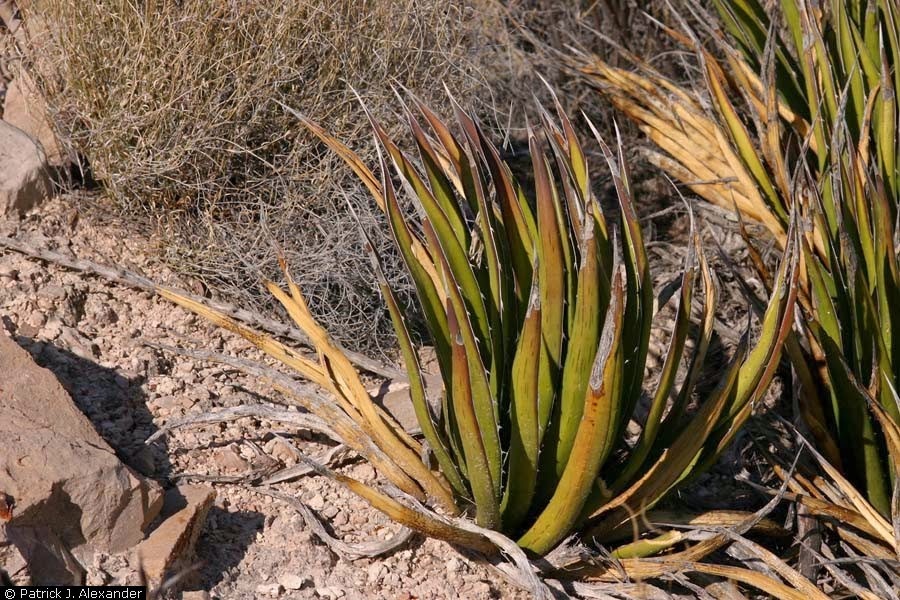
The leaf tips of Agave lechuguilla, shin dagger, can be deadly.  From USDA Plants.
Retrorse barbs of wild licorice (Glycyrrhiza lepidota) look nasty ...
... but they're only a few mm long, as seen here in context (dog fur).
Retrorse spines and barbs make plant parts difficult and painful to remove, but their purpose could be considered noble -- to send offspring out into the world.  Wild licorice is very effective at dispersing seed this way, as my dog frequently demonstrates (see Leaving Home).  [retrorse: (Botany) (esp of plant parts) pointing backwards or in a direction opposite to normal]
Puncturevine nutlets are especially devilish (Tribulus terrestris; source).
The fruits of puncturevine also have barbs, but they're so hideous that I have to think their purpose is evil.  The plants grow low to the ground, often over large areas.  When the fruits dry, they split into hard nutlets with nasty sharp little spikes that are very good at attaching to feet and tires.  They puncture the feet of whatever passes through the patch; walking then becomes extremely painful.  Removing nutlets with ones mouth (what else can most animals do?) makes the situation even worse, and can cause death.  This seems over the top.  Do these structures really aid in dispersal if they cause us to avoid the plants?  So perhaps they’re weapons “for” defense -- but do they increase chances of survival given that we kill the horrid plants wherever we find them?
Puncture vine mat and closeup of flower.  Flowers are 0.5-1 cm across.  Source.
The most infamous pain-inflicting plants in North America are cacti, with their diverse assortment of spines.  Surely they are adaptations to discourage animals from eating the delectable fleshy stems, so appealing in deserts.  This is a reasonable conclusion.
Prickly pear cacti have tiny very sharp spines called glochids below the regular spines.  They're especially difficult to remove from skin.  Some cultivars are spine-free -- these are the tasty nopales or indian figs.
However there seem to be other “purposes” for cactus spines as well as defense. Consider that they’re found mainly in deserts -- plants of moister regions are rarely covered with spines.  Might spines shade stems and reduce water loss?  For the fragile prickly pear (beginning of post) and the infamous jumping cholla of Arizona (below), they appear to be "for" dispersal.  Stem segments readily disarticulate, and can attach to an unsuspecting passerby thanks to the spines.

Though many purposes can be conjured up by a curious partially-informed mind, it’s difficult to know why a plant structure evolved -- what it’s an adaptation for.  We rarely understand the evolutionary history of adaptive traits.  For example, something may have evolved for an unknown purpose long ago, and later was co-opted or redesigned for something else.  The opportunities for speculation are infinite.  There’s a thought-provoking discussion about this dilemma at The Mermaid’s Tale:  Why do cholla cacti use torture?, written by Anne Buchanan after a hike in the Arizona desert.
“The problem is that there may be no single reason, nor even any single kind of history involved here.  ... we think this illustrates why, even when the assumption that the trait is 'adaptive'--that is, is here ultimately because of natural selection--that assumption is hard to prove and in particular the reason is hard to be sure about.”
[Warning:  the included video featuring an unfortunate victim of cholla torture is not for the squeamish.]
Jumping cholla, Cylindropuntia fulgida.  Source.
Obviously we need to be cautious, not just in walking through dangerous plants but also in thinking about them.  Like so many biological phenomena, the more we learn, the more complicated it gets [sigh] but of course that makes the stories even more wonderful!  Here’s a great example:
Bullhorn acacia, Acacia hindsii.
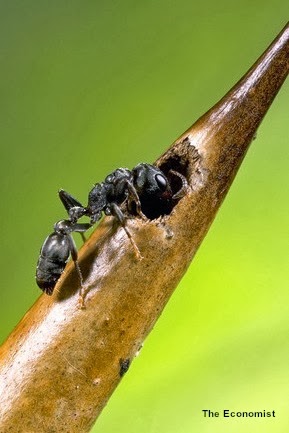
The bullhorn acacia is a well-armed desert tree, with long spines that deter browsers in ways both obvious and surprising.  Obviously the sharp-tipped spines discourage larger animals, but they don’t do much against insect pests and fungal pathogens.  Fortunately they also serve as ant homes, and in fact, the acacias strive to make the neighborhood attractive to ants by providing nutritious food via extrafloral nectaries.  It’s worth the investment.  The ants sting anything that tries to eat the leaves, from caterpillars to cattle.  Furthermore, acacias with healthy populations of the right kind of ant have a reliable supply of antibiotics to fight fungal infections on their leaves.  Their drugs are produced by bacteria living on the ants’ legs.  What a nice arrangement!  For more, see The Economist, Protect and Survive; and Science Daily, Ants protect acacia plants.

✿✿✿✿✿✿✿✿✿
This post is my submission to this month’s Berry Go Round, a blog carnival for plant lovers.  It’s hosted by Garry Rogers, and the topic is Botanical Warfare.
Spines are for beauty too -- for those who look close (from Excruciatingly Beautiful).