Showing posts with label Frank Tweedy. Show all posts

Friday, May 27, 2022

Pioneering Botanist Frank Tweedy, from Boom to Bust

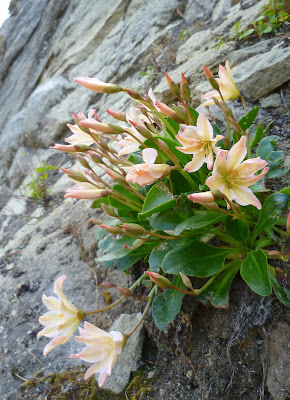
Tweedy's Pussypaws, Lewisiopsis tweedyi, is one of at least 35 species named for topographer and botanist Frank Tweedy. Thayne Tuason photo.
In the summer of 1882, in the Cascade Mountains of Washington Territory, three men left Snoqualmie Pass to climb a high peak nearby. One of them stopped occasionally to examine wildflowers—a passion he came to regret when he realized he had fallen behind. He shouted repeatedly. But the responses were so faint they could have been echos. "I wandered all day and climbed several peaks," he would write many years later (Tweedy 1926).

Frank Tweedy was an assistant topographer with the Northern Transcontinental Survey, which was in the process of establishing a railroad route to the coast. The boss, R.U. Goode, had hoped to set up a survey station on a peak near Snoqualmie Pass, but Tweedy carried the theodolite (for measuring angles). Because of his botanical dawdling, the day ended in failure.

"You jolly well made an ass of yourself!" Tweedy fumed, while waiting for the others to return to camp. But to his surprise, he wasn't fired. Instead Goode calmly explained, "You can't make a success of two things, botany and topography both, at the same time." But Goode was wrong.
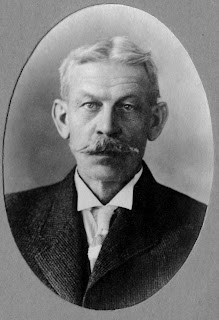
Frank Tweedy, date unknown. Union College archives, used with permission.

New England Beginnings

Frank Tweedy was born in New York City in 1854. After graduating from Union College (Schenectady) with a degree in civil engineering, he spent four field seasons surveying and mapping for the Adirondack Survey. He also collected plants.

Tweedy's botanical training remains a mystery, but his specimens show he was a serious and able botanist (1). He didn't shy away from difficult groups, and apparently found wetland plants especially interesting, collecting bulrushes, pondweeds, bladderworts, and numerous sedges. He published his discoveries—state records and notable range extensions—in the Bulletin of the Torrey Botanical Club.
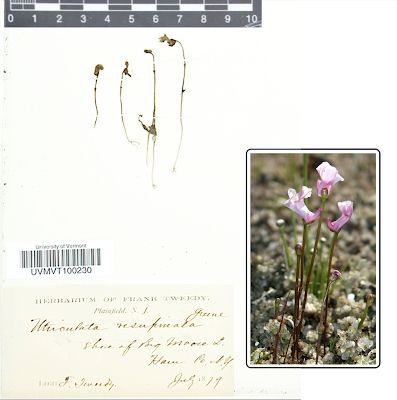
Tweedy specimen (in part) of Northeastern Bladderwort, Utricularia resupinata. "I do not think it uncommon through northern New York," he reported in 1880. US National Herbarium, scale in cm; added color photo by Doug McGrady (CC BY 2.0).

To the American West, Land of Discovery

Tweedy's botanizing underwent a radical change in 1882, when he was hired by the Northern Transcontinental Survey and sent to Washington Territory. No longer need he concern himself with range extensions. This was a botanical frontier, largely unexplored. A sharp-eyed collector might well find "novelties"—species new to science!
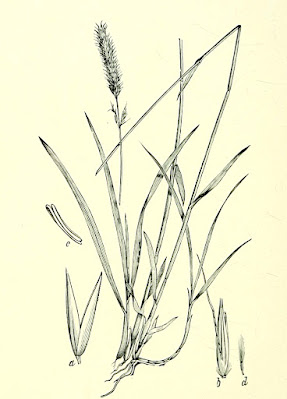
During two seasons of survey with the NTS, Tweedy made at least 112 plant collections, representing 90 species. Among them was a reedgrass grass from the Wenatchee Mountains, which Frank Lamson-Scribner, an expert on grasses, recognized as a new species—Deyeuxia tweedyi (now Calamagrostis tweedyi). This was the first of many novelties named to honor Frank Tweedy.
Tweedy's Reedgrass, from American Grasses by Frank Lamson-Scribner, 1897.
In 1884, Tweedy joined the US Geological Survey in Yellowstone National Park, where he surveyed for four topographic maps, made 605 plant collections, and published the highly-respected Flora of the Yellowstone National Park (1886). Among his collections were several novelties, including Tweedy's Plantain, Plantago tweedyi.
Tweedy's Plantain. Andrey Zharkikh photo.
Tweedy worked for the USGS in the Rocky Mountains for two decades, collecting plants wherever he went. Among his more productive projects were the Livingstone and Dillon topographic maps in southwest Montana, where he nabbed at least ten new species, including Tweedy's Daisy, Snowlover, and Thistle (Erigeron tweedyi, Chionophila tweedyi, and Cirsium tweedyi [now part of C. eatonii]).
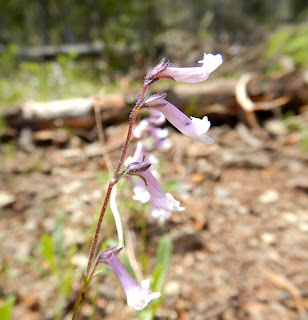
Chionophila tweedyi, Tweedy's Snowlover. Matt Lavin photo.
But it was in Colorado that Tweedy hit the jackpot ... or so it appeared. In the 1890s and early 1900s, while working on the Telluride, Durango, Boulder and Central City topographic maps, he made well over a thousand collections, some twenty of which were determined to be new species! Yet if we check current Colorado plant lists, we find nearly all of those novelties have vanished.

Names Come and Names Go

As budding botanists, we're taught to use scientific names in spite of the off-putting Latin. We're told they are unambiguous, universal, and enduring. But then when we go out into the real world, we learn otherwise. Scientific names do change, and more frequently than some of us would like!

There are many reasons for name changes, but one is especially common—the "law of priority" (Mori 2013). If a given species is described and named by more than one botanist, the first-published name is accepted (others become synonyms). The law of priority was frequently broken in the 19th-century American West, understandably. Floras and relevant literature were inaccessible or non-existent, and communication with other botanists was slow at best.

In the case of Frank Tweedy's discoveries, an additional factor was at play. Like many plant collectors then, he sent specimens of interest to experts at botanical institutions. They decided which were new species, and then described and named them.
Per Axel Rydberg, author of Flora of the Rocky Mountains and adjacent plains (1917).
Tweedy sent many of his specimens to Per Axel Rydberg at the New York Botanical Garden, an expert on Rocky Mountain plants and a notorious splitter. He often recognized new species based on what others considered minor details (Tiehm & Stafleu 1990). Indeed, many of Tweedy's novelties that were named and published by Rydberg did not survive later taxonomic study. Of the twenty supposed new species from Colorado, only one has survived—the North Park or Sagebrush Beardtongue.

In 1901, Tweedy was surveying the Encampment mining district, which was mostly in southern Wyoming. However, "By reason of the faulty determination of the forty first parallel ... the State boundary was located approximately one third of a mile north of its proper position [and] consequently a narrow strip along the southern edge of the district ... is in the State of Colorado" (Spencer 1904). It was in this sliver of Colorado that Tweedy collected an interesting beardtongue. He sent the specimen to Rydberg, who designated it the holotype (basis for description) for a new species, Penstemon cyathophorus.
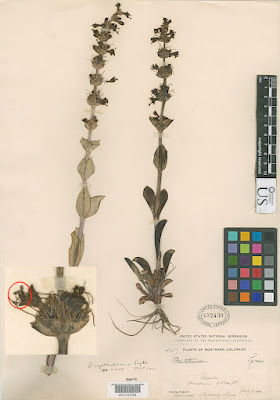
Tweedy's 1901 North Park Beardtongue specimen (US National Herbarium). Click to view 4 exserted stamens circled in the added closeup .
Today's botanists find the North Park Beardtongue difficult to identify with confidence unless it's in full flower. It's quite similar to Harrington's Beardtongue, differing mainly in the number of stamens exserted prominently (not just a little!) beyond the corolla lip—four in Penstemon cyathophorus, two in P. harringtonii. Despite the subtle distinction, this Rydberg species has survived its latest trial—update of the genus Penstemon for the Flora of North America.

End of an Era

Why did Tweedy find only one true novelty in Colorado? The answer probably is timing. Though the Rockies would continue to yield new plant species, the great era of botanical exploration was coming to a close by the early 1900s. No longer could a sharp-eyed plant collector rake in novelties (Williams 2003).

Did Tweedy realize what was happening? Is that why his large-scale botanizing ended after his Colorado projects? We don't know. In any case, after a field season in New Mexico, he worked for the USGS in Washington DC until his retirement in 1926. He lived another decade before passing away in 1937 at age 83 (Lesica & Kruckeberg 2017).

In his day, Frank Tweedy was highly respected as a pioneering botanist in the American West, with at least 35 species named in his honor. So it's surprising how few of today's botanists have heard of him. And until a few years ago, his presence online was negligible. But that has changed. Now there's a Wikipedia article where you can learn more about Tweedy's successful endeavors "in both botany and topography, at the same time." (2)
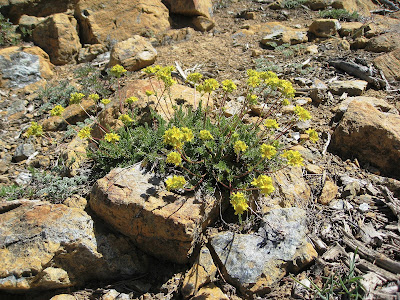
P.A. Rydberg named Ivesia tweedyi for Frank Tweedy, who made the first collection in 1883, in Washington Territory. Photo by brewbooks.

Notes

(1) The SEINet Portal Network is the source of information here about Tweedy specimens, unless noted otherwise. Digitization of herbaria is a work in progress; counts likely will change.

(2) Despite his early reprimand, R.U. Goode likely approved of Tweedy's double successes, for he became a close friend, and served as best man at Tweedy's wedding.

Sources (in addition to links in text)

Lesica, P and Kruckeberg, A. 2017. Frank Tweedy (1854–1937) in Potter, R, and Lesica, P (eds.). Montana's Pioneer Botanists: exploring the mountains and prairies. Montana Native Plant Society.

Spencer, AC. 1904. Copper deposits of the Encampment District, Wyoming. USGS Prof. Paper 25.

Tiehm, A, and Stafleu, FA. 1990. Per Axel Rydberg: a biography, bibliography, and list of his taxa. NY Bot. Gar. Mem. 58 (75 pp).

Tweedy, F. 1926. The Confessions of a Tenderfoot. Unpublished memoir.

Williams, RL. 2003. A Region of Astonishing Beauty—the botanical exploration of the Rocky Mountains. Roberts Rinehart Publishers.

Tuesday, August 17, 2021

Frank Tweedy's Traveling Plants: WY to NYC & back

Frank Tweedy. Union College Special Collections (used with permission); date unknown.
Readers of this blog may remember Frank Tweedy of the US Geological Survey, who surveyed the Laramie Plains in 1892 (Mapping the Laramie Plains, 3rd dimension captured). In August of that year, the Laramie Boomerang announced that Tweedy and assistant James McFarland would "commence work upon the topography of this section of the country." Three years later, the "Laramie Sheet" was published—one of the first topographic maps for Wyoming.

In January of 1903, there again was a Frank Tweedy in the Laramie news. "Prof. Nelson [University of Wyoming] has received a rare collection of plants from Mr. Frank Tweedy ... a botanist of considerable distinction" reported the Republican. Were USGS surveyor Frank Tweedy and distinguished botanist Frank Tweedy one and the same? And how did 700 plants survive a trip to Laramie in January?!

Dead, flat, & dry

Actually, survival was not an issue, for these plants were already dead. But they still were of great value. All were collected in 1900 in the wilds of the northern Bighorn Mountains. There they were carefully arranged in paper folders so that parts needed for identification were visible, and placed in a plant press with absorbent felt sheets until dry (several days to several weeks, depending on weather).

After the field season, they made their way east, ending up at the New York Botanical Garden where the great botanist, Per Axel Rydberg, either identified them, or, if they were new to science, named them himself. Then in 1903, "upward of 700" traveled west to Laramie, each accompanied by a label with the plant's name, collection location, date, and collector—Frank Tweedy.

At the university there was more processing, for dried plants are fragile, and won't last long if left loose in paper folders. They were mounted on 11" x 18" sheets of durable paper, preserving them for centuries to come, and properly filed in the university herbarium.

Pleated gentian, Gentiana affinis, collected by Frank Tweedy in 1900. Rocky Mountain Herbarium.

Herbarium?

If you don't know what a herbarium is, you're not alone. Few people do. Many think it's some kind of greenhouse, but actually it's the opposite—a collection of pressed dried plants. The first, called a "hortus siccus" (dry garden), was created in the 1520s by Italian botany professor Luca Ghini. He wanted a way to teach plant identification in the winter, so he pressed and dried plants, and glued them to paper sheets. Fed up with their ancient textbooks, Ghini's students loved him for it.

Today, students still use herbarium specimens to learn to identify plants. But they took on a much bigger role during the golden era of global exploration (16th–19th centuries)—documentation of the world's flora. Herbaria proliferated and flourished. Now there are at least 3300, holding nearly 400 million pressed dried plants!

New herbarium grows fast

By 1892, the University of Wyoming had been operating for five years with a botany professor (Aven Nelson) but no herbarium! This was unacceptable for the state's only university. Fortunately, Experimental Station Supervisor Burt C. Buffum had collected Wyoming plants for several years, accumulating on the order of 500. Several hundred were set aside for an exhibit at the 1893 World's Columbian Exposition in Chicago. As for the rest, University President Albinus Johnson directed Nelson to use them to start a herbarium.

Nelson knew little about plant identification and herbarium management, but that didn't slow him down. In 1899, he launched an ambitious project. For 14 weeks, he traveled Yellowstone Park by horse-drawn wagon, with his wife, two daughters, and two students. They collected zealously, returning to Laramie with 30,000 specimens! Most were duplicates, to be sold or traded to fund and expand the UW herbarium.

Collecting plants in Yellowstone, 1899. Photo by Aven Nelson; American Heritage Center (AHC).
Before the trip, Nelson wrote to his esteemed colleague Per Axel Rydberg at the NY Botanical Garden, asking where in Yellowstone he should collect. Rydberg replied: "The flora of the park is, however, well worked up as several collectors have been in there ... The one that has done the most, however, is Frank Tweedy of US Geological Survey. He spent two whole summers in the park."

Indeed, surveyor Frank Tweedy and botanist Frank Tweedy were one and the same!

An eye for novelty

Frank Tweedy was born, raised, and educated in New York, graduating from Union College in 1875 with a degree in civil engineering. He began his surveying career the next year in the Adirondacks, followed by a stint as a sanitation engineer in Rhode Island. All the while, he collected plants.

If we follow Tweedy's trail of herbarium specimens (accessible online), we go from New York to New Jersey to Rhode Island. But then we make a huge leap west. In 1882, Tweedy went to work as a topographer on the Northern Transcontinental Survey in Washington Territory. And he collected plants.

For Tweedy, this was a very different kind of botanical world, largely unexplored and rich in novelties—species new to science. He collected his first that summer, a grass from the Wenatchee Mountains. It was named Tweedy's reedgrass (Calamagrostis tweedyi) by grass expert FL Scribner, who wrote: "Mr. Tweedy has been a careful and zealous collector of the plants of the various sections of our country which he has visited, and it is with pleasure that I dedicate this species to him."
Calamagrostis tweedyi, Tweedy's reedgrass, from American Grasses (FL Scribner 1897).
This was the first of more than 100 plant species discovered by Tweedy, and the first of at least 35 named in his honor. By the time his specimens arrived in Laramie in 1903, he was a highly-regarded pioneering botanist of the American West.
Erigeron tweedyi, Tweedy's fleabane. Photo by Matt Lavin (Flickr).

Herbarium in the news

Meanwhile the UW herbarium had grown rapidly, thanks to collecting by Nelson and his students, and acquisitions through purchase and trade. In 1899, he convinced the University Trustees to make it a separate institution—the Rocky Mountain Herbarium (as it is today), with Nelson as curator.

Within a few years, Nelson and the Rocky Mountain Herbarium had become newsworthy. In May of 1902, the Rawlins Republican reported "[a set] of 800 Wyoming plants has just been forwarded to the Carnegie museum (Pittsburg) by Professor Nelson" who also "received an interesting collection of plants, some 300 in number, from Dr. Riser of Rawlins ...". Even more notable, Nelson shipped a collection of potentillas (cinquefoils) to Germany, to "Dr. Theodore Wolf, a German botanist, who is preparing a monograph of all the species of the genus in the world." In exchange, German potentilla specimens would be sent to the Rocky Mountain Herbarium.

In July, the Cheyenne Daily Leader had exciting news. "12,000 Specimens of Rare Herbs and Plants for the State University" had been collected in Nevada, New Mexico, Utah, and Wyoming by Leslie Goodding, one of Nelson's students. About 800 species were represented, including every botanist's dream—species new to science (several were named in Goodding's honor).
University of Wyoming, 1901. AHC, SH Knight Collection.
According to the Laramie Boomerang, by September of 1902, UW's herbarium contained 36,000 specimens—impressive given there were still just three buildings on campus (not counting barns and greenhouses). At the end of the year, when Nelson's articles about saltbushes and hawthorns were published in the University of Chicago's Botanical Gazette, the Laramie Republican proudly and rightly declared, "Prof. Nelson is a recognized authority on Rocky Mountain and western plants."

Thus we shouldn't be surprised that a botanist of Tweedy's caliber would contribute a "rare collection of plants" to the Rocky Mountain Herbarium.

Imagining the past

During my research, I often imagined Tweedy and Nelson in conversation—the renowned western botanist encouraging Nelson's ambitions. Did they meet when Tweedy was surveying the Laramie Plains in 1892? Or maybe they made arrangements in May of 1901, when the Personals section of the Boomerang reported that "Frank Tweedy of Washington is in the city" (no further details).

I searched and searched for correspondence between the two men, eager to find a climax for this story. Instead, I discovered that the Republican, or perhaps Nelson, had led me astray.

In examining Tweedy's specimens at the Rocky Mountain Herbarium, I discovered a puzzling label on the lower left corner of each: "Received from A.A. Heller, 1903". As I would learn, Nelson didn't receive the specimens directly from Tweedy. He bought them from Amos Arthur Heller. (Heller probably got them through a trade, but we can't be sure.)

A fantastic bargain just the same

Heller was an American botanist active from 1892 to 1940. The standard botanical sources include his professorships in Minnesota, California, and Nevada, as well as work for prominent botanical institutions. But I knew nothing of his stint as a freelance plant dealer until I visited UW's American Heritage Center, where I found a folder of letters from Heller to Nelson. 

On December 3, 1902, Heller wrote Nelson from Puerto Rico: "If you care for them, I have a collection of 700 Wyoming plants collected by Frank Tweedy, which I will sell for $45.00. There are a lot of new species among them [named] by Rydberg, and I understand he [identified] the whole collection. I am giving you the first chance at these, as I know they will be of more value to you than any one else." He then advised, "If you want the Wyoming plants, Mrs. Heller [in Pennsylvania] will attend to sending them."

Apparently Nelson jumped at the opportunity. In a letter dated December 29, E. Gertrude Heller wrote: "I will ship you the plants at once ...", which she must have done since they arrived sometime before January 14, when their story appeared in the Laramie news.

Surely Nelson was happy with his purchase—nearly 700 specimens representing 500+ species, collected by a highly-respected botanist. And, as the Republican explained, "As not more than three of these sets of plants are in existence this herbarium is fortunate in securing one" (the others went to the National Herbarium and the NY Botanical Garden).

Furthermore, "since [Tweedy's] work carries him into many places, inaccessible to the ordinary collector, his plants are unusual and interesting." Here the Republican was correct. A dozen of the specimens were species new to science! Obviously Frank Tweedy was very good at spotting botanical novelties, even while surveying.
Tweedy's gilia (Gilia tweedyi), collected by Frank Tweedy in the Bighorn Mountains. Dried plant is about 8 in tall. H. Marriott photo; added flower photo by Matt Lavin, 2012 (Flickr).

🌺🌼🌾

This post is based a recent contribution to the History column of the Laramie Boomerang, which features articles by volunteers eager to share our local history. We also hope to relieve the dismal monotony of pandemic news, and support our flagging local newspaper! Articles are archived at the Albany County Historical Society website.

For more about Frank Tweedy, perhaps our most under-appreciated pioneering botanist, see his Wikipedia page. It was created just last year by this author (herself a botanist), and Noel Sherry, who is exploring Tweedy's mapping, plant collecting, and more.

Monday, November 16, 2020

Tweedy's Pussypaws' Tortuous Taxonomic Journey

Tweedy's pussypaws has long challenged plant taxonomists. Should they abandon Darwinian evolution for an alternative? Photo by Hike395.

Tweedy's pussypaws lives here! Tronsen Ridge, Wenatchee Mountains. Photo by brewbooks.

In the summer of 1883, in the Wenatchee Mountains of Washington Territory, Frank Tweedy and T.S. Brandegee went exploring, perhaps hoping to climb Mt. Stuart. En route they spotted striking plants among the rocks, with thick roots, broad fleshy basal leaves, and salmon-pink flowers an inch across. They collected one plant, and once back in camp, arranged it carefully in a plant press for drying. It would be sent to the great North American botanist, Asa Gray, at Harvard.
Specimen 37514, Gray Herbarium, Harvard. Washington Territory, 1883 ("Mt. Stewart" is Mt. Stuart).
Minor damage and loss of color due to long drying time (no other option on early expeditions). Material was removed from the fragment packet for imaging.

Frank Tweedy was a civil engineer, with a degree from Union College (New York). After graduation, he worked as a surveyor in the Adirondack Mountains, followed by a stint as sanitation engineer in Newport, Rhode Island. All the while he collected prodigiously, publishing notable finds in the Bulletin of the Torrey Botanical Club. Then in 1882, he boarded a train and headed west.

Townshend Stith Brandegee was a civil engineer with two degrees from Yale, the second in botany. By the time he collected with Tweedy in the Wenatchees, he was well-respected for his botanical knowledge of the American West, having been on four survey expeditions. Several of Brandegee's articles in the Botanical Gazette—Flowers and Snow and Timber Line in the Wasatch Range—show his attentiveness to plant ecology as well as floristics.
Left: Frank Tweedy, 1875. Union College Special Collections. Right: Townshend Stith Brandegee, date unknown. Jepson Herbaria Archives, U. California, Berkeley.
In 1882, Tweedy and Brandegee were hired by Richard U. Goode of the Northern Transcontinental Survey (NTS), which was established to lay out a route for the nation's northern railway. Both men were surveyors professionally, but it was no secret that plants were their passion. In fact, they were encouraged to collect [1]. On August 5, 1893, Goode wrote in his diary, "Yesterday Mr. Tweedy collected for me over 60 kinds of flower-bearing plants within a few rods of camp. They are now being dried ...".

Frank Tweedy found himself in an exciting new botanical world. Not only was the flora unfamiliar to him, it was poorly-known in general, thereby offering fresh thrills—novelties! Unfortunately this term has largely fallen out of use; now we call them "species new to science".

We don't know what Tweedy and Brandegee thought of the plant they found near Mt. Stuart. The oldest label on their specimen (see image below) indicates they didn't realize it was a novelty. Based on the label, it appears Brandegee thought it was Claytonia megarhiza, the fell-fields claytonia—a related plant also found in talus and scree in western mountains.

But attached to the upper right corner of the sheet is a message from botanist William Marriott Canby (head of Economic Botany for the NTS) absolving Brandegee. There was a mixup in labels! Canby wrote, "Tweedy has just sent me his #s 898 and 900 Coll[ected] 1893. #898 is Calandrinia Tweedyi and 900 is Claytonia megarrhiza."

The next oldest label (bottom right corner, below Brandegee's) documents Professor Gray's decision that the plant was a novelty. He named it in Tweedy's honor, writing "Calandrinia tweedyi" on the label—but only after crossing out "brandegei"!
Brandegee label above, Gray annotation below; note edit (red arrow). "TYPE" (blue arrow) marks this specimen as the holotype, the basis for describing the new species, Calandrina tweedyi.
What was the reason for Gray's edit? Perhaps friction between Brandegee and Gray was already developing, one more example of the growing rift between field botanists and "experts" in academic institutions. "they held Gray in high esteem and generally agreed with his scientific principles, [but] the Brandegees [2] eventually claimed a superior ability to classify and appropriately name the plants they had collected ..." (Carter 2011).
Specimen V211615, U. British Columbia Herbarium. Washington, 1996. Faster drying makes better specimens. Note the different name on the label.

In school, budding botanists are taught to use standardized plant names made of Latin(ized) words—known as scientific names. Whereas common names vary from region to region, a plant has only one scientific name ... or so we're assured. But that's only true if taxonomists keep their mitts off it.

Scientific names are intended to reflect evolutionary relationships. For example, species in a given genus are thought to be closely related, evolved from a common ancestor. But sometimes it's hard to decide in which genus a species belongs, and as our understanding evolves, name changes may be needed [3]. Tweedy's pussypaws has been especially difficult in this regard.

Click on image for a "clearer" view.
Asa Gray (far left above) devoted his last decade to his life goal—the Synoptical Flora of North America, a compendium of all known species ordered by evolutionary relationships (Gray was a strong proponent of Darwinism). Several volumes were published before his death in 1888, but volume 1 part 1, which included Tweedy's pussypaws, wouldn't appear until 1895-97 (published in fascicles).

By that time, the pussypaws had been renamed twice! In 1893, Thomas Jefferson Howell, a well-respected self-taught botanist in the Pacific Northwest, moved it and several thick-rooted relatives to a new genus, Oreobroma—"a natural genus, named in allusion to the edible fleshy roots." He made the name change himself, being long frustrated with decisions by experts far away. "... the books and papers [of the experts] relating to these plants present many incongruities, according to the views of field botanists who are better acquainted with the real characteristics of the plants."

But Oreobroma tweedyi didn't last long. The next name change appeared just a few years later in Gray's Synoptical Flora, by then under the leadership of protégé Benjamin Lincoln Robinson. Robinson saw no need for a new genus, instead assigning Tweedy's pussypaws to Lewisia, where it rested for almost a century.

In the mid 1990s, Rafaël Govaerts at the Royal Botanic Gardens, Kew, moved the pussypaws from Lewisia to Lewisiopsis, another new genus. This was one of many name changes he published in the World Checklist of Seed Plants, without explanation! This drew loud criticism, understandably (see Schmid 1996).

Govaerts's decision was not accepted. In Flora of North America (FNA, 2003)—considered the definitive treatment for North American plants—Tweedy's pussypaws became Cistanthe tweedyi [4], based on work by Mark Hershkovitz. However, the FNA authors finished with a warning: based on DNA analyses, "inclusion of [Tweedy's pussypaws] appears to be somewhat equivocal and it might best be treated as a distinct genus."
Tweedy's pussypaws is popular with gardeners, and has received the Royal Horticultural Society’s Award of Garden Merit. From Curtis's Botanical Magazine, 1899 (more here).

This story ends (for now) in Santiago, Chile, where Hershkovitz, who had studied Cistanthe and its relatives for years, was dismissed from the University for lack of funding. Living on the streets with support from friends, strangers, McDonalds employees, and the Reshet Foundation, he "abandoned mathematical interventions and statistical analyses" and considered alternative evolutionary models. Tweedy's pussypaws is likely a hybrid, explaining its similarity to both Lewisia and Cistanthe. Hershkovitz called it Lewisiopsis tweedyi.

Speciation by hybridization is not some wild idea from a crazed street person. In fact, it's now (finally) widely accepted that "The origin of species is more complex than Darwin envisaged ..." For more, see How hybrids have upturned evolutionary theory in The Economist.
Tweedy's pussypaws by any name would be just as lovely! Photo by Richard Droker.

Notes

[1] In the mid to late 19th century, natural history was at its heyday in North America. Exploratory expeditions often included a botanist.

[2] Wife Katherine Brandegee also was a botanist. The couple made many important and long-lasting botanical contributions, especially in California and Baja California (see Carter's excellent article).

[3] It has been proposed that plants be given names independent of evolutionary relationships. Then they wouldn't have to be changed as our understanding changes. I have just a vague memory of this, from systematics classes 40 years ago. If you're familiar with such proposals, please leave a Comment.

[4] Currently, three names are commonly used: Lewisia tweedyi; Lewisiopsis tweedyi, e.g., in Wikipedia and among gardeners; and Cistanthe tweedyi, which seems to be the most popular one among taxonomists, at least for now.

Acknowledgements and Sources (in addition to links in post)

Once again, a huge "thanks" to Biodiversity Heritage Library for providing quick and easy access to older botanical literature. I couldn't have done this without you! Tropicos Name Search was essential for tracing the tortuous path of Tweedy's pussypaws—both its names and the characters involved. 

Carter, Nancy Carol (2011). "The Brandegees: Leading Botanists in San Diego." Journal of San Diego History. 14 (4): 191–216. PDF

Goode, R.U. 1883 (1990). Ed. C.W. Tazewell. The Goode Diary: A personal journal of the Northern Transcontinental Survey, 1883. Virginia Beach: WS Dawson Co., 1990.

Govaerts, Rafaël. 1999. (ca. 1996 originally). World Checklist of Seed Plants 3(1): 21. (Lewisiopsis tweedyi)

Gray, A. 1887. Contributions to American botany. Proc. Amer. Acad. Arts 22:270-314. (Calandrinia tweedyi)

Hershkovitz, M.A. 1990. Nomenclatural changes in Portulacaceae. Phytologia 68:267-270. (Cistanthe tweedyi)

Hershkovitz, M.A. 2019. Systematics, evolution, and phylogeography of Montiaceae (Portulacaceae). Phytoneuron 2019-27:1–77. Don't miss the Acknowledgements, p. 65 (Lewisiopsis tweedyi)

Howell, T.J. 1893. Rearrangement of American Portulacaceae. Erythea 1(2): 32. (Oreobroma tweedyi)

Lesica, P., and Kruckeberg, A. 2017. Frank Tweedy (1854-1937); in Potter, R., and Lesica, P., eds. Montana's Pioneer Botanists. Montana Native Plant Society.

Robinson, B.L. 1895-97. Lewisia; in Gray, A. Synoptical flora of North America, v. 1 pt. 1. (Lewisia tweedyi)

Schmid, R.C. 1996. Govaerts, Rafael. "World checklist of seed plants" [book review]. Taxon 45:579-580.