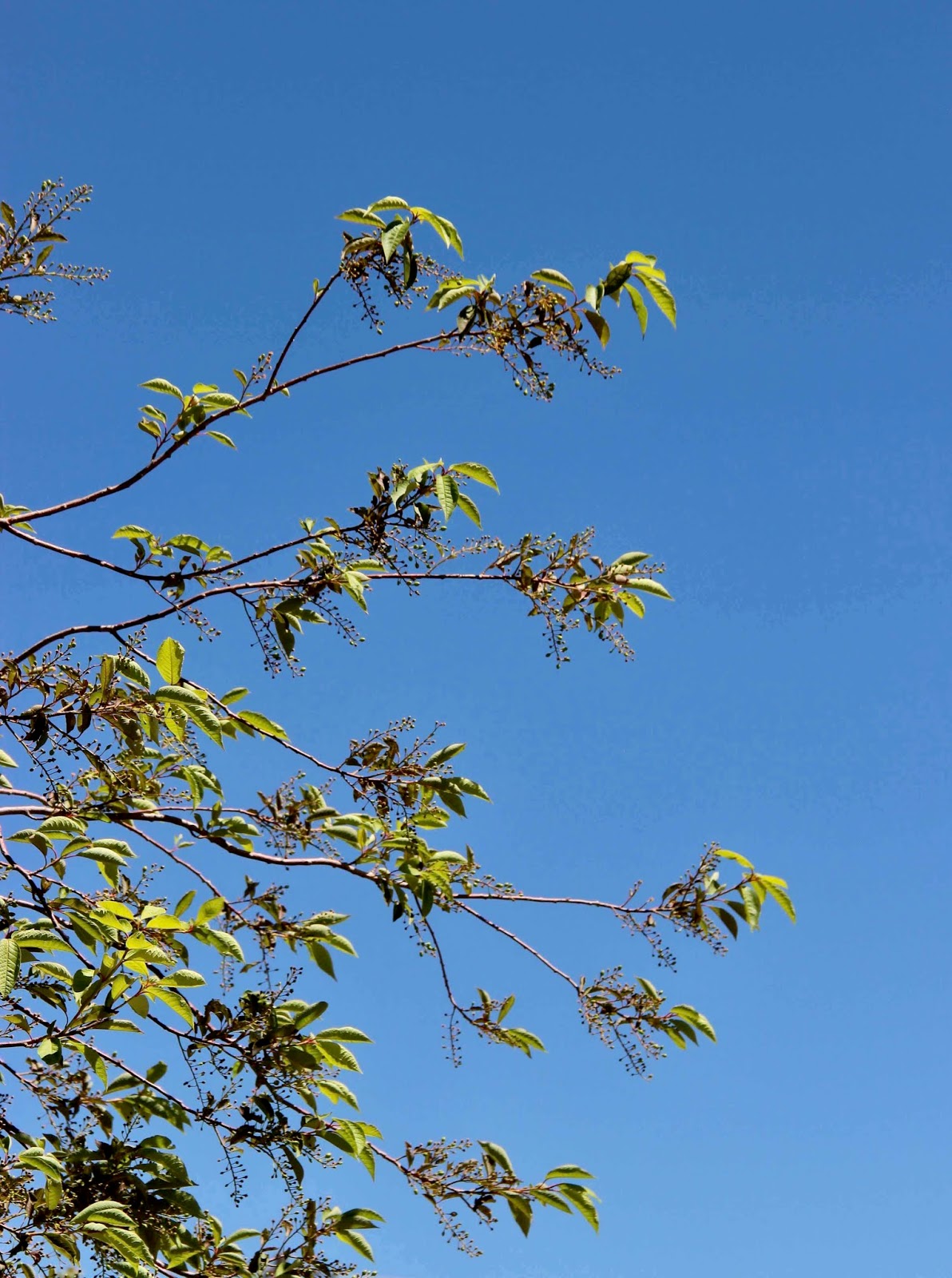
Showing posts with label chokecherry. Show all posts

Monday, December 14, 2020

Chokecherry Farewell

Purple-leaved chokecherry, August 2020.
Yesterday afternoon, I went to LaBonte Park to bid adieu to the chokecherry tree I followed this year. But I forgot my camera. But I had my phone. But it was a brand new (to me) smartphone (AT&T didn't want me and my little flip phone anymore). But by tapping here and there on various screens viewed through dark glasses in bright sunlight, I got what I wanted.

Last night, I learned that with just a few taps, this wondrous device would send photos to my laptop—very cool! But for the next half hour I tapped, searched, read, tapped some more and wondered, while my laptop remained oblivious to the phone "Waiting" just six inches away.
Grrrr ...
Then I heard the boing of digital media arriving. Turns out neither device was to blame—our WiFi had disconnected. But it returned, so off we go to LaBonte Park.

It was a beautiful day—cold, sunny, calm. The pond is frozen and snow-covered. But it's still too early in the season to test it, even along the margins.
Chokecherry from afar.
Sky and canopy, with the last leaves tightly huddled.
Characteristic curving stems and branches. Note the American crow eating something it found on the street (black spot left of tree).
The requisite selfie: me and my tree.

This is my final report for 2020, posted at the monthly gathering of tree-followers kindly hosted by The Squirrelbasket. Now it's time to select a tree for next year :) Want to join in the fun? Information here.

Thursday, November 12, 2020

November News, from leaves to windows

 
Not surprisingly, the chokecherry tree in LaBonte Park that I've been following this year is mostly bare, only a few dead leaves were hanging on. Just as well, it was much too windy for leaf photography. But it was a good day for black and white.


The photo above shows the major branch damaged by heavy snow in early June after the tree had leaved out. It seemed to do just fine through the summer, with healthy leaves, flowers and fruit. Will it survive winter?

Next I spent time composing with lenticels. Once home, I asked Google if they truly are lenticels. Indeed, they are. Next I asked if it's true that trees "breathe" through their lenticels. Again, affirmative, at least some of the time (more when young?). Air can pass through lenticels because the tissue is spongy, with more space between cells.

Not only was it windy (23 mph with gusts to 36), it was cold, 34º F. Maybe that's why the park was empty of people. Or maybe due to Wyoming's huge spike in covid cases. No longer can folks simply cowboy-up; we really do need to follow safety guidelines.

Even worse, our county—Albany—is second highest in the state in reported cases over the last week. Only Weston County has more. Weston has a prison; we have the state's only university. As of yesterday, students are sent home as soon as they test negative, to continue classes online. 

I wasn't totally alone in the park. American crows foraged in the dried grass. Mr. and Mrs. Mallard sailed among reflected trees on Stink Lake, which never produced much of a stink this year. Maybe the City found a solution.


Yet in spite of the cold, wind and pandemic, I'm happy. As of last Saturday, we have a new president-elect, and I have new well-sealed windows in my sunroom—major upgrades in both cases!
Test-driving the new windows.

This is my contribution to the monthly virtual gathering of tree-followers kindly hosted by The Squirrel Basket. More news here.  New members are always welcome; join us for a good time!

Sunday, October 11, 2020

Trees Turning, Trees Burning

With Laramie's trees now changing color, the debate is on. Some claim that chlorophyll, the compound that captures solar energy and also makes leaves green, is breaking down, thereby revealing other pigments—yellow and orange carotenoids. And if conditions are right, trees will manufacture additional pigments—red and purple anthocyanins—for purposes not understood. Perhaps it's an aesthetic choice.

In these dreary demoralizing times, I cling to the tiny-artists hypothesis. Autumn leaves are painted by darting leaf fairies so small that we can't see them, no matter how hard we try. But we can easily appreciate their masterpieces. Toward that end, I headed off to LaBonte Park to find out what the leaf fairies had done to my chokecherry tree.

This particular tree is my tree-following subject this year, the idea being to visit and report on it each month (I've missed a few). I was curious about the leaves because it's a purple-leaf chokecherry. What color do purple leaves turn in autumn? 
LaBonte Park has a nice show of trees currently—yellow and orange deciduous trees, and dark green conifers.
The purple-leaf chokecherries haven't changed much. The leaves are more on the red side of purple, but nothing dramatic.

Have you noticed the "subdued" quality of these photos? I resisted the temptation to photo-enhance. This is what our world looks like much of the time. Actually, this was a relatively good day.
LaBonte Park yesterday afternoon, "unhealthy for sensitive groups".
St. Matthew's Cathedral in Laramie Oct. 5, "very unhealthy". Laramie Boomerang.

On September 17, in the Mullen Creek drainage on the west side of the Medicine Bow Mountains, a spark still being investigated set the forest ablaze. These mountains are thick with standing dead trees, "victims" of pine bark beetles. In many areas, half to three-quarters of the trees are dead. With all this dry fuel and very strong winds, the Mullen Fire raced eastward, consuming 175,00 acres (71,000 hectares) as of this morning.
Mullen Fire, just one of many in the western US (InciWeb, Oct. 11).
Thirty miles south of the Mullen Fire, the Cameron Peak Fire is also burning beetle-killed trees and generating lots of smoke (InciWeb, October 11)).
Fortunately, thirty miles of prairie lie between Laramie and the mountains—grassland where fire can be quickly extinguished. But the smoke will be with us for awhile. Wildfires typically create a mosaic of burned and unburned areas within the overall perimeter. Unburned patches will continue to ignite, producing large amounts of smoke until enough snow falls and stays.
Smoke and airtanker, Mullen Fire. From every news outlet in the region; original source unknown.

Next spring, it will be fascinating to investigate the mosaic of live and dead trees created by the fire ... perhaps a subject for  2021 tree following :)


For more news, visit our monthly gathering of tree-followers kindly hosted by The Squirrelbasket. Want to join in the fun? More here.

Friday, August 14, 2020

My Purple Tree on a Lovely Day in the Park

Last month, an afternoon thunderstorm kept me from visiting the chokecherry tree I'm following. So when I saw it yesterday, I was really surprised. It's purple!
June
August
In the wild, chokecherries have green leaves. But there are purple-leaf cultivars that turn from green to purple over the summer. They're said to turn gradually, but having skipped July, I missed the transition.
I especially like the trunk.
In June, I visited shortly after a heavy wet snow fell. With trees already leafed out, the town was a mess of downed branches. This tree suffered a broken branch, a major one. But it stayed in place, and the vascular cambium (main growth tissue, under the bark) continues to function—plenty of leaves and cherries.
June
August
The damaged branch droops, but is covered with leaves and cherries.
Chokecherries (Prunus virginiana) are native to North America, from Canada to northern Mexico. "Choke" refers to the astringency of the berries. Indeed, it takes a lot of sweetener to convert chokecherry juice into syrup, jelly or wine. I'm happy to leave them on the tree for birds to harvest.

LaBonte Lake, known to locals as Stink Lake, was emitting no foul odors despite our consistently warm weather—highs in the mid 80s F (~30º C). Through binoculars (for birding) I could see that the City's aerator was working, bubbling away. It was such a lovely day in the park. So I stayed awhile.

This is my monthly contribution to the virtual gathering of tree-followers kindly hosted by The Squirrel Basket. Consider joining us—it's interesting, fun, and stress-free! More information here.

Saturday, June 13, 2020

Naming Trees

all the trees have names,
both family and genus
on small brass plaques at the base of each …
looking once like any other
burlapped ball of roots
when it was lowered to earth
those decades after the war. (1)

Tree-following sometimes becomes a struggle in identification (2). If we don’t know a tree’s name, don’t know its kind and all the information that goes with that, may we follow it? Sure, why not? But of course we feel a little guilty, and still hope to learn its name.

The tree I chose for 2020 has partially revealed its identity. With its elongate clusters of flowers and small fruit, it looks like a chokecherry. But the leaves differ from our native ones (Prunus virginiana). Is this a landscaping cultivar? I will check with the City arborist, whom I recently met (more below).
Leaves on sucker shoots are more chokecherry-like.
In the photo below, do you see that the left side of the crown is a bit droopy? A large limb broke with the heavy wet snow we had about a week ago. Unfortunately, all our trees had leafed out, so now the town is quite a mess with downed branches, especially from cottonwoods. Cleanup is underway.
Broken limb.
Cones and truck signal cleanup underway (note branches under cottonwood/poplar).

Next I visited the puzzling tree with maple-like samaras at the Art Museum, which I considered following earlier this year. It's now leafed out, in flower, and filled with busy insects.
Flowers not unlike maple flowers ... but leaves?
These sure look like maple samaras!
It’s puzzling because the leaves don’t look like maple leaves. Or so I thought.

But then two trees with names showed up in my yard. Please meet Winter King Hawthorne, Crataegus viridis ‘Winter King’.
And … FANFARE!! … here's the dazzling Hot Wings Tartarian Maple, Acer tataricum 'GarAnn' PP 15023. Note the leaves on this maple!
These young trees reside in my yard courtesy of Rooted in Laramie. Laramie's arborist helped select locations. Tiger Tree did the planting, complete with stakes, mulch, slow-release water bags and trunk protectors. Through the fall, there will be in-person health-checks and e-mail reminders about caring for my new trees. All this for just $50 US per tree! I'm grateful to all the local businesses and organizations that contributed.
Two pros had the trees in the ground in no time.

Notes

(1) “Naming the Trees” by Bruce Guernsey was inspired by the national cemetery at Gettysburg. Read the entire poem at Ted Kooser’s American Life in Poetry (thanks to Tom Rea of WyoHistory.org for sending it).

(2) We tree-followers pick a tree to follow each year. We report on it monthly, in virtual meetings kindly hosted by The Squirrel Basket. Read the latest news here. Consider joining us! Jump in any time.