Showing posts with label geopoetry. Show all posts

Wednesday, July 27, 2022

Geology of Slim Buttes II—a literary perspective

[For geological detachment and unconformity at Slim Buttes, see previous post.]


The Mystery of Slim Buttes
by Danny Rosen

The mystery of Slim Buttes is that,
laid bare, ‘ol Slim, as he was known,
was slimmer than ever. No slouch, but
he slipped, above and below didn’t add up.

Detached, Slim slid off to love only
his dog - who loved to hunt
Reva’s Gap and figure mysteries
with his snout. Slim learned history

and held dear to his doubt.
An angular guy who tried as he might
could not conform, so he remained
close to his castle, true to his form.


Danny Rosen is a geologist, poet, owner of Lithic Press, and major supporter of the literary scene in Fruita, Colorado. You can find him most days at his bookstore and gallery.


Wednesday, March 15, 2017

Books from a Land of Rocks

All photo-poetry montages by Hollis (click to read). Thank you, poets, for your words.

The Grand Valley, in western Colorado, is a land bounded by rock. To the north, the Book Cliffs stretch for almost 200 miles—sinuous bands of muted sandstones and shales. To the south stands the steep face of the Uncompahgre Plateau—red, yellow, buff and orange sandstone walls, on a foundation of dark ancient rock. And in between—in the community of Fruita, just off the roundabout near the west end of town, on the second floor of the old bank building—eponymous Lithic Press makes words into books and sends them off, dispersing poetry across the Southern Rocky Mountains and Colorado Plateau (in this land of rock, we find ourselves using physiographic provinces rather than political subdivisions).

First off the press was Whacking the Punchline, a small square spiral-bound collection of compression sketches by Jack Mueller, published in 2008. Since then, 27 more books—many in custom format—have been ushered into the world. Lithic recently joined a national trend of small independent presses opening brick-and-mortar bookstores. They hung out their shingle in 2015.
Lithic’s shingle features predatory Xiphactinus—“probably the most photographed fossil specimen in the world” (click on photo to view the smaller fish inside; source).
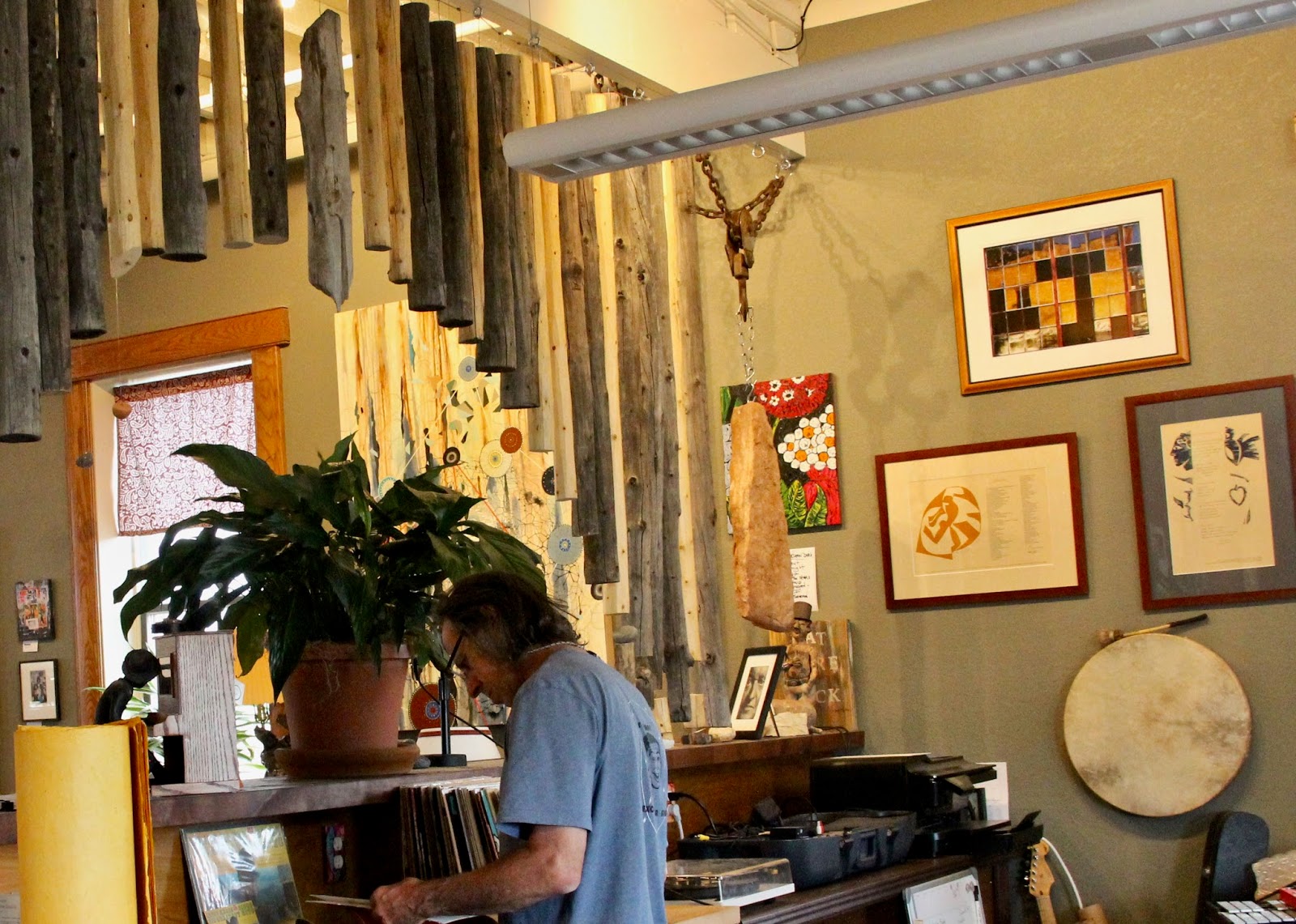
Lithic Bookstore & Gallery—a space for design, sales, poetry readings, contemplation, inspiration.
Danny Rosen, at the office.
Last September, I stopped in Fruita to enjoy the local literary scene, as I do most years. This time I cornered Lithic-owner Danny Rosen in his office. “I have some questions for you” I said firmly, swinging a six-pack for emphasis. We sat down for an interview.

How did the name Lithic Press come about?
The name stems from my background in geology; the word means stone-like or pertaining to stone. Also, it alludes to early methods of printing. Lithography involved spreading a greasy kind of ink onto etched limestone to print from one medium to another.

What kinds of books does LP publish—what subjects, genres?
So far, Lithic has published books of poetry—largely because that has been my interest. I would like to publish other genres in the future, like natural history. More than any particular subject matter, I want to work with writers who pay attention to language, tell intriguing stories, teach me something.

What’s your policy on manuscript submission?
We do not accept unsolicited manuscripts; we accept manuscripts largely by invitation. I had an open submission period last year for chapbook manuscripts (simple books, folded and stapled, 20-40 pages long). We received over 100 submissions. It was time-consuming to go through all of them, and unpleasant to send out so many rejections. I don't anticipate doing that regularly. But we did get a few books out of it.

Though we don’t advertise for submissions, they show up anyway … frequently. Seems everyone who ever wrote a poem wants a book. Maybe that's a reflection of “celebrity culture.” Being a publisher offers interesting viewpoints on human psychology! Recently we've been reaching out to writers we admire, asking for manuscripts. This year and next we have books coming out by writers in North Carolina, South Carolina, Oregon, New York, California, and Bombay.

What is the Lithic bookmaking process?
I facilitate the process. One way or another I find manuscripts (or they find me). I don't edit so much as closely read each manuscript to find errors and give suggestions. The books I've done for Jack Mueller required a lot of work, a labor of love. He's a close friend, and this friendship played a big part in the creation of Lithic Press. I wanted to publish his work—I love it so much and I think it has great value. Amor Fati took four years to complete.

Most of our books start with manuscripts that are fairly polished when we receive them—that’s what I want. My strength is to make books for strong writers, not to help make writers strong. The early phases can be very exciting, when the idea first turns into a concept of an artifact. We decide what the book will look like: size, shape, kind of paper and binding type, font and font size, and so on. Kyle Harvey does all the design and layout for Lithic. He is very talented and imaginative. I nudge him continually, to be open to what possibilities we may conjure: new kinds of paper, different presentations.
The making of a book presents possibilities at every juncture, on every page, like Jack Mueller’s The Gate, which we made as both an inexpensive chapbook and as a limited edition, cloth-bound, foil-stamped hardcover. For Kierstin Bridger's Demimonde, a book of poems written from the point of view of prostitutes in frontier mining towns in Colorado, we paired antique images with each poem and printed them on paper vellum pages.

I want every book to stand alone as a fine artifact—a handsome object that feels good in the hand, that makes a contribution to the human story—a little something to spread around, leave behind.
I’ve been fascinated with books all my life. As a kid, I was blown away by “All the Books in the Library.” To make something that will go into that library feels like important work. Someone said to me recently that I was like a midwife to the book. That’s a strange but accurate description. It’s awesome to hold a newborn book and usher it into the world.
Going Down Grand, Lithic’s pocket-sized book of poems for your next trip down.


Yet stones have stood for a thousand years, and pained thoughts found 
The honey of peace in old poems.
–Robinson Jeffers

Monday, May 30, 2016

Geopoetry: Counter Currents, by Danny Rosen


What lies on the counter does not lie, 
utters no false word, speaks volumes …

The edge of an indurated ash spear point says, 
100,000 years ago some man he sat here flaking, 
grunting, bleeding, thinking.

An iron cast of an iron ball in a lunar-like crater
but younger cretaceous only a place
for the thumb to thumb.
Rhombohedral calcite crystal, rhombohedrally needs to be 
picked up, felt about with fingertips looked at clear through, 
dirty, cloudy, angled, morphed and helpless.
(I could have been an evaporite without a tongue!)

A polished black chunk of Nama Dolomite fits ripe
in the palm, a coral brain, formerly sentient rock?
sandblasted a million years, can no longer talk.
(rock as a memory repository?) Spin, spin, spin ___.

Slow thought: shark tooth—great white 
from Carolina’s phosphate, dug up by the dozer load.
Dangerous sea. Hear the scream. Munch münch.

Professor in a white suit in full moonlight
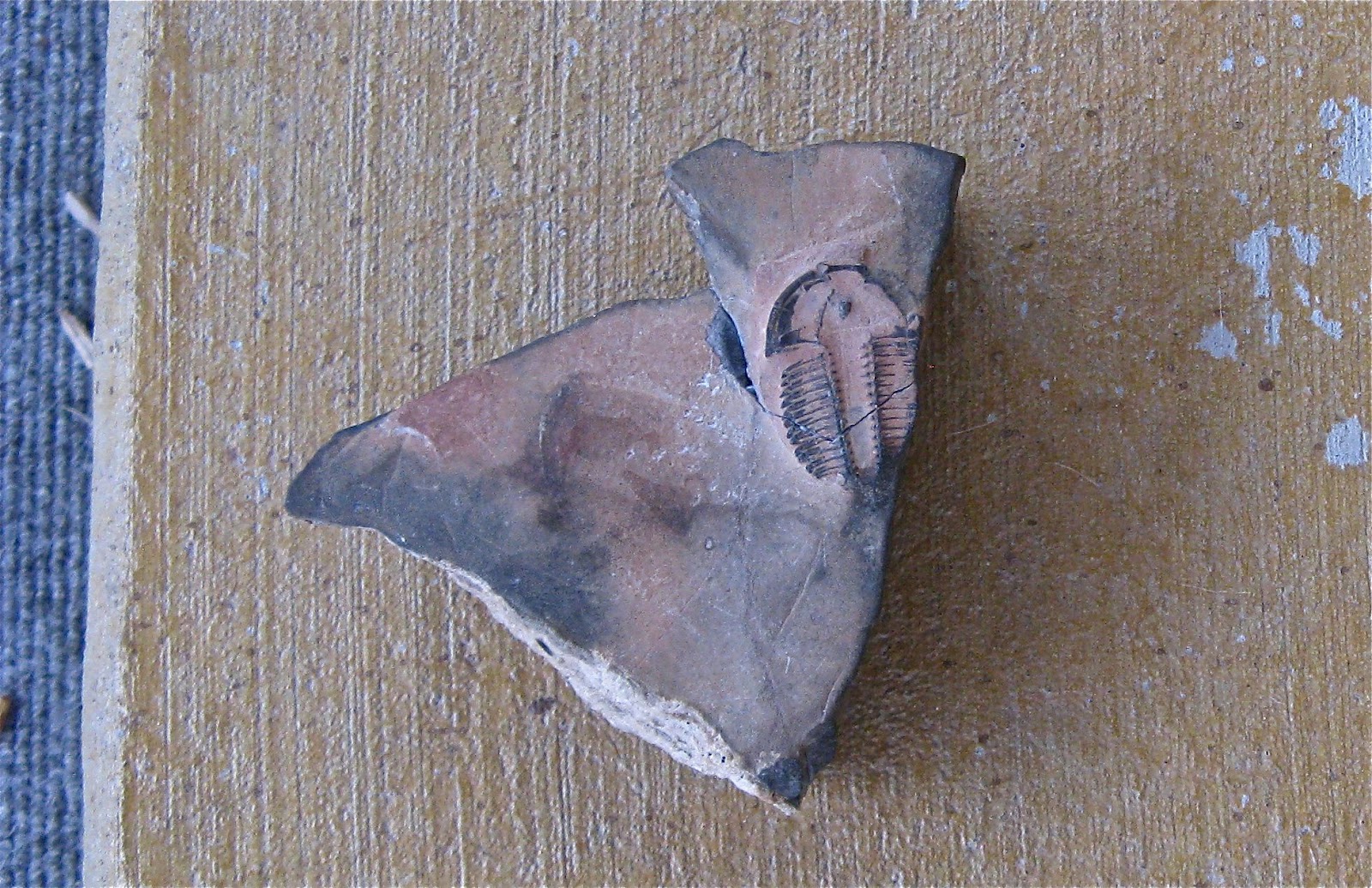
stole the fallen meteorite, that sits on a trilobite 
from older hills, (“in this country,” 
‘ol Spit Chin said, “you can be your own granddad.”)
(“when I first got that rock I slept with it”) 
Jesus is the name of the trilobite.
Trilobite Jesus
Rising from that space rock, a magnet tower
from the toy store, where the Toy Store Guy 
stood behind a display of force at a distance 
that made my head ice cream and leap with joy 
like a circus porpoise, like the tautness of air 
pushing air pushing on the counter one magnet 
against another - from a distance - is magic.
Pieces of air and small spaces between the pieces,
(at the super bowl party I dropped the pizza.)

A bowl turned by Old Sir John-On-The-Lathe, 
died 1845? Everyone spins his tops, like magnets
they attract thoughts of places that show 
the possibility of balance on a planet spinning,
slowly slowing down, begun to wobble—
and so reveal: The Reasons for the Seasons.
The Fall will come, that’s for sure, the wobbler
will wobble off the counter through the floor
to the center of a star – Fall In >< Fall Out – mind
goes supernova: the heat of molecular feeling felt.

Imagine, a white sand beach:
the pier you take evenings for a drink, (below,
small cilia undulate to and fro in pulsing waters)
you think: attach to pier, synthetic barnacles; 
spin, spin, spin, and so, Monkey Man learns 
to harness the Energy of Ocean Currents!

Photo by RC Koeppel.
• • •

Geologist and poet Danny Rosen lives in the Grand Valley of western Colorado, in a house filled with geological mementos. He is founder of the Lithic Press—an independent press publishing, primarily, books of poems—and recently opened the Lithic Bookstore and Gallery in downtown Fruita.
Rosens at the Counter, Danny supervising.

Sunday, March 16, 2014

"Never so ghosted or small as when alone ..."

"Never so ghosted or small as when alone
on the fragile truce of this strand where sky
and sea stretch what you can hold in the shell
of your ear, your film of skin, between your eyes,
standing on wrack and kelp amid the shoosh
of crisped surf on cockled sand and shore stones.

From further out you feel the heave and thrash
of black-green breakers, bull-headed hellbenders,
white-tipped whale waves, as the swollen lour
and weight of the world in water thunders
while crosswinds girl and breach to scour
and scrub clean the hollow and heft of yourself."

-- from On Cloughey Beach by Alan Gillis
Montaña de Oro State Park, California.

Sunday, February 9, 2014

Your African Fold -- sojourn in the Namib Desert

Quiver tree on Cambrian/Precambrian dolomite overlooking dunes of the Namib Sand Sea.

Guest post by astronomer, geologist, poet and good friend Danny Rosen.

From 2003 - 2008, for a few months a year, I ran an observatory and taught astronomy and geology in the Namib Desert in far southwestern Africa.  I wrote this poem during a period of observing the best sky I’d ever seen every night for three months. There was essentially no light pollution. The Southern Cross, Alpha Centauri and the southern Milky Way were enough, but going deeper into the sky with a fine telescope was life changing. The poem sprouted when I began sleeping under the telescope to more easily wake for pre-sunrise viewing. I got caught up in the rising and lowering of the horizons, the planetary spin, and at some point imagined the eye of a Nautilus at the center of its spiral looking out -- like the human eye in the Milky Way.

As astronomer in residence I stayed up later than anyone and walked back to my room alone. There were animals about, and endless stories of rough encounters, some nearby, not all were just legend. I heard footsteps all the time and set folding chairs around my head to keep curious hyenas away. Lured by CO2, they are known to take investigative face bites of unwary campers.

The center of our galaxy is in the direction of the constellation Sagittarius. It’s dense that way: fields of stars, clusters of stars (butterfly, coathanger, jewell box), nebula seen with the naked eye, and the big and small Magellanic Clouds, spinning around. From Namibian latitudes this area of the sky is especially bright -- seen almost straight overhead, where we look through the least of our atmosphere, the stars are most clear. (We can see Sagittarius from mid-northern latitudes but it never gets very high above the southern horizon -- so, we look through a thicker slice of the atmosphere and the view is not as sharp.) That’s a good reason in itself to travel south.

Paul Theroux, in Dark Star Safari, wrote that V. S. Naipaul helped him see the comedy of Africa. Tragedy is more obvious with all the difficulties of the post-colonial period, and ever burgeoning and needy populations. People die young, life goes on, there is laughter and song, silly things are done, vehicles get stuck in the sand, there are difficulties with the hi-lift jack ...

It’s a hard rock desert canyon landscape inhabited by people whose ancestors go way back, overlain with a European cultural fabric, and a vestige of Pleistocene megafauna. Rhino on the desert floor. Continental knife and fork at the German Club. Eco-lodges with camouflaged diesel generators.
Des with Bev

Your African Fold

The sunrise in your gray eyes speaks
the history of man with no words.
Silence spirals across the sky.
This nautiloid look from the inside.

Wrapped in saugins and duvet,
with eyes wide against the sounds
outside, trembling at your footsteps
in the dawn moonlight, Sossusvlei,
I miss your naked eye nebula,
your pale chanting evenings,
the truth of your false cross.
I still see the baboons staring
down the gravel highway I drove
all the way to fata morgana herself,
her moist finger motioning me to jump
from the cliffs of my unspoken east.
I can still hear the what-what of your
quick click chit chat this that and the other,
tell me another story so hard from the start,
far from home, close to the heart. The tragedy
of the easy tip, the comedy of the kitchen lip,
the opera of the landy stuck in the sandy
and old jack hi-boy only knows one way to go.
Pull the damned thing out, sounds
Mr. Basso Profundo, ‘un-air these tires man,
get thee out of this godforsaken land.
’Godforsaken? Why,
here He comes just now, walking
through the shadow of a quiver tree,
out across the gravel plain, walking on one leg
with one arm and one eye that can still find
the road ahead. Namib lands,
I’ll sail through your lagoons anytime,
and paint butterflies in your sand all night.
I’ll lay by your side as you die before your time,
and see you rise again with Mimosa. Mimosa,

I can still feel the bowl of your soft dark belly
hanging above me every night, tucking me in,
rolling me over and over until I’d been rolled
into the arms of your African fold.

☆☆☆☆☆

Sossusvlei is an area of the central Namib Desert. The name derives from the Nama word "Sossus" -- no return or dead-end -- and the Afrikaans word "Vlei" -- marsh (similar to a playa lake). Gervasius Nangolo, a handyman, was a good friend -- he had gray eyes. Pale chanting goshawks are a common bird of the Namib. The False Cross is an asterism made of stars in the constellations Vela and Carina (part of the mythological ship Argo Navis that Jason sailed on his quest for the golden fleece). Many native people of the Namib, and throughout southern Africa, incorporate clicks into their language. Quick, loud, sharp clicks. Talk radio is great! (here's a cool instructional video).

Quiver trees (Aloe dichotoma) almost resemble Joshua Trees but have a more surreal nature. Gravel plains are the desiccated remains of horizontal rock layers that have broken down in place and been transported very little. They are emblematic of how geologically stable the area has been since Gondwanaland broke up and Africa split away from South America 130 million years ago. The “Lagoon” is a nebula in Sagittarius. The “Butterfly” is a star cluster in Scorpius. A “lay-by” is a roadside rest with a picnic table. I spent part of every night with Mimosa -- a star in the Southern Cross. For some reason, I thought the word "saugins" was a kind of blanket or comforter, but when I later looked it up, I couldn’t find it at all. Apparently, I made it up, but kind of liked the sound of it anyway and decided to keep it.
The quiver tree (Aloe dichotoma).
Euphorbia virosa -- the poison tree, 
Fairy circles below the Virgin's Nipple. Various explanations for the barren, sandy or gravelly circles in the midst of grassy plains have been proposed over the years, including ants, termites, and grass-killing gas emanating from the soil. A recent hypothesis suggests they're caused simply by plant competition for water and minerals. As University of Wyoming's Doc Mears might have said, probably all these possibilities are true in part.
Hartmann's Mountain Zebra, commonly seen on the Namib grasslands.
Gemsbok (Oryx gazella) on thick grassland (the area averages less than one inch of precipitation per year).  "Oryx" are a signature species of the Namib.


Dan Rosen lives outside Fruita, Colorado, where he runs the Western Sky Planetarium and Lithic Press, a free independent press devoted to making fine books for an old planet.

Friday, January 17, 2014

A Letter to the Earth from S. H. Knight, Mr. Geology of Wyoming

Dr. Samuel H. Knight in 1916, his first year on the faculty at the University of Wyoming.  By the time he retired in 1966, he had taught an estimated 10,000 students.  American Heritage Center photo.

[Note to readers: this email message arrived yesterday.  I about fell over when I read it!]


Dear Madam:

One of our recent arrivals lit up with delight when we were introduced, for he had read about me in a blog ... and of the fossilized Algal growths (stromatolites) of the high Medicine Bow Mountains.  I was quite surprised, pleasantly so, and I had to ask:  “What is a blog?”  He's still explaining.  It’s taking awhile as I knew nothing of the Web, the Internet, etc., but we don't mind.  We have plenty of time, an eternity in fact.

He showed me your articles on his little computer, and though I still don't understand how they came to be, I am absolutely delighted!  Such lovely color photographs and so realistic!!  I sincerely hope that many many readers will not only enjoy these “posts” as they’re called, but also take the information, maps, etc., and go see for themselves.  Studying the remains of two-billion-year-old tropical algae in an alpine setting was for me one of the most exciting experiences during my life on Earth.

My new friend also explained how I could contact you (with his help of course).  I am doing so in the hope that you will find of interest my poem about the Algal mats of the Medicine Bows.  It concluded the speech I delivered at ceremonies naming the “S. H. Knight Geology Building” on the University of Wyoming campus on August 2, 1974. Probably you will think it old-fashioned; after all, the lines do rhyme.  If you happen to like it, you are welcome to include it in your blog.  In any case we will continue to read In the Company of Plants and Rocks, so do blog on.  We have plenty of free time up here, and I’ve been told that our internet access is instantaneous and throughput infinite.

Sincerely,
Samuel H. “Doc” Knight
Professor Emeritus, Department of Geology, University of Wyoming


[Doc Knight (if you happen to be reading this) -- I like the poem very much, and of course I want to share it!!]
"High near the crest of the Medicine Bows" in southeast Wyoming.

In commemoration of two billion year old Algal growth-patterns,
Nash formation, Medicine Bow Mountains

High near the crest of the Medicine Bows
Where an alpine meadow grows,
Where columbines nod azure heads
And purple gentians make their beds

Fire-scarred trunks of fallen spruce
Like giant jack-straws, scattered loose,
Etched by blasts of driven snow
As seasons come and seasons go.
... and purple gentians make their beds


Things were not always thus
Time has changed the Earthly crust,
The crust was once an ocean floor
Two billion years ago -- and more.

Bent and rent by crustal blows
Marred and scarred by glacial flows,
Sculptured by erosion’s incisive knife
The fossil remains of primal life.

Patterns spun on algal looms
Locked forever in marble tombs,
Nurtured in the ancient sea,
Prophetic of the life to be.

... nurtured in the ancient sea, prophetic of the life to be.

[This poem was included in A Collection of Verse by Samuel Howell Knight, published by his children on September 1, 1974.]
Portrait of Doc Knight, from the University of Wyoming Geology Museum.

Monday, October 22, 2012

Poems for the Inexplicable

Franciscan Complex up close, near San Simeon, California.
I’m from California's Central Coast, home to the Franciscan Complex.  It’s a good thing I waited until I moved to Wyoming to learn about geology, otherwise I would have been totally turned off!
“The whole point of geology is to make sense of the rocks ... If all rocks resembled the Franciscan complex, no science of bedrock geology would have emerged.” (David Alt and Donald Hyndman in Roadside Geology of Northern and Central California, Mountain Press Publ. Co., 2000).
I’ve contemplated writing a post about the craziness of the geology there, the chaos that occurred as the North American Plate overran the Farallon Plate, and that continues today as the Pacific Plate bumps and grinds against the North American.  The resulting scenery certainly is fantastic!  But I always end up intimidated.  The story is just too complex -- multiple accretionary events, goo scraped off subducting seafloors, blueschist, eclogite, serpentinite, mantle rocks now at the surface, major shifts in the dance of the plates, repeating ophiolitic suites of shale, chert, pillow basalt, peridotite and gabbro, and of course the infamous Franciscan mélange -- all deformed again and again. Perhaps this inexplicable mess is better suited to awe and wonder, poetry and photographs.
Point Sal, home to the Coast Range ophiolite.
 The Big Sur Coast, a coast of dreams.  Photo by Ronn Koeppel.

Move

Fog softens the scuffle
of rock against rock
crashing waves
are just
caresses
gulls call is
muted by mist
while what we call
eternal moves a little
and then, suddenly, a lot
shredding itself into
piles of debris
squeezing
its innards out
for all to gape at:
“Oh my god thats so incredible
I must get a photo please
move a little to
the left.”

And from Robinson Jeffers:

Carmel Point

The extraordinary patience of things!
This beautiful place defaced with a crop of surburban houses--
How beautiful when we first beheld it,
Unbroken field of poppy and lupin walled with clean cliffs;
No intrusion but two or three horses pasturing,
Or a few milch cows rubbing their flanks on the outcrop rockheads--
Now the spoiler has come: does it care?
Not faintly.  It has all time.  It knows the people are a tide
That swells and in time will ebb, and all
Their works dissolve.  Meanwhile the image of the pristine beauty
Lives in the very grain of the granite,
Safe as the endless ocean that climbs our cliff.  --As for us:
We must uncenter our minds from ourselves;
We must unhumanize our views a little, and become confident
As the rock and ocean that we were made from.
Searching for enlightenment at Big Sur, in the day.

GeoPoetry is the topic for this month’s Accretionary Wedge, hosted by Matt Herod at Geosphere.

Thursday, April 26, 2012

Trilobite Jesus, A Geological Pilgrimage

By guest blogger Danny Rosen, geologist and poet, for Accretionary Wedge #45, Geological Pilgrimage.  Photos by Hollis.
I wanted a trilobite. I wanted to find one myself. I was prepared to go a long distance. My buddy Bert, a fellow federal garbageman, told me of a friend whose brother had a rock shop in Delta. I drove to Delta. Lyle probed to find out if I was a seller in disguise. Nope, I just wanted to find my own trilobite, and I knew Bert. Lyle drew a map. I filled my water jug and drove out of town on Highway 6, turned onto gravel west of Hinckley, headed over Marjum Pass toward the Wheeler Amphitheatre in the heart of the House Range.

I spent a couple days walking the sharp ridges, turning over detritus, finding many fragments, sleeping under Cambrian skies. The only other people around were a couple of Lyle’s men, working a quarry. At last, I found Trilobite Jesus, Elrathia kingi, one-eyed and quiet, segmented and frozen, beautifully imperfect. I asked the man what it was worth. He eyed the jagged hard shale and said, “Well, if a Texan wanted to give fifty bucks for it, I’d take it.” We’ve been together ever since, almost thirty years, Trilobite Jesus and me.
Danny and friend.
Trilobite Jesus

He didn’t die for my sins,
but from a sudden build-up of ash, 
a thickening weight. 

The last new level of the sea found him 
awash on a hardened beach, by a river,
burrowed in, covered over, fast asleep 
in far Utah, able to send one last signal,
as the mud thickened about his lobe, 
all his work turned to stone, he lost hold 
of every belief. Trilobite Jesus.

He did not die for my sins,
but He came back,
and I am drilling a hole in His head
with a carbide hammer-drill bit,
to wear Him around my neck
like an albatross, to mark this moment,
this moment on the cross.