Showing posts with label palms. Show all posts

Wednesday, June 8, 2022

Belated Tree-following at Fossil Lake

A lake in southwest Wyoming, lined with palm trees!
This month there's little to report about the trees I'm following aside from a bit of green in the aspen canopy—emerging leaves I think (forgot binoculars). Instead I have news about a tree I tried to follow five years ago, a Wyoming palm. This was not an extreme cultivar able to survive -10º to -40 °F average annual minimum temperature but a native. However, Wyoming palms went extinct millions of years ago, and now exist only as fossils.
Powell Palm, Sabalites powellii, at the U. of Wyoming Geology Museum (also called Palmites sp.).
That year (2017) I had hoped to visit Fossil Butte National Monument in southwest Wyoming, where the palms used to grow. I would go after finishing a field project nearby. But a June blizzard intervened. Three weeks ago, there was another opportunity, on my return trip from the Great Paleozoic Sea, but again a blizzard threatened. This time I ignored it, for awhile.

Above, Fossil Butte National Monument in the high dry desert of southwest Wyoming (NPS, Tyra Olstad photo). Below, same general area 52 million years ago.

Lotus plants (Nelumbo sp.) in foreground; click to view dragonfly and mosquitos.
My first stop was the Visitor Center, small but packed with fossils and information. A ranger greeted me and offered a tour. "Absolutely!" I replied. "Can we start with plants?" I followed him to the Plant Wall. In addition to the familiar palm leaves, there was a palm inflorescence and many other plant fossils, with modern genera surprisingly (to me) well represented.
Plant Wall at Fossil Butte NM (NPS photo). Below left of the palm leaf on the right is a palm inflorescence.
Like today's palms, those at Fossil Lake had large inflorescences with hundreds of tiny flowers.
Fossilized palm inflorescence.
Fossilized palm flower (NPS photo), c. 8 mm across.
Fifty-two million years ago, in what would become southwest Wyoming and adjacent Utah and Colorado, there were three large lakes, larger even than our Great Lakes. These were Lake Gosiute, Lake Uinta, and Fossil Lake. The last was the smallest, but its sediments were especially rich in plant and animal remains. The now-lithified sediments of Fossil Lake are famous for abundant well-preserved fossils.

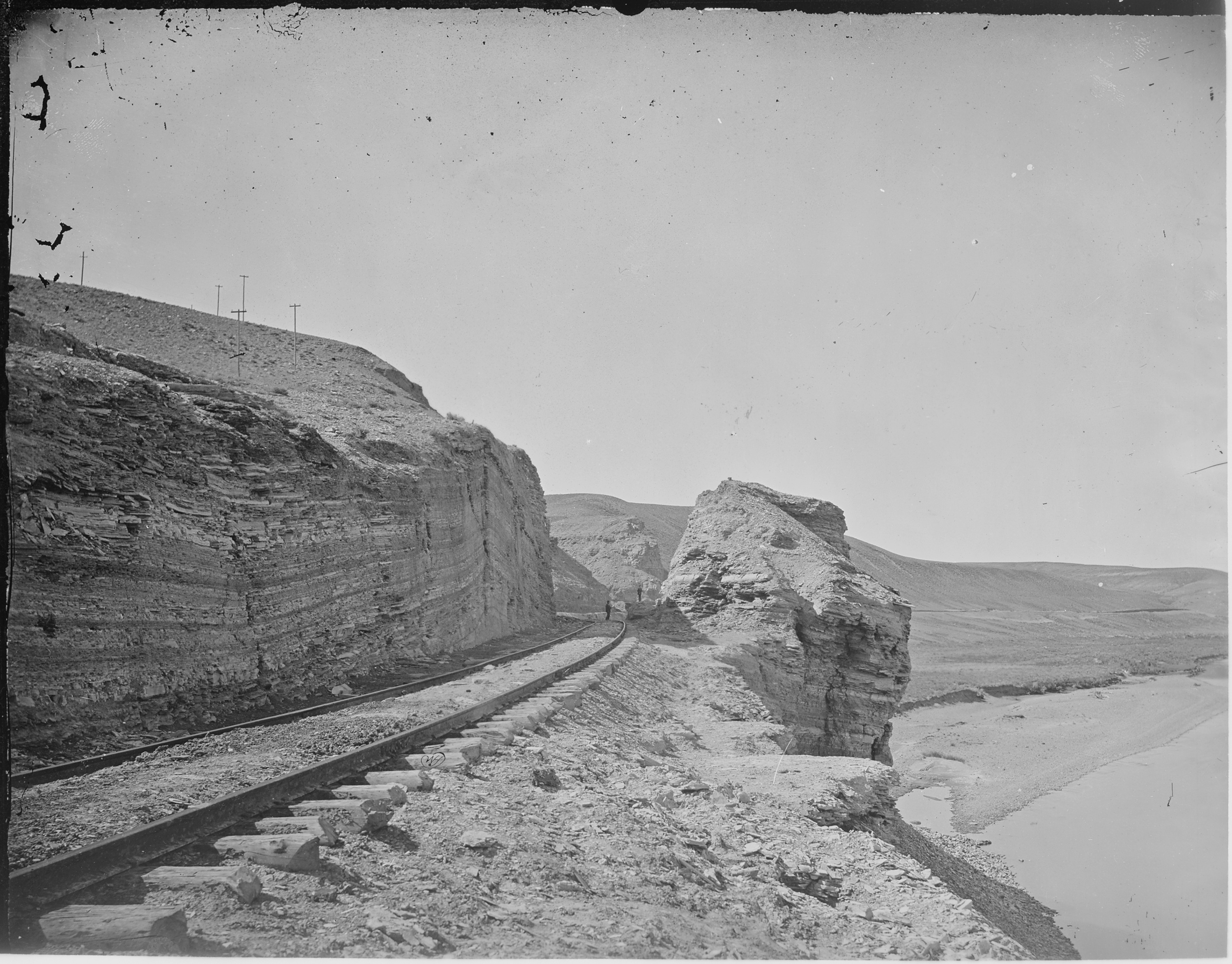
Petrified Fish Cut near Green River, Wyoming, excavated in 1868 during construction of the transcontinental railroad. William H. Jackson photo, 1869 (Hayden Survey) (source).
Fossil Lake's Knightia (the many small fish in this photo) is said to be the most common of vertebrate fossil in the world. It's also the state fossil of Wyoming (photo by Mike Nelson).
This ray fossil is an example of the exceptional preservation at Fossil Lake (NPS photo). As I learned on my visit, rays usually aren't well preserved because they have cartilage rather than true bones.
We finished the tour at a diorama showing southwest Wyoming 52 million years ago. Dioramas of ancient worlds have enchanted me since I saw my first, 60+ years ago. I've never outgrown them, though I now know there can be a fair amount of informed speculation involved.

The many diverse creatures and plants preserved in Fossil Lake sediments indicate the climate was warm and humid. Vegetation along the shoreline was lush, with forests of palm, cinnamon, maple, and oak inhabited by mammals small and large, including some of our ancestors.

Yikes! Is that a giant oreodont approaching upper left?

As we finished, I asked the ranger about his background. Just five days earlier he graduated from university in California, then drove for two days to Wyoming, and went to work the next day. He was eager to share the joy of visiting the distant past, and his enthusiasm was contagious. Lucky me!

Next I hiked the nature trail, past high desert cushion plants blooming profusely in light snow and howling wind. The blizzard was closing in. I decided to skip the old quarry, where I would have seen remnants of Wyoming palm habitat up close. That and much more await another visit. I raced home ahead of the storm, easy to do on Interstate 80 with a ferocious tailwind. Good mileage too.

Sources

Grande, L. 2013. The lost world of Fossil Lake. University of Chicago Press.

McGrew, PO, and Casilliano, M. 1975. The Geologic History of Fossil Butte National Monument and Fossil Basin. NPS Occasional Paper No. 3.


Tuesday, October 10, 2017

Goodbye Sabalites ... Hello Boxelder?

If I had an extra $85,000 (64,000 £), I could have Sabalites right here in my own home! Then I wouldn’t need to travel (5-foot slab, Denver rock show; photo courtesy Mike N).

* * *

For the second time, bad weather foiled my plan to travel to southwest Wyoming to visit what was once the home of Sabalites—a fossil palm I was following. Just like in mid June, a surprise spell of rain, snow and cold arrived. But this time I knew it would get colder, not warmer, so I'm moving on—choosing another tree to follow for the year to come.

After four years of tree-following, I now have realistic criteria for choosing a tree. Actually, there are only two: easily accessible and dynamic. It needs to be somewhere that I can get to on short notice if necessary, and in whatever weather. And it needs to do things! or be where things happen. There are some impressive conifers not far away, but from our perspective, they hardly change through the year. So I’m considering deciduous trees in or very close to town.
The cottonwood on the Laramie River that I followed in 2014 (photo taken yesterday).
A leading candidate is a boxelder (aka ashleaf maple, 3-leaf maple, Acer negundo) just five minutes from my house. It’s a tough little “street-tree” that manages to survive in the light-industrial / riparian ecotone on the edge of town (ecotone = biological transition zone). This area is vegetated mostly with herbaceous species—Canada thistles, dandelions, tumbleweeds, knotweeds, and such. Most people call them weeds, but really they’re pioneering species able to colonize disturbed sites (like yards). I think they’re under appreciated, which is another reason I’m interested in following this tree.
Being deciduous, the boxelder will reveal a lot more about its life than a conifer would—buds, flowers, leaves, changes in color, and surely things I can't predict. The next photos show it at the height of the growing season in 2015. [Recently, the old palettes and trash that accumulated in this nook were hauled off. Hopefully no one will decide to remove the boxelder in the interest of urban renewal!]

Now, most of the leaves are dead, killed by frost. Interestingly, the few that catch late afternoon sunlight still show signs of life.

Living where it does, human activity will contribute drama to the boxelder's life—delivery trucks, trash that comes and goes, and, for the next year, road construction.
Boxelder in corner by parked car.
Road construction in foreground, Murdoch's warehouse in mid-ground, riparian habitat in distance. 
The big cranes on the skyline are installing a new bridge across the railroad tracks.


Monthly gatherings of tree-followers are kindly hosted by The Squirrelbasket. Consider joining us; it’s easy and always interesting! More information here.


Friday, April 7, 2017

Following a Tree, from Fronds to Rebar


April 7 has arrived, and being a tree-follower, I’m posting the latest news of my tree at the monthly gathering kindly hosted by The Squirrelbasket. If you like trees and would like to join us, check out the links above (it’s interesting and fun, with no obligation).

This year I’m following an extinct tree—Sabalites powellii, a palm that grew in southwest Wyoming 50 million years ago. I discovered it in December in our Geology Museum, and in May I will visit its ancient habitat. In the meantime, tree-following consists of learning about Sabalites and its world. This month, I decided to look into its wood. The Green River Formation—the rock layers where fossilized fronds have been found—also contains fossilized palm wood. It’s common, beautiful, and popular with collectors.
Fossilized palm wood is the state rock of Texas (source).
However, my search for “Sabalites wood” was futile, both in Google and the scientific literature. That’s because fossil palm wood is called Palmoxylon. Is this weird? Are paleobotanists exceptionally obsessed with publishing new names?
Sabalites powellii, a fossil palm frond “species” from southwest Wyoming.
Palmoxylon includes 200+ “species” of fossil palm wood (source).
Plant fossil names proliferate because paleobotanists are faced with an unfortunate situation. Most fossilized plants are actually fossilized plant parts—leaves, branches, flowers, etc., that fell off some plant. Generally there’s no way to know if different parts came from the same species, so they’re given different names.

Palm wood usually is easy to recognize. Cutting a petrified palm trunk cross-wise reveals a characteristic pattern of scattered dots—the vascular bundles that conduct water and nutrients up and down trees.
Cross-section through petrified Palmoxylon log (click on image to view dots; source).
Length-wise view of Palmoxylon (source). Xylon means “one having (such) wood—in generic names” (Merriam-Webster) … in this case, having palm wood.
In most trees (dicots), vascular bundles are arranged near the perimeter, but in monocots, they're scattered through the stem (diagram below). Monocots include orchids, grasses, lilies and more. Most are herbaceous, but a few produce wood and grow large, e.g. yuccas, bamboos and palms.
Cross-sections through dicot and monocot stems (source, modified).

Wait a minute!!! As botany students we're taught that monocots don’t make wood. Wood is produced by secondary growth in the vascular cambium (below), and monocots have no vascular cambium. Yet palms are monocots and obviously woody … ??
In dicots, wood develops from secondary growth via the vascular cambium (source, modified).
Large monocots are said to produce strong trunks through abnormal secondary growth. I think we call it “abnormal” because it’s disorderly and hard to categorize … and poorly understood. Webpage after webpage explains that palms thicken their trunks through diffuse secondary growth, in which parenchyma cells divide and enlarge. And yet a recent study revealed that at least some palms have a vascular-cambium-like meristem! (Botánico & Angyalossy 2013; article here):
“… we analysed palm stems of four species, with the aim to understand the possible presence of such secondary growth. We found that a meristematic band occurs between the cortex and the central cylinder and gives rise to new vascular bundles and parenchyma internally, producing parenchyma and fibres externally. … In fact, a meristematic band is present and may be more common than currently believed, but uneasy to detect in certain palms for being restricted to specific regions of their stems.”

Palms’ tough rigid tissue may not be “true wood,” but it’s called wood and functions as wood. Some kinds are used in construction, including that of the coconut palm. Wood from the outer part of the trunk, where the vascular bundles are dense, is harder even than oak and Douglas fir (source).

In fact, sometimes palm wood is better than true wood. It's more flexible—palms can bend 40º without breaking! The tough fibrous vascular bundles scattered through the trunk serve as plant rebar—like the steel rods that give strength and flexibility to reinforced concrete.
Flexibility is a great adaptation in hurricane-prone environments. Courtesy US Navy.
When a tropical cyclone tore through this rainforest, the palms were left standing (source).

We'll stop here. Once again, tree-following has taken me on a winding journey, this time to fossil palm wood, woody monocots, meristems, vascular bundles and finally rebar. We’re lucky there’s so much of interest in this world!


Thanks to Mike of CSMS Geology Post, for continued paleontological guidance.

Saturday, March 11, 2017

Tree-following: Wildlife

Sabalites in the hallway to the University of Wyoming Geology Museum.

We tree-followers have gathered once again to report on the status of our trees, the ones we’ve chosen for the year. Mine is a Sabalites palm tree that grew in southwest Wyoming 50 million years ago, and then went extinct. It must have been common around ancient Fossil Lake, and fairly close to shore, because many intact frond fossils have been found in lake sediments now turned to rock—the Green River Formation.

I won’t visit Sabalites in its native habitat until it's warm enough for an outdoor vacation, and our local Sabalites, on display in the Geology Museum, doesn’t change from month to month. So what to report? Sometimes tree-followers write about wildlife seen on or near their trees; this month I’ll do the same.
Knightia and Sabalites. Courtesy CSMS Geology Post.
My wildlife sighting was a school of Knightia, small herring-like fish. They were swimming around a large Sabalites frond that was floating in warm subtropical water near the lushly-vegetated shore of Fossil Lake. But wait … there’s something wrong with this idyllic scene. The fish weren’t swimming … they were dead!
Mass mortality slab, University of Wyoming Geology Museum.
How ironic that mass die-off was preserved in exquisite life-like detail! (NPS photo; click to view).
Fossil Lake occupied the southwest corner of Wyoming early in the Eocene Epoch.
Fossil Lake was the smallest of the large Eocene lakes of southwest Wyoming and adjacent states, yet it’s exceptional in terms of the number of Knightia fossils it left behind. In some “death layers” there are 100+ per square meter—over an area of tens of thousands of square meters! Millions of Knightia fossils have been excavated—it’s the most common fish fossil in the world! In 1987, it was designated the state fossil of Wyoming.
Most common vertebrate fossil or fish fossil? Both claims are out there.
The Fossil Butte Member of the Green River Formation includes many mass-mortality layers, representing multiple events scattered across thousands of years. Apparently die-offs were not rare catastrophes, but something that occasionally happened under specific conditions. But those conditions remain a mystery. Maybe fish were poisoned by cyanobacteria, or suffocated by super-blooms of algae, or killed by changes in water temperature or chemistry or both. Maybe Knightia was especially susceptible. Its modern-day relatives, the herring, are known to die off en masse in response to sudden environmental change. Fortunately herring recover quickly—one fish can lay 200,000 eggs at a shot! Maybe Knightia was equally fecund.

Knightia had more than environmental change to worry about. Given its abundance, it probably was the main food for predator fish, like Diplomystus dentatus below. This fossil is not from a mass mortality bed, so what killed it? “It most likely died from starvation or suffocation because it could not spit the Knightia out” (NPS).
Did Diplomystus' dinner do him in? (NPS photo; click to view the remarkable preservation).

For more tree-following news, check our virtual gathering. And consider joining us ... it's amazing what we learn when we follow trees. There's always something interesting, and never any pressure or obligation :-) Thanks to The Squirrelbasket for hosting!


Sources  (in addition to links in post)

Grande, L. 2013. The lost world of Fossil Lake. University of Chicago Press.

National Park Service. Geology Field Notes, Fossil Butte National Monument.

Virtual Museum of Geology. Green River Formation.


Friday, February 10, 2017

A Powell Palmetto Perhaps?

Am I following a palmetto?
Sabal palmetto (source).
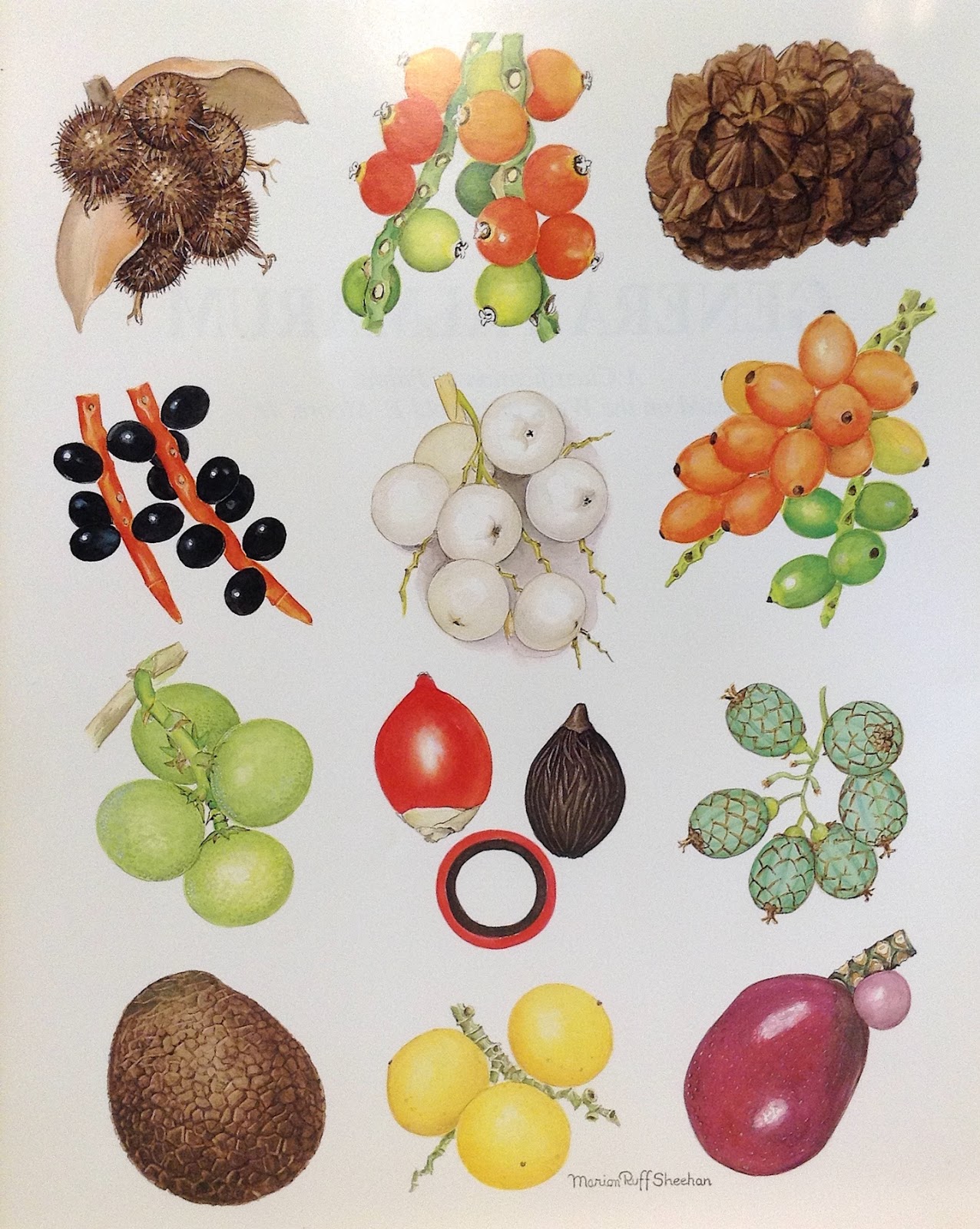
I’m intent on learning more about palms, as I decided to follow a palm tree this year (unfamiliar with tree-following? click on the link). My tree has a name, Sabalites, but what kind of palm is it? No one is sure. There are lots of choices—the palm family (Arecaceae) is large and diverse. It includes five subfamilies, 16 tribes, 2500 species, and many products consumed by humans: coconuts, dates, oil, betel chew, rattan and more. Most palms grow in tropical or subtropical regions, and occasionally in deserts.
Selected palms of the world; click on image to view details (source).
Palm fruit are beautiful as well as delicious (Dransfield et al. 2008).
Desert fan palms near Twentynine Palms, California (source).
When I lived in California, I was familiar with palm trees—specifically the ones planted along highways and in cities, and the native fan palms of desert oases, Washingtonia filifera. Then I moved to Wyoming where currently it’s much too cold for palms. However, fifty million years ago they lined the shores of huge lakes in the southwest part of the state. Even though their leaves are beautifully preserved in rocks of the Eocene Green River Formation (more here), no one is sure what kind of palms they were. Since I started following this tree, I’ve learned that plant fossil identification is really tough. Even the most challenging living plants are easy compared to fossilized ones.
Fossil Lake of Early Eocene Wyoming (Chicago Field Museum).

In 1870, geologist Ferdinand Vandeveer Hayden’s exploratory expedition stopped near Green River Station, Wyoming, where they found lots of fossils. Some looked very much like palm leaves. In the expedition report, staff paleontologist Léo Lesquereux assigned them to Flabellaria Eocenica. I don’t know why … modern day Flabellaria is not a palm, nor do the leaves resemble palm leaves.

Later, Hayden sent the fossils to paleontologist John S. Newberry of Columbia College, who decided they looked enough like today’s palmettos, genus Sabal, to call them Sabal powellii (I presume in honor of geologist John Wesley Powell, then Director of the US Geological Survey, but I haven’t been able to confirm this). The Powell palmetto was one of ten new fossil plant species from the Green River area published by Newberry in 1882.
8. SABAL POWELLII, n. sp. Leaves of medium size, 4 or 5 feet in diameter, petiole smooth, unarmed, terminating above in a rounded or angular area, from which the folds diverge; beneath concavely narrowing to form a spike 3 to 4 inches in length; rays about fifty, radiating from the end of the petiole, perhaps sixty in the entire leaf, compressed to acute wedges where they issue from the petiole, strongly angled and attaining a maximum width of about 1 inch; nerves fine, about twelve stronger ones on each side of the keel, with finer intermediate ones too obscure for enumeration. Formation and locality. — Eocene strata. Green River Station, Wyoming.
Why did Newberry conclude that these fossils were palmettos? Because the leaves are clearly costapalmate. (Yes, this is an esoteric term, but the concept is easy and useful.)
Costapalmate leaf of the Puerto Rican hat palm, Sabal causiarum (source).
Palm leaves are huge, with blades divided into many narrow segments arranged in several different patterns. In palmate leaves, segments fan out from the base of the blade—like fingers from the palm of a hand. In costapalmate leaves, the leaf stem (petiole) extends up into the blade to form a costa, where leaf segments are attached. The costa is only visible on the underside of the leaf, and from above, leaves look palmate. [Here’s a helpful webpage devoted to costapalmate palm leaves.]

In a paper about extinct floras of North America (1898), Newberry included a photo of a Wyoming palm leaf fossil with an obvious costa. “In the figures given, that on Pl. LXIII, fig. 6, represents the under side of the leaf at its base, showing [a] pointed spike [costa] formed by the prolongation of the petiole.”
From Newberry 1898; no scale provided (leaves can reach 4-5 feet across).
Unfortunately, costas are not unique to palmettos, and in 1930, paleobotanist Edward W. Berry overrode Newberry’s decision, renaming the fossils Sabalites powellii:
[the leaves] “are superficially much like the leaves of the existing species of Sabal, and their northern range appears to afford some corroboration of such a relationship, but this is by no means established, and it appears to me to be a better practice to refer such remains to the form* genus Sabalites rather than to Sabal.”
[*In form classification, fossilized organisms or their fragments are classified based on appearance, not biological relationships. If different parts of a single species are not obviously from the same source, they may end up as different form species or even genera.]

Robert Read and Leo Hickey agreed with Berry in their 1972 Revised Classification of Fossil Palm and Palm-like Leaves. They were adamant that leaves alone are insufficient evidence:
“Numerous similarities in the form and gross external features of [fossil] palm leaves make it difficult or impossible to assign them to modern genera based only on their external morphology. The uncertainty … becomes even greater with the limited, incomplete collections available to the paleobotanist. A modern specialist might speculate that a given fossil closely resembled a modern genus such as Sabal, Geonoma or Thrinax. Such a suggestion would be debatable since it is almost impossible to distinguish these genera … without seeing flowers, fruit or other diagnostic characters. Forced identifications with modern genera contribute nothing to evolutionary theory but give instead a confused picture of the floristics of the geological record. Since it is very difficult to identify specimens of modern palms accurately from their leaves alone, no attempt should be made to place fossil palm fragments in genera of modern palms unless unquestionably identifiable with them.”

Maybe we shouldn’t give up just yet. After all, thousands of fossils are collected from the Green River Formation every year! Maybe some will reveal the true identity of Sabalites powellii. There’s reason for hope. Paleobotanist Sarah Allen has been working nearby on another fossil palm, in the Bridger Formation, and has enough fossils—leaves, flowers and even pollen—to confidently assign the trees to Phoenix, the genus that includes today’s date palms (Allen 2015). Will we be so lucky with Sabalites? Already its fossils include not just leaves, but also apical buds, flowers, inflorescences (flower clusters), and even inflorescences attached to leaves. Are more discoveries likely? When I visit the remains of Fossil Lake later this year, I'll look for some experts and ask them what they think.
Fossil terminal bud, from the Green River Formation (in palms, leaves originate from a single terminal bud at the top of the trunk); University of Wyoming Geology Museum.

Personally, I hope paleobotanists find that Sabalites powellii is indeed a palmetto, and that they resurrect Newberry’s Sabal powellii. “Powell palmetto” has such a nice ring to it ...
We’re off to Fossil Lake to see the Powell palmettos!


Sources

Thanks to the Biodiversity Heritage Library for providing easy access to older paleontological literature, and to Mike for continued guidance in paleontology.

Berry, EW. 1930. A flora of Green River age in the Wind River basin of Wyoming. USGS Professional Paper 165: 67.

Dransfield, J., et al. 2008. Genera Palmarum, the evolution and classification of palms. University of Chicago Press.

Newberry, JS. 1882. Brief descriptions of fossil plants chiefly Tertiary. Proceedings US National Museum 5: 504.

Newberry, JS (A. Hollick, ed.). 1898. The later extinct floras of North America. Washington: Government Printing Office.

Read, RW. and Hickey, LJ. 1972. Revised classification of fossil palm and palm-like leaves. Taxon 21:129-137.