Showing posts with label rock climbing. Show all posts

Friday, June 30, 2023

Goodbye, Jan Conn—legendary rock climber, caver, musician & much more

Jan Conn (center) with her woodworking group.
Jan Conn passed away in May at age 99. She was a valuable part of my life, following a lifestyle to which I aspired, encouraging me in music, sharing my interest in native plants, and showing by example that being one's self, enjoying life, and helping others do the same are so important. Maybe this short account of Jan and our friendship will encourage others as well.

It was while I was working as a ranger at Devils Tower that I first learned of the Conns.
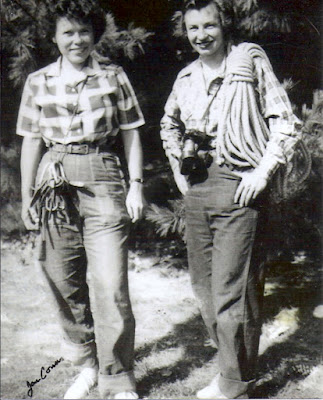
In 1948, Jan and her husband Herb drove to northeast Wyoming in their converted panel truck and climbed Devils Tower, an 800+ ft rock monolith rising from the valley of the Belle Fourche River. Jan thereby nabbed the first female ascent (not counting Linnie Rogers who used a wooden ladder). Four years later, Jan repeated the climb with Jane Showacre, making the first manless ascent.

Jan Conn and Jane Showacre after the first manless ascent of Devils Tower, 1952.
Devils Tower was just one stop of many in their wanderings. The Conns drove from area to area, living in their little camper, climbing, working the odd job, climbing, working, climbing ... actually mostly climbing. Really?? I totally understand the lifestyle, I know it well. But these people are old enough to be my parents! Yet that was indeed what they did, living the dream, doing first ascents and establishing new routes from the east coast to the west. The Conns have been called the first climbing bums. And after the great Fred Beckey passed away in 2017, Jan was anointed the oldest living dirtbag.
Jan and Herb in their converted panel truck, 1957 (source).
Camping at Devils Tower, 1956 (source).
In the early 1950s the Conns settled near Custer, South Dakota, in the high country of the Black Hills. The area was filled with granite spires, fins and massifs awaiting first ascents, which they happily supplied. Then in 1959, a friend introduced them to caving by way of a "small" local cave (Jewel Cave) and they were hooked. Supporting themselves by selling leatherwork, giving music lessons, and living really cheaply in the Conncave, they would discover and map 62+ miles.

By the early 1980s, they had "retired" from caving and returned to climbing. That's what they were doing when I had the good fortune to share a bit of their lives.

One day Jan invited me to an ascent of the 3BT massif (a classic Conn name meaning 3 Billion Tons). Should I, of intermediate skill, join two world-renown climbers? Sure, why not? After all, these were white-haired elf-like characters in their early 80s.

We followed a secret winding trail marked by subtly arranged pine branches to the base of the massif and into a deep rock-walled gully, which soon narrowed. Here I observed a conn-flict, a rare event. "Herbie, I think we go this way." Herb smiled, "No, we go up the gully a bit further." Jan wasn't conn-vinced, "But I remember that tree." "We need to head for that chockstone" Herb said, pointing up the gully. This conn-tinued for another minute or so until I interjected dramatically, "Quit fighting!!" We all burst out laughing.

Herb was right of course (he was the mapper in the family), and so we scrambled up the gully, wriggled around beneath the chockstone, roped up for a short section of easy climbing, and then strolled to the summit.
Getting close to the top!
Headed home after a successful ascent of 3BT.
Climbing was not the only kind of adventure Jan offered. One day, having learned I played recorder, she asked if I would come to the monthly Hootenanny (Jan was a product of the Beat Era). It sounded like fun until I learned that all attendees had to perform. She suggested we perform a duet for flute and recorder.

Oh dear. I was untrained and played only for my own enjoyment. Yet like all things Conn, it turned out to be fun. Performances ranged from a boy's poem about his frog (in his hand) to a phone company employee demonstrating how to hook up a new phone line. We fit right in. I would go on to play and perform with the French Creek Folk (Jan and any locals that were available) until I left the Black Hills.
French Creek Folk c. 20 years ago. Jan on bass next to Hollis on fiddle.
Jan was (in)famous for her yodeling, including underwater (watch here).
And there was more. Jan told me about an odd fern they had found on one of their climbs. Since I was a botanist, she was sure I would know it. The three of us went to investigate, with a rope. Herb led the climb, Jan and I followed. There they were—two different ferns, one of which I did NOT recognize. After consulting with an expert who confirmed that it was a significant range extension, we published our discovery in the American Fern Journal.
Botanizing by rope; Jan pointing to fern habitat.
Having shared some of my stories, I will finish with links to others. The Conns were special to many people in many ways. The final sentence of the first article below says it all: "It has been a wonderfully satisfying life for the Conns, just doing what appealed to them, and they are grateful if their fun has brought things of value to others." Indeed it has!!

Legacy Jan Conn, induction into the South Dakota Hall of Fame in 2011. 

Explorers of an Unseen World by Paul Higbee, South Dakota Magazine, revised & republished in early 2012 after Herb's passing.

Jan Conn: Always Improving (or, The Oldest Living Dirtbag) by Elliott Becker. 11/7/2017. Includes links to audio.

The Ups and Downs of Herb and Jan Conn by South Dakota Public Broadcasting. 05/03/23

For much more, see Wikipedia's Jan and Herb Conn article.
Herb and Jan at home in the Black Hills.

Sunday, July 28, 2013

Signs -- context is everything

The National Park Service awarded me the highest rating, A1, for my work at Devils Tower National Monument.  Congratulations to self!

Well, actually ...
... it was my campsite, Site 1 in Loop A.

The sign above had a lot more impact when it was on the summit of Devils Tower.  I bet no one disobeyed!
Devils Tower in northeast Wyoming, a rock climber's paradise.
Unfortunately, someone took the Chief Ranger climbing less than a week after we put it there.  Now it's back at the top of the talus slope, where it's often ignored.

☞   ☜
These signs are my meager contribution of detritus for Accretionary Wedge #58 -- Signs!, kindly hosted by Evelyn Mervine.  With free time so scarce these days, I considered sitting it out ... but tectonic forces are hard to resist!

Sign?  What sign?
Ignorance is bliss.  Sparky the Geo-Dog enjoys freshly-exposed red beds.

Saturday, February 25, 2012

The Many Mysteries of Rock


A rock climber marvels at the undulating thin cracks on Devils Tower ... how convenient!

Climbers know the rock they climb on intimately.  They know the basic types -- sandstone, limestone, granite.  They are experts on the nature of the rock surface, whether it is smooth or has features -- tiny crimper edges, big buckets, knobs, pockets, slopers, jugs.  They are acutely aware of the angle of the rock face and its height.  They know the nature of the fractures -- narrow vs. wide, undulating vs. parallel -- critical for hand and foot holds and gear placement.  They worry about the competence of the rock; might those hand holds or even an anchor bolt pull out?  Climbers clearly are a ready audience for stories about the geology of their playgrounds.
“Why are there so many offwidths at Vedauwoo?” Jason
Haas wonders, as he makes his way up Main Street (5.10a).
Many climbing guidebooks include something about the geology of the area, but these explanations typically are brief, sometimes just the rock type and its age.  Fortunately there is an alternative.  Flakes, Jugs, and Splitters: A Rock Climber's Guide to Geology, by geologist/climber Sarah Garlick, covers 50 climbing areas in North America as well as some in Africa, Asia, Australia, Antarctica, South America and Europe.  This is an ambitious project!  Climbing areas vary widely in rock type and geologic history, and most include at least one geologic mystery.  A lengthy paper could be written on each I’m sure.

The book begins with “Geology 101” -- introductory material including geologic time, rock classification and formation (even the tricky classification of granites), plate tectonics, uplift, and weathering/erosion.  The main part of the book is organized by climbing area within geographic regions.  It would be impossible to provide comprehensive explanations for each, and so Garlick focuses instead on specific geologic features, for example the steepness of New River Gorge in West Virginia, the high elevations of the Rockies in Colorado, the parallel-sided splitter cracks of Indian Creek in Utah, and the cavernous hollowed-out huecos of Hueco Tanks in Texas.  Each section starts with a question:  “Why are there big walls in Zion?”, “What are all those chicken heads at Cochise Stronghold?”, “Why isn’t there rock climbing in Florida?”
How old are the Grand Tetons? ... depends on what you mean.  They are composed of some of the oldest rock in North America (the granite is 2.5 billion years old, the gneiss 2.7!) but are among the youngest mountains, uplifted less than 2 million years ago.
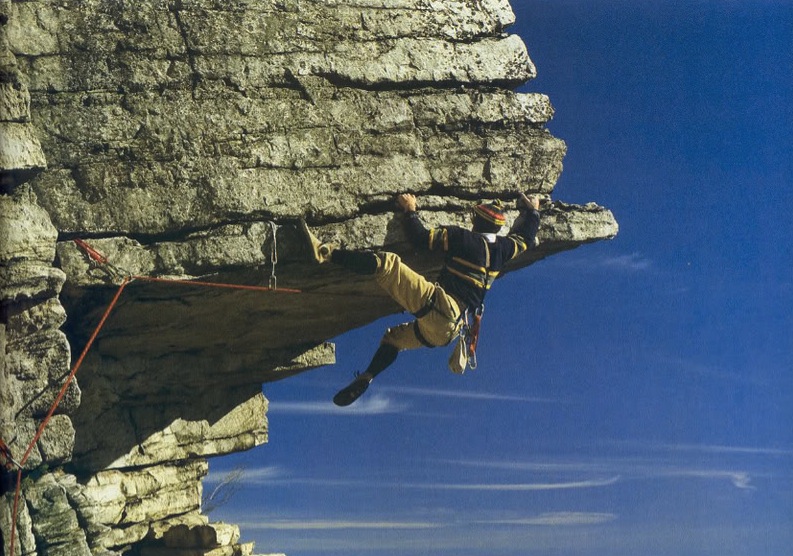
Though organized by area and focused on specific features, the book includes more than just local geology.  Garlick does a good job of describing the bigger picture.  For me, the explanations of plate movements, collisions, rifts, jostling and passive margins and how they relate to climbing areas are the most interesting parts of the book.  For example, we can’t explain the Gunks in New York without invoking 1) mountain-building 450 million years ago when a chain of islands collided with the eastern margin of North America, resulting in erosion and deposition of sediments that would become the hard conglomerate we climb on; and 2) tectonic compression 300 to 250 million years ago during the formation of Pangaea that tilted the strata and produced those bomber holds, making some of the big Gunks roofs surprisingly easy to climb.  Thank you plate tectonics.
Bigggg roof but only 5.8.  Photo by Mike Freeman, from Dick DuMais'
Shawangunk Rock Climbing, 1985.  Posted at SuperTopo.
A well-illustrated brief overview of the history of the Appalachian Mountains is presented in a three-page “sidebar”, providing the context for many of the climbing areas in the eastern US.  A similar approach is used for the Rockies (“A Short History of Colorado”).  Other shorter sidebars explain diverse topics such as the multitude of granite plutons in California, the Ancestral Rockies and the mysterious Gunks quartz.  There are ample illustrations of geologic phenomena and processes throughout:  plate tectonics, uplifts and basins, stratigraphic columns, salt anticlines, metamorphic core complexes, ancient landscapes and many more.  And of course there are spectacular photographs of crags and climbers.  This is a book worth perusing from cover to cover, in addition to studying one’s favorite crags -- perhaps a good diversion for rainy days.
Excerpt from "A Short History of Colorado"; click to view.
Given the number and diversity of rock climbing areas, this kind of book can provide only a quick look at a selection of crags.  For example, discussion of Devils Tower includes just one of the theories behind this puzzling rock, but that’s understandable -- it has proven to have a history mysterious enough to support multiple possible explanations.  Less than a page is devoted to Yosemite Valley, in spite of its important place in the history of climbing (but see also the granite of the Sierra Nevada).  The Adirondacks are omitted entirely.  Even so, I think Garlick has made good choices about what to include; the result is a collection of interesting wide-ranging stories about the diverse materials and histories of the mountains and rocks we climb.

If you are a geologically-challenged climber, this book will make a bit of a geologist out of you and I bet you will enjoy it, even though sections may prove to be somewhat technical (a glossary would have helped).  If you are a geologist that climbs, the book provides introductory material as well as references for further research.  I am an amateur geologist and casual climber -- for me, it was a great read and will be a good reference in the future.


Flakes, Jugs, and Splitters: A Rock Climber's Guide to Geology by Sarah Garlick.  2009.  FalconGuides.  Paperback, 224 pages, ISBN 0762748370.  $13.59 from Amazon


F, J, & S won Best Book in the Mountain Exposition category at the 2009 Banff Mountain Film Festival.


Other reviews can be found at:


The climber website summitpost.org

Monday, February 6, 2012

Plants & Rocks: ferns and granite ... and climbers

This post is a tribute to pioneer rock climber Herb Conn, who passed away last week at age 91.  Actually, it is a tribute to both Herb and his wife, for I never thought of Herb without also thinking of Jan; it was always “Herb and Jan” or “the Conns”.

Herb and Jan were in their 20s when they gave up their home and work in Washington DC for freedom and the open road.  They outfitted their vehicle for camping, left the Establishment behind and went climbing.  This is a common lifestyle among my friends, and wouldn't seem so unusual except that it was shortly after World War II when the Conns dropped out.  They were pioneer climbing bums -- wandering from crag to crag in their 19-thirty-something panel truck, living simply and cheaply, picking up a little work here and there, and climbing rocks.  They never gave up that lifestyle, even after they "settled down" in western South Dakota.
The Cathedral Spires in the Black Hills Needles, South Dakota, USA.
Herb's guidebook to the Needles; self-published, ca 1957.
The nomadic life ended when the Conns arrived in the Black Hills and saw the seemingly-endless granite spires, fins, towers, domes and other fantastical shapes.  “We knew we had found the place we wanted to live” said Jan; they were “two cats in an untended fish market” according to Herb.  The Conns went on to make nearly 220 first ascents in the Black Hills Needles.
1959; from forums.caves.org
In 1959 Herb and Jan were converted to caving, and ended up exploring 60+ miles of passages in what had been considered just a minor cave.  The "Jewel Cave Adventure" is quite a story, but we'll save it for the future.

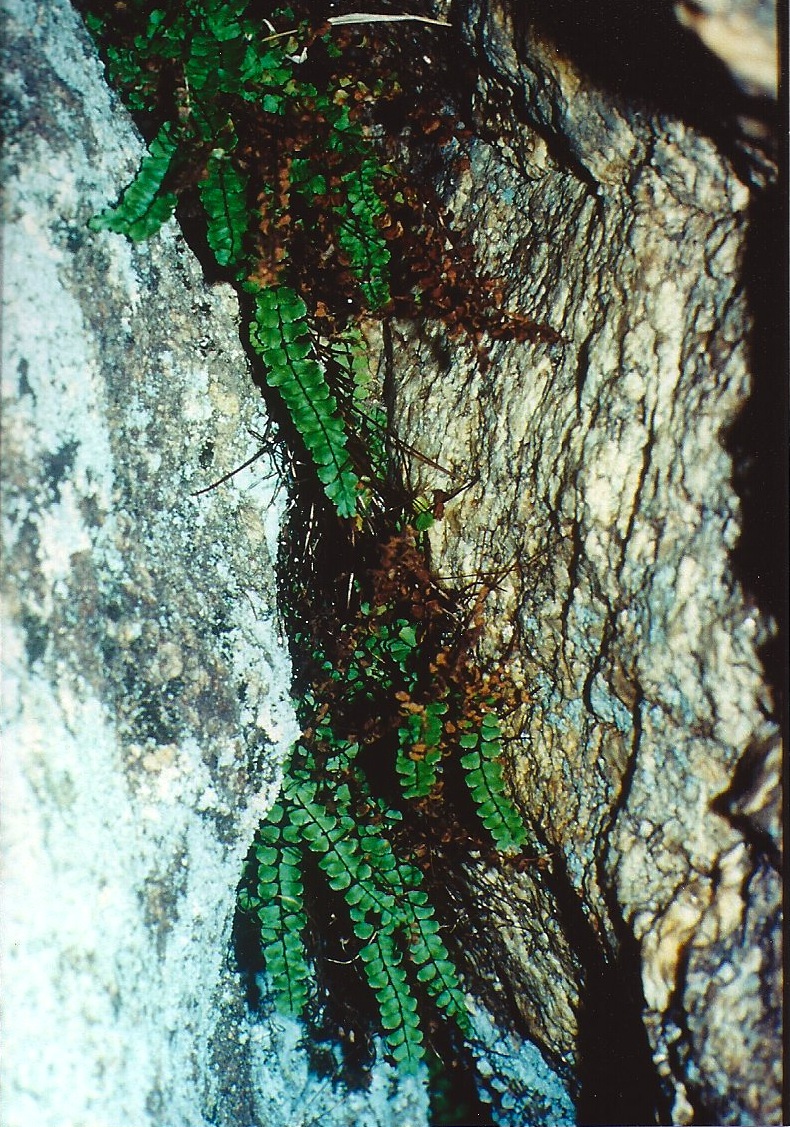
By the time I got to know the Conns in the mid 1990s, they had given up caving and were back into rock climbing (Herb was 76, Jan a few years younger).  They told me about an interesting fern they sometimes saw in cracks in the granite; they hoped I could tell them what it was.  We headed out for a look and found the maidenhair spleenwort, a very pretty fern indeed! I pointed out the grassy-looking forked spleenwort growing nearby, which Jan called “second-rate” with its scraggly demeanor.


To right, maidenhair spleenwort growing in crevice in 1.7-billion-year-old Harney Peak granite.  Photo by Larry Ebbert.


Then the plot thickened.  We found a Mystery Fern which I could not identify, even back in the herbarium.  I sent a specimen to Robbin Moran of the New York Botanical Garden, who identified it as the alternate-leaved spleenwort, at that time known from only three locations in the US, all on the East Coast.


To left, the alternate-leaved spleenwort (the Mystery Fern) growing above the forked spleenwort.  Photo by Larry Ebbert.


The Conns and I published our findings in the American Fern Journal, but the story is best told in Jan’s illustrated account (below).


Alternate-leaved spleenwort grows in well-shaded habitat; rock climber for scale.
One of Jan’s many talents is rubber stamp art.  Here is a story about the Conns' fern adventures.  Stamps designed by Jean Dolan, made by Jan; script by Hollis.  Jan explained that Jean had been a climbing friend in the 1940s.  Before making the designs, "she got in touch with present day climbers to get the gear correct."
Click on image for larger view.
Jan writing about ferns; Herb eyeing a new climbing route?
Herb belaying Jan on 3BT (3 Billion Tons, a really big rock).
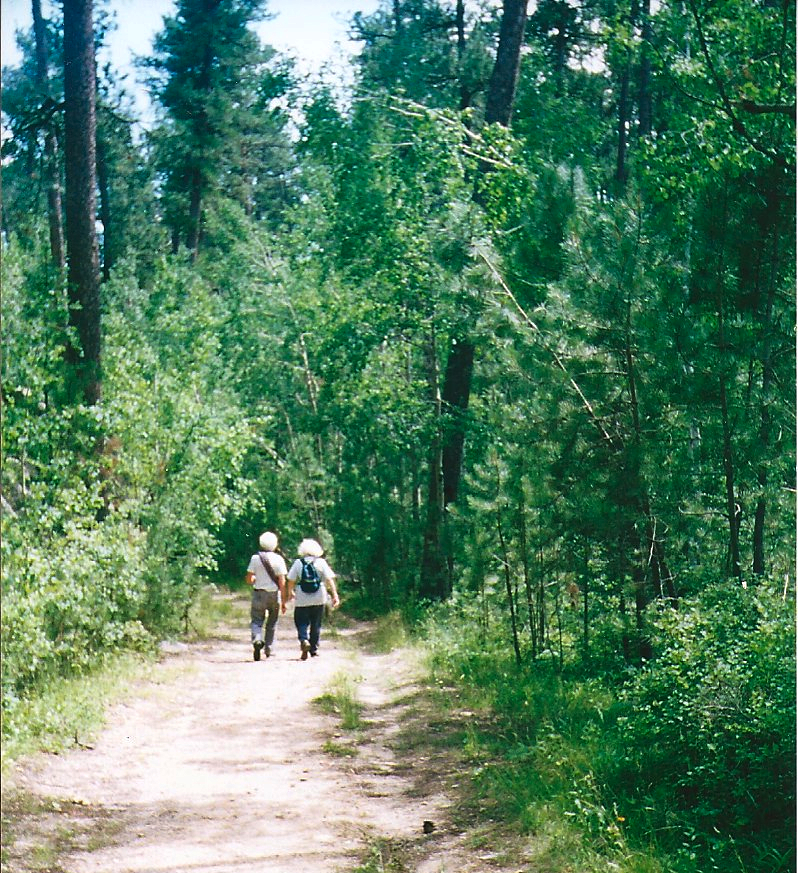
Heading home after another day on the rocks.

For more Conn lore:

The Conns and ferns:
Marriott, H.J., Jan and Herb Conn.  (2000). "Asplenium X alternifolium in the Black Hills of South Dakota".  American Fern Journal 90: 109.

The Conns and caving:
Conn, Herb and Jan.  2000.  The Jewel Cave Adventure: Fifty Miles of Discovery under South Dakota.  Cave Books.

The Conns and climbing:
Stephens, Lindsay.  2008.  South Dakota Needles: Adventure Climbs of Herb and Jan Conn.  Boulder, CO: Sharp End Publishing.  Among the highlights of this book are entertaining excerpts from the Conns' journals. Infinitely-many thanks to Lindsay for collecting and sharing the wonderful Conn stories, as well as documenting the Conn routes in the Needles.  If these routes seem terrifying now, imagine climbing them in smooth-soled sneakers with only pitons for pro!


UPDATE:  Daryl S. of Sylvan Rocks Climbing School and Guide Service has put up a nice post about his friends the Conns.