Showing posts with label Nevada botany. Show all posts

Thursday, September 1, 2022

Blue-eyed Marys in the Forest

Blue-eyed Mary, Collinsia parviflora.
The piñon forests of the Great Basin lie in a great rain shadow. Air traveling east from the Pacific coast gets sucked dry—very dry. No wonder the trees are short. And because they give each other space to survive, it's it a stretch to call them a "forest". Fortunately the canopies of these small trees are large enough to provide shade for weary hikers, which we needed. I hadn't expected 85º at 8000 feet in May.
Piñon forest in Egan Range near Ely, Nevada (these trees are Pinus monophylla).
Often the understory in a piñon forest is sparse, the ground covered mostly in pine needles. But not always. Spring brings color here too. At our first rest stop, I noticed tiny blue and white flowers in a sunny spot next to our shade. They were Blue-eyed Marys, and I was glad to see them. They are long-time friends.
Click to zoom, then look close.
Can such tiny flowers be pollinated?
As we know, many flowers are designed (i.e., evolved) with pollinators in mind. There are all kinds of elaborate mechanisms to persuade creatures to visit, pick up pollen, and carry it away to another flower of the same species but on a different individual—the ideal form of plant sex. The purpose is outcrossing, which could increase genotypic diversity. This could help adapt to environmental change. Or there could be advantages we haven't yet discovered (scientists sometimes forget this and jump to conclusions).

This Blue-eyed Mary is Collinisa parviflora, "parviflora" meaning small flower. The petals are only 4–9 mm long. Are pollinators attracted to flowers this small? Apparently so; bumblebees, mason bees and hover flies have been observed visiting C. parviflora flowers. But visitation ≠ pollination. Sometimes a plan B is needed for reproductive assurance.
Some Blue-eyed Marys have an alternative for situations when sex with another plant is impossible: selfing (quit giggling!). This is a common strategy in plants that grow where likelihood of outcrossing is low. Perhaps tiny flowers also justify self-pollination.

Curious about this, researchers Elizabeth Elle and Robert Carney studied outcrossing vs. selfing in Collinisa parviflora (2003, available here). They chose three populations that differed in flower size (remember, petals can be 4–9 mm long). They saw that pollinators preferred the population with larger flowers. And with experiments, they showed that selfing was more successful (higher seed set rates) in small-flowered populations than in the large-flowered one. It looks like Blue-eyed Marys with tiny flowers are prepared to self-pollinate if nobody shows up to do the job.
Photo courtesy Matt Lavin via Flickr.

Blue-eyed Marys in the Forest

Among dead pine needles
blue-and-whites face morning sun
and still small voices whisper.
Or is wind singing its way through trees?
How do we catch and hold words offered us
by flowers and wind? —E.M.


Saturday, December 11, 2021

Two Trees and a Rock on a Trail

First, the Weather Report.
It's time for a final report about the trees I followed this year. But they haven't changed since last month, and it's cold and wicked windy. I'd rather think about that nice October day when I met two trees and a rock on the trail to Lamoille Lake, in the Ruby Mountains in northeast Nevada.
Rock huggers.
I imagined these gnarled old trees as seedlings emerging above ground in a protected spot next to the giant boulder. For years they grew taller from apical buds, and wider by adding new vascular tissue (plant nerds—see diagram further on). They were symmetrical saplings until they bumped into the rock. But they kept growing anyway, taller and wider ... except where they couldn't.


Limber pines, Pinus flexilis (named for tough flexible branchlets).

Trees grow taller at the top, not from the base (a common misconception).

This is my contribution to the monthly gathering of Tree Followers kindly hosted by The Squirrel Basket. Consider joining us for some low-key good times (more here). Now I need to go find another tree!

Tuesday, November 30, 2021

Late Season Early Morning Beauty

Prickly poppy, Argemone sp.
When I visited northeast Nevada in October, the days were mild, the nights cold, and the light low and warm. There were few flowers, but still much to see, for death and drying reveal forms overlooked earlier in the season. These backlit examples were growing along a dirt road in the Snake Range.

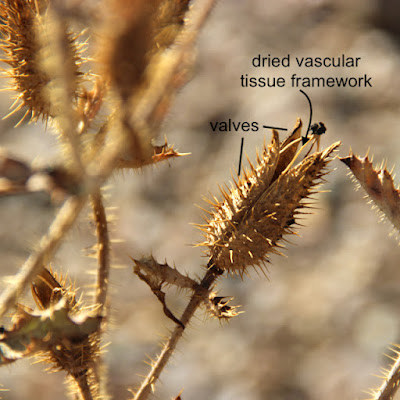
Prickly poppies are common roadside plants, with large showy white flowers. After the petals fall, and the plant turns brown and dry, the interesting structure of the capsules becomes apparent. A prickly poppy capsule opens by splitting from the apex down about ⅓ of its length, producing segments called valves. The valves spread to reveal a framework of dried vascular tissue, joined at the top by the persistent style and stigma (female flower parts).

Prickly indeed!

Wild buckwheat, Eriogonum sp. The diffuse inflorescence is roughly 30 cm across.
Inflorescences of wild buckwheats (Eriogonum spp.) range from tightly globose to spike-like to diffuse, like the one above. All species have tiny flowers, which are nicely displayed in plants with diffuse inflorescences. I don't know this plant to species, but the hanging flowers suggest the common E. deflexum or something close to it.

Within the buckwheat inflorescence, flowers are clustered in cup-shaped structures called involucres. In the next photos, dried white-and-pink flowers emerge from the pendant involucres. Each flower contains an achene—a single seed wrapped in dried tissue of the ovary.
Involucres are about 2.5 mm long.

Finally, a classic view of my field assistant, who is as fascinated by plants as I am :)

Friday, October 29, 2021

Finding Petrophytum & Sereno Watson's Ghost

Petrophytum caespitosum mat on limestone. Dark spots are shadows cast by flower clusters.
In a narrow rocky canyon on the east side of the Ruby Mountains, I was stopped in my tracks by Petrophytum caespitosum—rockmat. It's not that I was surprised. There's plenty of limestone in eastern Nevada. Rather I was pleased. It's always a treat to come across this striking rock dweller.

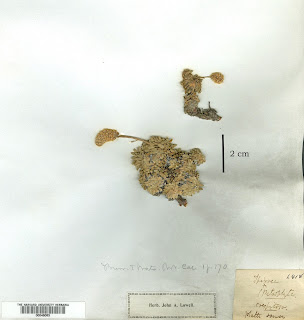
It was first collected by the great pioneering botanist Thomas Nuttall, probably in 1836, probably somewhere in the southeast quarter of Wyoming. His specimen—two small fragments, each with a flowering stalk—now resides at Harvard University (HUH; closeup below). Nuttall's yellowed handwritten label in the corner is terse: "Spiraea (Petrophyta. Caespitosa. Platte [River] sources." We shouldn't blame him. The expedition was on the move; time and space were limited. Large specimens and detailed location information were out of the question. Furthermore, it was an exploratory expedition. The country was still being figured out.

Spiraea caespitosa collected by Thomas Nuttall. (HUH; lower right corner of herbarium sheet; scale line added).
Nuttall's description of the new species was published in 1840. He named it Spiraea caespitosa, for its caespitose (matted) growth form. Most species in the genus Spiraea (meadowsweet) are erect shrubs, but this one was "A singular dwarf alpine plant (1), with scarcely the habit of Spiraea."  It was distinctive enough that Nuttall put it in its own section, which he called Petrophytum (rock plant). He also noted that "The taste of the plant is scarcely perceptible."

Sixty years later, Per Axel Rydberg of the New York Botanical Garden would argue that the rockmat was distinctive enough to warrant its own genus. He called it Petrophytum caespitosum, as it remains today (2) (Rydberg 1900).

The next known collection was made by William Whitman Bailey, botanist with Clarence King's Geological Exploration of the 40th Parallel. He found it in September of 1867, in the West Humboldt Mountains in western Nevada. His collection also resides at Harvard. But Bailey went further. That winter, he made a sketch of the rockmat eponymously sprawling across rock. It was added to the herbarium sheet, showing what can't be seen in a dried pressed specimen.

WW Bailey's Spiraea caespitosa (one of six specimens, from various collectors, on a single sheet; HUH).
Bailey's sketch of Spiraea caespitosa in the West Humboldt Mountains (HUH).
A year later, rockmat was again collected by a botanist with the King survey, this one an unlikely hire. Sereno Watson was in his early 40s, not a young man, with limited botanical training at most, and no previous expedition experience. But after a series of unsatisfying careers (teacher, medical student, insurance company secretary), he was desperate for change. In the spring of 1867, he sailed from New York to the promised land—California.

From San Francisco, Watson took the train as far east as it went, and then walked across the Sierra Nevada to King's survey camp. After presenting a letter of introduction from a mutual friend, he begged for a job. He would help in any way he could. King hired him as an assistant topographer and general camp helper, for "nominal" pay—basically a "volunteer" (Brewer 1900).

But the gods soon smiled on Sereno Watson. Bailey, the official botanist, began to have health problems, so Watson became his assistant. When Bailey quit in early 1868, Watson was appointed expedition botanist, with a salary. It was the beginning of a successful and very satisfying life collecting and studying plants (3). 

In early May of 1868, the expedition "took the field again and worked eastward from the Washoe through the Trinity, West Humboldt, Havallah, and the several other mountain ranges to Ruby River [possibly the Franklin River in the Ruby Valley], and from there the East Humboldt Mountains were explored" (Brewer 1900).

It was in the East Humboldt Mountains that Watson collected Petrophytum caespitosum. At that time, the East Humboldt range included the Ruby Mountains, which is where I saw it. Was the ghost of Sereno Watson nearby?

In his catalogue of collections, Watson provided a specific location: "Cliffs above Camp Ruby 7,000 ft." On my visit, I camped at the foot of the Ruby Mountains just 7.5 mi north of old Camp Ruby (also called Fort Ruby). I found the rockmat in a canyon immediately west. Sereno and I definitely were in the same area! And though I don't believe in ghosts, I do see them on occasion.

Petrophytum caespitosum at base of limestone cliff, east side Ruby Mountains; October 2021.

Caespitose rockmat is now known from many sites scattered across the interior western US and into Mexico. It seems to be restricted to limestone and limy sandstone. Though widespread and sometimes locally abundant, its distribution is curiously patchy. It's often absent from what looks like perfectly good habitat. Challenges in dispersal or establishment might be the explanation.

The growth form of Petrophytum caespitosum is striking. Its prostrate stems intertwine to form dense rock-hugging mats, sometimes a meter or more across. Short stems rise above the mat, with cylindrical flower clusters 1–4 cm long. The flowers are tiny, the white petals just 1.5–2.5 mm long.

Stems rise from clusters of leaves 3–12 mm long.
Inflorescences can be branched, but usually are simple cylindrical racemes.
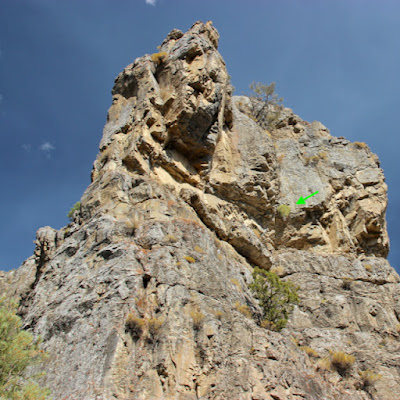
As well as sprawling across rock, the rockmat can grow in vertical cracks, or even hanging from cracks!

Petrophytum caespitosum in a crack high up on the cliff (tip of arrow).
"The top of this two foot long plant is attached to the rock wall; the rest of the plant swings gently with any breeze." Photo ©Al Schneider, http://www.swcoloradowildflowers.com  

I end this story with a lovely shot by Andrey Zharkikh, who shares his many plant photos on Flickr. With the right setting, and a knowing eye, rockmat can be exceptionally photogenic!

Petrophytum caespitosum, with butterfly; Wasatch Range, Utah. Photo by Andrey Zharkikh.

NOTES

(1) In Nuttall's day, "alpine" did not necessarily mean the highest elevations, above treeline. It was sometimes used for lower montane sites with no trees—a common situation in the arid American West.

(2) The genus is sometimes called Petrophyton, said to be an "orthographic variant (misspelling)".

(3) Among other things, Sereno Watson became Curator of Gray Herbarium at Harvard in 1888, a position he held until his death in 1892 (Coulter 1892).

Sereno Watson, a "thorough and painstaking" botanist, working at Gray Herbarium (Coulter 1892).

SOURCES

Once again, I'm immensely grateful to the Biodiversity Heritage Library (BHL) for providing such easy access to original literature!

Brewer, WH 1903. Biographical memoir of Sereno Watson, 1820-1892. National Academy of Sciences. PDF 

Coulter, JM. 1892. Sereno Watson. Bot. Gaz. 17:137–141, Plates VI, VII. Available online courtesy BHL.

Nuttall, T. 1840. Spiraea cespitosa in Torrey, J, and Gray, A. Flora of North America v. 1, 417-418, Available online courtesy BHL.

Rydberg, PA. 1900. Catalogue of the flora of Montana and the Yellowstone National Park, vol. 1:206–207.  Available online courtesy BHL.

Watson, S. Catalogue of botanical collections made in Nevada and Utah, in 1867-9. Harvard University Botany Libraries. Available online courtesy BHL.

Williams, RL. 2003. A Region of Astonishing Beauty: The botanical exploration of the Rocky Mountains. Roberts Rinehart.


Friday, June 18, 2021

Two Great Basin shrubs—each showy in its own way

Mountain mahogany in flower, field assistant for scale; Kingston Canyon, Nevada.
Like the Great Basin itself, many of its shrubs strike people as drab. Sagebrush, bitterbrush, snakeweed, rabbitbrush, shadscale, and more—all have subdued green to gray foliage, and small unpretentious flowers. But like so many things, it all depends on our perspective.

For example, the yellowish flowers of curl-leaf mountain mahogany are less than a centimeter long and have no petals. But this simplicity is made up for by their abundance. At peak bloom, they turn the entire canopy yellowish brown.

Cercocarpus ledifolius var. intermontanus can be a shrub or small tree.
Flowers by the hundreds!
Mountain mahogany flowers. The sepals form a floral cup (hypanthium), with 10 stamens and a single pistil.
After fertilization, an impressive transformation of the pistil takes place, underscored in the name of the genus, Cercocarpus (Greek kerkos, tail, and karpos, fruit). The single-seeded ovary dries and hardens, while the style elongates to be come a tortuous and hairy "tail". Mature fruits persist for some time, creating beautifully frosted shrubs!

Mountain mahogany in fruit; courtesy Andrey Zharkikh via Flickr.
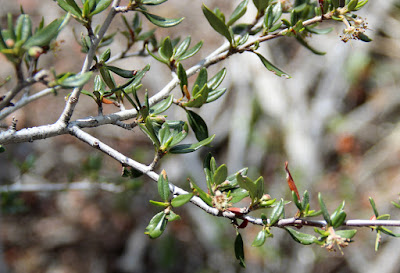
The leaves of curl-leaf mountain mahogany reminded Thomas Nuttall of those of Labrador tea, so he named it Cercocarpus ledifolius (ledum-leaved) in 1840. In the latest taxonomic treatment, three varieties  are recognized. The shrubs I saw in Kingston Canyon, Nevada, are var. intermontanus, which has leaves with revolute margins, but not strongly so; they aren't particularly hairy, and often glabrous above.


Nearby was a shrub with a very different kind of showiness, more in line with what people consider beautiful. It was covered in flowers that were large and colorful, at least by Great Basin standards. The petals were each about a centimeter long, and deep pink in bud becoming paler in flower. This is the desert peach, Prunus andersonii.

Desert peach branchlets become stiff and spiny with age.
Like the mountain mahogany, when the desert peach blooms, it does so in profusion. Can you imagine stumbling upon it in a stand of sagebrush?!

Prunus andersonii with sagebrush; courtesy Matt Lavin via Flickr.
We're familiar with many of Prunus andersonii's close relatives. Domestic peaches, cherries, plums, apricots, and more are members of the genus Prunus. But while the desert peach looks like a peach, complete with fuzz, there's no edible fleshy pulp around the seed.

Courtesy Jason Hollinger via Flickr.

Some will be surprised to learn that curl-leaf mountain mahogany and desert peach are in the same family. With such different flowers and fruit, how can this be?! But those of us who know the Rosaceae simply shrug in resignation. The rose family is notoriously diverse. It used to be divided into six subfamilies, most of which were treated as full-on families at one time or another. Now experts recognize three subfamilies, and within these, 16 tribes. Get the full details of this tangled web here.

Or perhaps you would prefer Robert Frost's thoughts on the Rosaceae:

The rose is a rose,

And was always a rose.

But the theory now goes

That the apple’s a rose,

And the pear is, and so’s

The plum, I suppose.

The dear only knows

What will next prove a rose.

You, of course, are a rose –

But were always a rose.

—Robert Frost, The Rose Family


Sources

Cercocarpus ledifolius in Flora North America

Prunus andersonii in Flora North America

Rosaceae in Flora North America

Mozingo, HN. 1987. Shrubs of the Great Basin. U Nevada Press.


Tuesday, September 3, 2019

Dwarf Lousewort & the Joy of Learning

On a cool bright May morning in the Egan Range of eastern Nevada, I was stopped in my tracks, stunned by what I saw. Glowing in the sunshine was a cluster of flowers that defied expectations. My brain struggled with conflicting input; there was even a moment of anguish. But as soon as I checked the plant guide, I experienced that combination of strange and familiar that brings surprise and then joy. Here growing with sagebrush and very little else, in an opening in dry pinyon-juniper woodland, were louseworts!—specifically Dwarf Louseworts, Pedicularis centranthera. (Broomrape Family, Orobanchaceae).

This was a surprise. I thought louseworts were plants of wet meadows, shady montane forests, and the subalpine zone. Furthermore, these plants had no long clusters of flowers standing well above the basal leaves. The flowering stems were so short that the flowers were nestled among the leaves. But they were typical lousewort flowers—petals united into a tube that was two-lipped at the opening, lower lip three-lobed, upper lip hood-like (called a galea, meaning shaped like a helmet).
Flowers of Dwarf Lousewort, Pedicularis centranthera., nestled in basal leaves.
Typical lousewort flower (Pedicularis bracteosa); photo source.
In addition to the Bracted Lousewort above, the following are those I'm most familiar with, all common in the mountains of southeast Wyoming:
Parrot’s Beak, P. racemosa, (Matt Lavin photo) grows in montane forests, woodlands and meadows.
Elephant Head Lousewort, P. groenlandica, is unmistakable! The galea has a “trunk” and the lateral lobes of the lower lip are enlarged to form “elephant ears” (photo source).
Elephant Heads in wet meadow, Medicine Bow Mountains, Wyoming.
But now, thanks to that joyful encounter with the Dwarf Lousewort, my concept of Pedicularis has been expanded to include pinyon-juniper habitat. In fact, this lousewort is common enough in pinyon-juniper woodland in the western United States that it’s often called Pinyon-Juniper Lousewort.
Sagebrush opening in pinyon-juniper woodland on Ward Mountain in the Egan Range.
Dwarf Lousewort prefers stony soils in pinyon-juniper woodland—tough plant! (Lesica & Fertig 2017)
But why “lousewort”? Because back when the genus was first described, by Carl Linneaus, it was thought that when cattle and sheep ate these plants, they became infested with lice. Wrong! But Linnaeus was the great namer, having invented 266 years ago the system of scientific names that we still use today, so we’re stuck with Pedicularis—from Pediculus, Latin for louse. As for the common name, though Pedicularis is sometimes called Wood Betony, Lousewort is far more common, at least in the western US (“wort” comes from the Old English “wyrt” meaning plant).

Sources

Fertig, Walter. No date. Plant of the Week: Leafy lousewort (Pedicularis racemosa). USDA Forest Service, Celebrating Wildflowers. https://www.fs.fed.us/wildflowers/plant-of-the-week/pedicularis_racemosa.shtml (accessed Sep 1, 2019).

Lesica, P and Fertig, W. 2017. Spring Wildflowers of Utah’s Red Rock Desert. Mountain Press. https://mountain-press.com/item_detail.php?item_key=767

Southwest Colorado Wildflowers. No date. Pedicularis centranthera. https://www.swcoloradowildflowers.com/Pink%20Enlarged%20Photo%20Pages/pedicularis%20centranthera.htm (accessed Sep 3, 2019).


Tuesday, July 25, 2017

Waylaid by Wildflowers

“The world would be a much better place if everyone was required to get down on the ground and look for tiny flowers—on a daily basis!”  (Mike N)

In late May, I drove Highway 773 through the Volcanic Hills in western Nevada, about 45 miles west of Tonopah. It was harsh but beautiful country, with colorful rocks dating to roughly 20 million years ago, back when Nevada was a truly hellacious place. Huge calderas erupted on a massive and terrifying scale. Viscous magma exploded from vents, and fiery sheets of ash and debris raced across the land, destroying everything for miles.

Intent on examining the remains of that horrifying time, I turned off on the first promising two-track, parked at the toe of a sparsely-vegetated (so I thought!) alluvial fan leading up to multi-colored outcrops, and started walking. But I didn’t get far. I was stopped by hundreds of flecks of color on the ground.

In between the shrubs, tiny plants were blooming. I suppose the show was lackluster compared with this year’s super bloom of the lower deserts—annuals so thick that they formed carpets of color. But I was impressed! It was such a surprise, and in some ways more rewarding. Only when I looked close did I see the beauty. The subdued display seemed fitting for the high desert, with its shorter growing season and harsh winters.
Click on image to see flecks of color (maybe).

I never made it to the volcanic rocks—spent a lot of time happily photographing flowers instead. Here are of some of the more common ones, all new to me. A humongous thanks to randomtruth at Nature of a Man for identifications … saved me from major struggles!

Many were true belly plants—little annuals growing so close to the ground that I had to lie on my belly to get a good look (for scale, see photo at top of post). The first to catch my eye was ground nama, Nama aretioides (Boraginaceae), which was super common. Up close it looked like a fairy’s flower arrangement—miniature bright pink flowers with yellow throats streaked red, and tidy clusters of hairy leaves.

Desert calico (Loeseliastrum matthewsii, Polemoniaceae) has really distinctive bilateral flowers. For some reason they reminded me of surprised faces, maybe because of their dark pink "raised eyebrows." I like the common name, but couldn’t find an explanation for it. Maybe the flowers are enough mottled or multicolored to qualify as calico.

Apparently Linanthus campanulatus (Polemoniaceae) goes only by the awkward common name of bellshape gilia, a literal translation of an earlier scientific name, Gilia campanulatus. Sand grains stick to its stems because of its glandular hairs.
Sticky stems.

I easily recognized this next plant as a cryptantha (Boraginaceae), maybe because of the hairs—glassy spikes like those of many of our cryptanthas. This is cushion cryptantha or cushion catseye (C. circumscissa). Flowers are super tiny, about 1/8 inch across (1-2 mm).

Signs of a belly-plant botanist.
Eventually I left the land of belly plants (above) and moved into a swale (below) where plants were denser and taller—must be (or have been) more water. These also were mostly annuals, just bigger.

The mentzelia (stickleaf) below was another plant I could recognize to genus, probably because of the pale stems and rough leaves. It may be Mentzelia dispersa or M. affinis (Loasaceae). According to experts, the two are almost impossible to tell apart based on appearance. They differ clearly only in habitat: “Verified populations of M. affinis have not been found above 1200 meters in desert habitats” (Flora of North America). The alluvial fan was at 1800 m (6000 ft), does that make this M. dispersa? Can we rely on such a simple criterion? Of course the name didn’t really matter—I enjoyed the plants just fine without it.

Desert or Esteve’s pincushion (Chaenactis stevioides, Asteraceae) is said to be “among the most abundant spring wildflowers in the higher Mojave Desert and southern Great Basin” (Flora of North America). The Volcanic Hills are in the southern Great Basin and this plant was indeed abundant. It grows through much of the American West.

I thought the scale buds (Anisocoma acaulis, Asteraceae) were especially photogenic. These are not to be confused with bud scales, which protect over-wintering buds. Scale bud is named for its distinctive patterned phyllaries (bracts), most obvious when the flower (head) is closed. It’s the only species in its genus, which is closely related to Malacothrix.
Obviously someone finds scale buds tasty—missing heads were common.

Fortunately I didn't ignore the shrubs. They too surprised me with something new. The alluvial fan was covered in greasewood (Sarcobatus vermiculatus, Sarcobataceae), a very familiar plant but not the kind of greasewood vegetation I know. I looked close just to be sure ... yep, greasewood. Succulent green leaves and sharp-tipped twigs make greasewood easy to recognize. The reddish structures are its distinctive winged seed pods.
Here in Wyoming, we say greasewood grows in valley bottoms where water is near the surface, usually on saline soil (1). But it appears to be doing just fine on alluvial fans in the Volcanic Hills.
Greasewood on alluvial fan; White Mountains on horizon.

Footnote

(1) Knight et al. (2014, Mountains and Plains, the ecology of Wyoming landscapes, p. 167) mention there are a few stands of greasewood in foothills, calling them an “anomaly” … “as it is usually found where groundwater is near the surface on saline soils …” However, Waring (2011, A Natural History of the Intermountain West, p. 146) includes badlands and playa dunes, as well as saline bottoms, as greasewood habitat.

Sources

Two websites were especially helpful for verifying identifications and learning more about these plants. Foremost was the awesome Calflora (the Volcanic Hills are just 15 air miles east of California). Plants of West and Southwest USA was useful for selected species.