Monday, November 25, 2013

Autumn Tree Strategies II

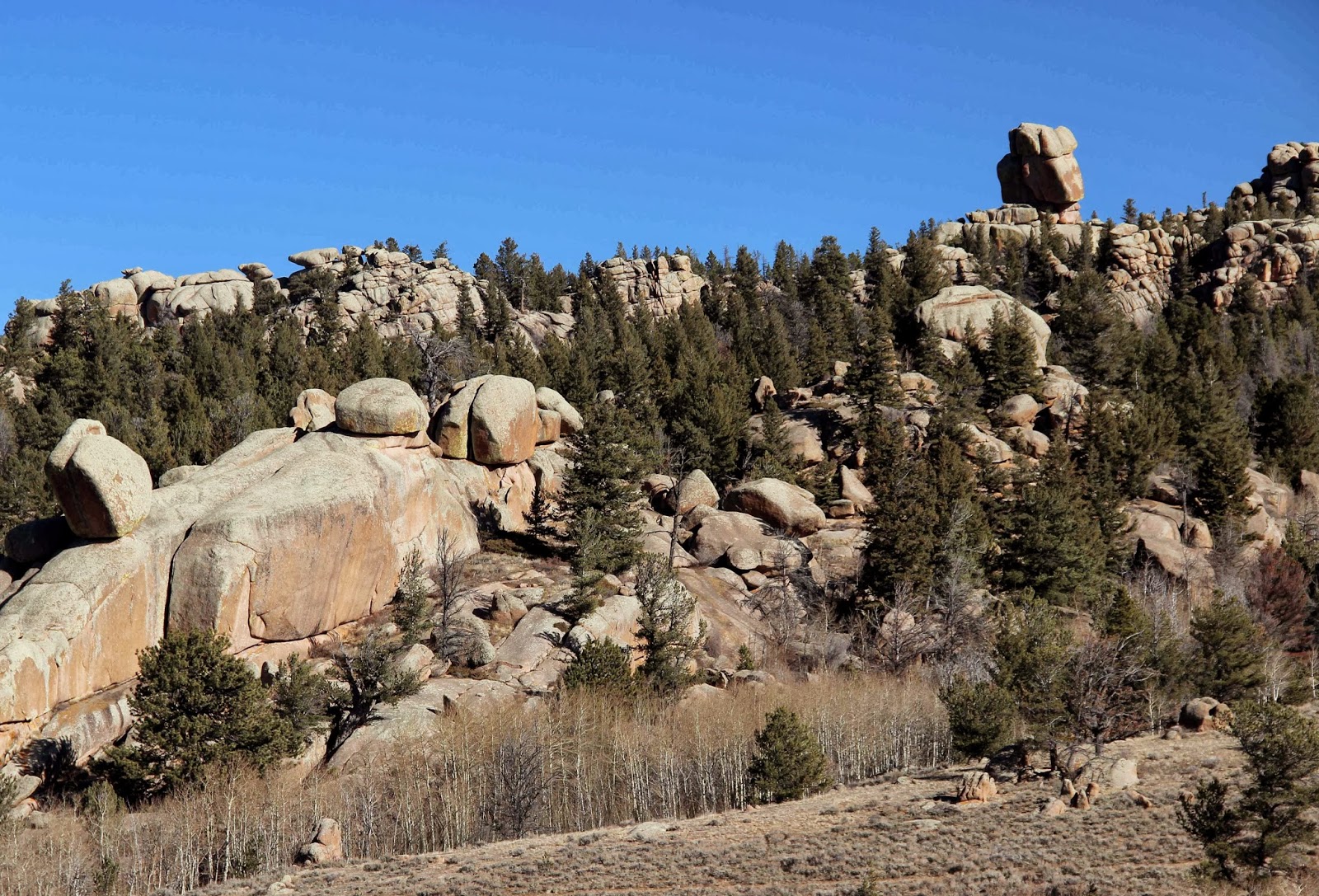
Note leaning limber pine emerging from large fissure in granite outcrop, near center of lower left quarter of photo (click on image for better view, or see photo at end of post).
I’m following two trees.  One is a weeping birch that grows in my yard, subject of a recent post.  All summer long its leaves collected sunshine and carbon dioxide, cranking out carbohydrates to keep the birch healthy and growing.  Then about a month ago, after turning a pretty gold, they died and fell off.  Just as well ... thin flimsy birch leaves would freeze in winter.  Now the tree is dormant.
Weeping birch, Betula pendula, native to Europe and Asia.
My other tree is a limber pine (Pinus flexilis) in the Laramie Mountains east of town.  It grows out of a deep fissure in a large outcrop of 1.4-billion-year-old Sherman granite.  I went up there just last week to see what it’s doing.  These are the perks of tree-following, going to nice places and seeing and learning things I probably wouldn’t otherwise.

All the quaking aspen along the trail were bare.  They got rid of their worthless leaves over a month ago.
Below, approaching the limber pine.
This tree appeals to me because of where it grows, and because it’s big, rugged, gnarled and scarred.  Unfortunately, the location makes it difficult to photograph.  The photo below was shot from the best place to see most of it.  I’m always impressed by the large half-dead tree growing out of the rocks.
The tree got its start in a fissure 4-5 feet deep.  How did it survive down there in the shade for so long?  Did it take off once it was tall enough to bask in sunshine?
Some of the larger branches are dead and others are missing bark, but no bother.  The pine keeps growing, a little bit each year.
Below is the tree from above.  I walked along the top of a large granite fin, peeking over the edge until I saw it.
It's November, so what has the limber pine been doing to get ready for winter?  Not much it appears.  The long flexible branchlets still have green needles and in fact they will all winter, for limber pines are evergreen.

This is one of several common but confusing tree terms:
Evergreen -- with leaves year-round; most conifers and many broadleaved trees.
Deciduous -- leafless part of the year when conditions are inhospitable to growth; a few conifers and many broadleaved trees.
Conifers -- Gymnosperms, with naked exposed seeds frequently in cones (no flowers); e.g. pine, spruce, Douglas fir, redwood.  Leaves usually needle-shaped or scale-like, but sometimes broad.  A more primitive group evolutionarily.  Also called “softwoods”.
Broadleaved trees -- Angiosperms, with developing seeds housed inside ovaries in flowers; e.g. magnolia, maple, eucalyptus, beech, weeping birch.  Leaves usually broader than needles but not always.  A more advanced group evolutionarily.  Also called “hardwoods”.

Below, a compact and durable conifer needle, followed by part of a thin flimsy but more productive broad leaf.  Source (modified).  Photosynthesis takes place in the mesophyll.
Fortunately the limber pine has needles instead of broad leaves, a much better choice for winter.  They shed snow more readily and have less sap that could freeze.  They lose less water (big issue in winter) because the ratio of surface area to volume is smaller.  Their thick epidermis covered with a waxy cuticle also protects from desiccation.  These are all very good adaptations but ... they aren’t enough for frigid winters in the mountains.
Limber pine needles are five to a cluster.
Turns out the limber pine has been getting ready for winter, for some time now.  It went through a pre-dormancy stage as it does every year.  Resting buds were formed, growth stopped, metabolism slowed, and various chemical changes took place -- for example increasing salts and sugars in cells to lower the freezing temperature.  Now it can rest through the winter.

Dormancy ends in spring after a sufficiently long period of sufficiently cold weather.  It’s then that the benefit of keeping needles all winter becomes apparent.  The limber pine won’t have to grow a whole new set of leaves, it can get to work photosynthesizing and making tree food right away!

Some conifers even photosynthesize at low rates during warm spells in winter, another advantage of keeping needles on.  Can a limber pine do this?  I don’t know.
I'm following a tree ... are you?

This is the second post in a short series about autumn tree strategies.

Sources  (in addition to links in post)

Havranek, WM and Tranquillini, W.  1995.  Physiological processes during winter dormancy in Smith, WK and Hinckley, TM, eds.  Ecophysiology of coniferous forests.  Academic Press.

Thomas, P.  2000.  Trees:  their natural history.  Cambridge University Press.

Wednesday, November 20, 2013

Figured Stones or Lithified Body Parts?

The curious stones at the bottom of the illustration look very much like shark’s teeth ... strange coincidence?  From Canis carchariæ dissectum caput by N. Steno (1667).
Nicolas Steno (Niels Stensen) was born in Denmark in 1638 during the Thirty Years War, lived through a major plague epidemic, pursued studies in medicine and anatomy, and by the time he was in his late 20s was recognized as one of the greatest anatomists of the day.  In 1666 he went to Italy, converted to Catholicism, settled in Tuscany, was accepted into the Accademia del Cimento (Academy of Experiment), and gave up anatomy.  His interests had turned to what we today call geology or earth science, piqued by curious forms in the Tuscan rocks that resembled sharks’ teeth and seashells. Steno's studies soon expanded far beyond these odd rocks, tackling basic problems of stratigraphy.  He came up with three of the basic tenets of geology taught today: the law of superposition, the principle of original horizontality, and the principle of cross-cutting relationships.

Then Steno abandoned earth science.  By 1678 he had devoted his life to Catholicism, though he grew disillusioned with the religious establishment, not surprising given his genius.  He spent more and more time in contemplation, living as an emaciated ascetic until he died in 1686.
A young Nicolas Steno.  Source.
This amazing man is the subject of Alan Cutler’s The Seashell on the Mountaintop, a book about Nicholas Steno’s contributions to earth science, especially his studies of the puzzling forms in rock that looked so much like living organisms but couldn’t possibly be.  After all, how could seashells have gotten inside hard rock thousands of feet above sea level?

Perhaps they were transported by the Great Flood, but wouldn’t that require God to have created the  mountains after the flood?  There was the additional problem that some of the forms didn’t resemble any living organisms.  Of course they could be creatures that had gone extinct, but that would be counter to the widespread “knowledge” that God didn’t create things to have them go extinct.  Most likely these figured stones were created in the beginning as part of the rocks, or generated from the rocks.  After all, different forms were found in different rock types.

Steno, though a devout man, disagreed.  He maintained that the tongue stones had once been sharks' teeth and the figured stones seashells.  A great debate ensued.
Martin Lister pointed out that many figured stones bore no resemblance to living creatures, for example this one, an ammonite.  From Historiae animalium angliae (1678).  Source.
Like Steno, Agostino Scilla concluded that figured stones looked like seashells because ... they had been seashells.  Collecting lithified shells far from the sea, from Vain Speculation Undeceived by Sense (1670).
In the end Steno convincingly argued that these oddities, which we now call fossils, must have been living creatures in the past.  The implications were huge.  It meant that landscapes undergo immense change, and that the Earth has a history on a scale much greater than our own.  Thus was the science of geology born.  Steno remained a religious man through it all, considering geologic processes  to be part of the wondrous work of God.

The Seashell on the Mountaintop is great reading.  Steno the man and the birth of geology are interesting stories in and of themselves of course, but Cutler’s talent as a writer makes them even more fascinating.  I highly recommend this book (and thanks to Lockwood of Outside the Interzone for suggesting it).