Friday, May 12, 2023

Tree-following: What to do on a windy Wyoming day?

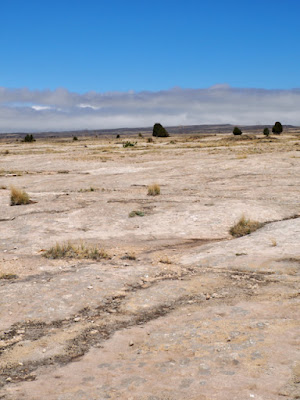
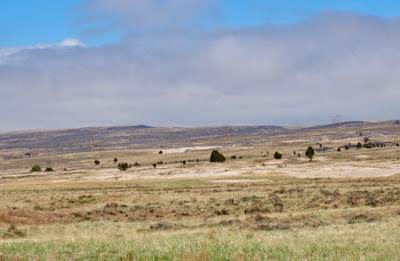
Mid-photo are the two Rocky Mountain Junipers I'm following, at the base of the Laramie Mountains.

The approach was not a problem.
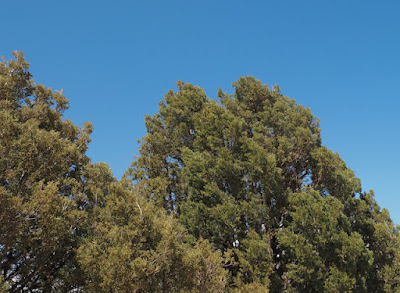
A few days ago I made a short excursion to visit the junipers I'm following this year. Average wind speed was 28 miles per hour, with gusts to 40. From a distance this wasn't a problem. But up close the trees were frantically waving in the blustery southeasterly wind, portent of an approaching storm system. Indeed it rained buckets the next two days!
Photo at highest shutter speed allowed.
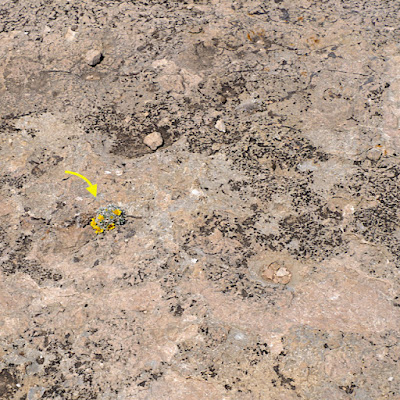
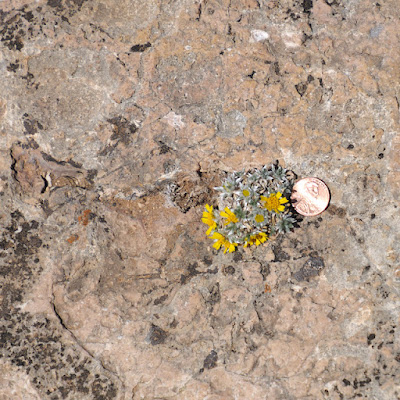
So I took photos of a neighboring plant instead. It was less than 2 cm tall and not much bothered by the wind.
Even after wandering out here all these years, I'm still impressed and astonished that plants can become established and survive in a tiny crevice or depression in bare rock, exposed to the desiccating Wyoming wind. I wonder how old this one is?
The leaves are covered in silky hairs.
The scientific name of this plant is Tetraneuris acaulis (Pursh) Greene var. caespitosa A. Nels. There's an interesting bit of history encoded here. F.T. Pursh was the first to name the species (Gaillardia acaulis), in 1814. Then in 1898, E.L. Green moved it to the genus Tetraneuris. In the meantime our very own Aven Nelson, Father of Wyoming Botany, found populations in the Laramie area that were different enough to be be recognized as a new variety. "Its matted habit, silky-lanate leaves and very short scapes [flowering stems] easily separate it." he wrote in 1899. Nelson's 1898 collection from the "Laramie Hills" was the type specimen (basis for description) for the new variety.
From the Rocky Mountain Herbarium, U. Wyoming. Click image to view labels.
Zooming in (below), we see this is a member of the daisy or aster family (Asteraceae). What some would interpret as a single flower is actually many tiny ones: a round cluster of disc flowers surrounded by ray flowers with strap-like united petals.
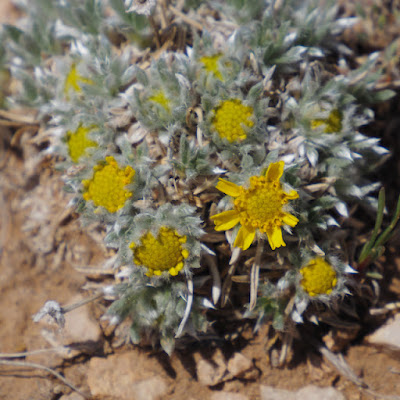
Nelson provided no common name, so I checked the Integrated Taxonomic Information System, supported and used by many North American governmental agencies. Officially, this is the Caespitose Four-nerve Daisy, a translation of the Latin. But there's gotta be something better! I suggest Nelson's Silky Stemless Daisy :)

Sources
Information about taxonomic and nomenclatural history of plant species is available at Tropicos, often with links to historical literature, including the wonderful offerings of the Biodiversity Heritage Library. That's where I found Aven Nelson's 1899 article about the genus Tetraneuris.

This is my rather tangential contribution to news from the tree-followers who gather monthly. More here. Thanks to The Squirrelbasket for continuing to host!

Friday, April 14, 2023

April Tree-following—about that Lichen

Several days ago, we headed off to visit the trees I'm following this year. It was a warmish sunny day that felt like spring, finally. And it was very windy, as is often the case in spring.

The two Rocky Mountain Junipers were looking good. The midday light showed their difference in color. The darker tree is the one with "berries" (fleshy cones) on the leeward side. Almost all are yellow. Two seasons are needed for berries to mature. Last year must have been a good one, given all the yellow berries. If the experts are right, this year we will watch them turn blue black.
With so much wind, sharp closeup photos were impossible.
Last month I included photos of a lichen that is really common on the ground in this area. Several readers responded with id suggestions and information—thanks!
Mystery lichen in March.
You probably know that lichens are symbiotic beings. That puts you are ahead of the great botanist Carl Linnaeus, who considered them “poor peasants of the plant world”. Wrong, Carl! But of course that was nearly three centuries ago. We've since figured out that lichens are not plants but rather composite organisms—a fungus and an alga or a cyanobacterium living tightly integrated lives. See Wikipedia's very interesting lichen page about their ecology, how they grow, their long evolutionary history, and the problems they cause when we try to classify them :) For a more philosophical view, try Lichens and the Meaning of Life.

The lichen that is so common in the eastern part of the Laramie Basin is ...  (fanfare) ... Tumbleweed Lichen! That is sooooo perfect for our windy world. Tumbleweed Lichen is a vagrant lichen, also an apt name. Instead of attaching to a substrate—rock, log, fence, etc.—it hugs the ground until wind sends it traveling again.
Our Tumbleweed Lichen is probably Xanthoparmelia camtschadalis or maybe X. chlorochroa. Seven Xanthoparmelia species occur in Wyoming and they're hard to tell apart. X. camtschadalis is common east of the continental divide, which is where Laramie is located.

The junipers I'm following grow in dry sagebrush grassland on thin rocky soil developed on limestone (at or not far below the surface)—harsh conditions, but Tumbleweed Lichen obviously does well here. Coverage ranges from small patches here and there to extensive ground cover, especially on the windward side of sagebrush, grass, and other plants.
Note penny on right, for scale.
Pale green patches at base of plants (lower right to mid left) are lichens whose tumbling was stopped by sagebrush and grass.
Tumbleweed Lichen and Pricklypear Cactus.
In some places, Tumbleweed Lichen dominates the ground cover.
Last month I predicted Easter Daisies (Townsendia) would be blooming now, but I was wrong. The daisies know better. In fact, we woke up to snow this morning.
Easter Daisies wisely waiting for spring.

Sources

Thanks to Judy vA for the articles included here. She met these vagrant lichens in her yard when she lived in Laramie. Thanks also to Jozien and Lysandra for id advice via iNaturalist.

Perry, Tyrell. 2018 (Winter). "What are Lichens?"  Barnyards and Backyards. U. Wyoming, College of Agriculture. PDF

Popova, Maria. 2023 (Mar 25) Lichens and the Meaning of Life. The Marginalian.