Showing posts with label plant fossils. Show all posts

Friday, February 10, 2017

A Powell Palmetto Perhaps?

Am I following a palmetto?
Sabal palmetto (source).
I’m intent on learning more about palms, as I decided to follow a palm tree this year (unfamiliar with tree-following? click on the link). My tree has a name, Sabalites, but what kind of palm is it? No one is sure. There are lots of choices—the palm family (Arecaceae) is large and diverse. It includes five subfamilies, 16 tribes, 2500 species, and many products consumed by humans: coconuts, dates, oil, betel chew, rattan and more. Most palms grow in tropical or subtropical regions, and occasionally in deserts.
Selected palms of the world; click on image to view details (source).
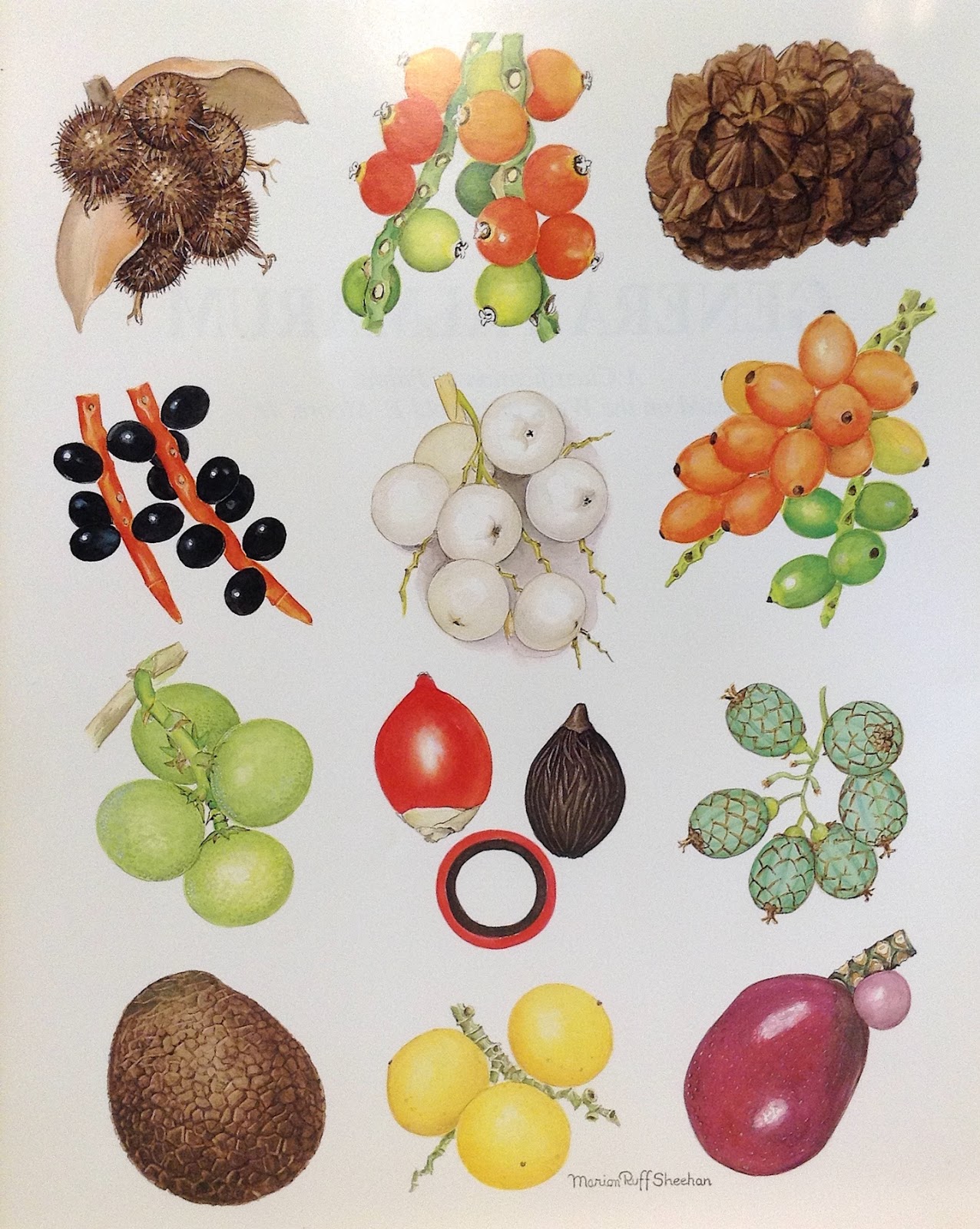
Palm fruit are beautiful as well as delicious (Dransfield et al. 2008).
Desert fan palms near Twentynine Palms, California (source).
When I lived in California, I was familiar with palm trees—specifically the ones planted along highways and in cities, and the native fan palms of desert oases, Washingtonia filifera. Then I moved to Wyoming where currently it’s much too cold for palms. However, fifty million years ago they lined the shores of huge lakes in the southwest part of the state. Even though their leaves are beautifully preserved in rocks of the Eocene Green River Formation (more here), no one is sure what kind of palms they were. Since I started following this tree, I’ve learned that plant fossil identification is really tough. Even the most challenging living plants are easy compared to fossilized ones.
Fossil Lake of Early Eocene Wyoming (Chicago Field Museum).

In 1870, geologist Ferdinand Vandeveer Hayden’s exploratory expedition stopped near Green River Station, Wyoming, where they found lots of fossils. Some looked very much like palm leaves. In the expedition report, staff paleontologist Léo Lesquereux assigned them to Flabellaria Eocenica. I don’t know why … modern day Flabellaria is not a palm, nor do the leaves resemble palm leaves.

Later, Hayden sent the fossils to paleontologist John S. Newberry of Columbia College, who decided they looked enough like today’s palmettos, genus Sabal, to call them Sabal powellii (I presume in honor of geologist John Wesley Powell, then Director of the US Geological Survey, but I haven’t been able to confirm this). The Powell palmetto was one of ten new fossil plant species from the Green River area published by Newberry in 1882.
8. SABAL POWELLII, n. sp. Leaves of medium size, 4 or 5 feet in diameter, petiole smooth, unarmed, terminating above in a rounded or angular area, from which the folds diverge; beneath concavely narrowing to form a spike 3 to 4 inches in length; rays about fifty, radiating from the end of the petiole, perhaps sixty in the entire leaf, compressed to acute wedges where they issue from the petiole, strongly angled and attaining a maximum width of about 1 inch; nerves fine, about twelve stronger ones on each side of the keel, with finer intermediate ones too obscure for enumeration. Formation and locality. — Eocene strata. Green River Station, Wyoming.
Why did Newberry conclude that these fossils were palmettos? Because the leaves are clearly costapalmate. (Yes, this is an esoteric term, but the concept is easy and useful.)
Costapalmate leaf of the Puerto Rican hat palm, Sabal causiarum (source).
Palm leaves are huge, with blades divided into many narrow segments arranged in several different patterns. In palmate leaves, segments fan out from the base of the blade—like fingers from the palm of a hand. In costapalmate leaves, the leaf stem (petiole) extends up into the blade to form a costa, where leaf segments are attached. The costa is only visible on the underside of the leaf, and from above, leaves look palmate. [Here’s a helpful webpage devoted to costapalmate palm leaves.]

In a paper about extinct floras of North America (1898), Newberry included a photo of a Wyoming palm leaf fossil with an obvious costa. “In the figures given, that on Pl. LXIII, fig. 6, represents the under side of the leaf at its base, showing [a] pointed spike [costa] formed by the prolongation of the petiole.”
From Newberry 1898; no scale provided (leaves can reach 4-5 feet across).
Unfortunately, costas are not unique to palmettos, and in 1930, paleobotanist Edward W. Berry overrode Newberry’s decision, renaming the fossils Sabalites powellii:
[the leaves] “are superficially much like the leaves of the existing species of Sabal, and their northern range appears to afford some corroboration of such a relationship, but this is by no means established, and it appears to me to be a better practice to refer such remains to the form* genus Sabalites rather than to Sabal.”
[*In form classification, fossilized organisms or their fragments are classified based on appearance, not biological relationships. If different parts of a single species are not obviously from the same source, they may end up as different form species or even genera.]

Robert Read and Leo Hickey agreed with Berry in their 1972 Revised Classification of Fossil Palm and Palm-like Leaves. They were adamant that leaves alone are insufficient evidence:
“Numerous similarities in the form and gross external features of [fossil] palm leaves make it difficult or impossible to assign them to modern genera based only on their external morphology. The uncertainty … becomes even greater with the limited, incomplete collections available to the paleobotanist. A modern specialist might speculate that a given fossil closely resembled a modern genus such as Sabal, Geonoma or Thrinax. Such a suggestion would be debatable since it is almost impossible to distinguish these genera … without seeing flowers, fruit or other diagnostic characters. Forced identifications with modern genera contribute nothing to evolutionary theory but give instead a confused picture of the floristics of the geological record. Since it is very difficult to identify specimens of modern palms accurately from their leaves alone, no attempt should be made to place fossil palm fragments in genera of modern palms unless unquestionably identifiable with them.”

Maybe we shouldn’t give up just yet. After all, thousands of fossils are collected from the Green River Formation every year! Maybe some will reveal the true identity of Sabalites powellii. There’s reason for hope. Paleobotanist Sarah Allen has been working nearby on another fossil palm, in the Bridger Formation, and has enough fossils—leaves, flowers and even pollen—to confidently assign the trees to Phoenix, the genus that includes today’s date palms (Allen 2015). Will we be so lucky with Sabalites? Already its fossils include not just leaves, but also apical buds, flowers, inflorescences (flower clusters), and even inflorescences attached to leaves. Are more discoveries likely? When I visit the remains of Fossil Lake later this year, I'll look for some experts and ask them what they think.
Fossil terminal bud, from the Green River Formation (in palms, leaves originate from a single terminal bud at the top of the trunk); University of Wyoming Geology Museum.

Personally, I hope paleobotanists find that Sabalites powellii is indeed a palmetto, and that they resurrect Newberry’s Sabal powellii. “Powell palmetto” has such a nice ring to it ...
We’re off to Fossil Lake to see the Powell palmettos!


Sources

Thanks to the Biodiversity Heritage Library for providing easy access to older paleontological literature, and to Mike for continued guidance in paleontology.

Berry, EW. 1930. A flora of Green River age in the Wind River basin of Wyoming. USGS Professional Paper 165: 67.

Dransfield, J., et al. 2008. Genera Palmarum, the evolution and classification of palms. University of Chicago Press.

Newberry, JS. 1882. Brief descriptions of fossil plants chiefly Tertiary. Proceedings US National Museum 5: 504.

Newberry, JS (A. Hollick, ed.). 1898. The later extinct floras of North America. Washington: Government Printing Office.

Read, RW. and Hickey, LJ. 1972. Revised classification of fossil palm and palm-like leaves. Taxon 21:129-137.

Wednesday, November 5, 2014

Cottonwood Encounters

Cottonwood leaf in mud.
Cottonwoods are common in the American West, even in the drier parts (they often mean water's close by).  I was pleased to meet three on my recent trip in eastern Utah.  The first was an old friend.  The second I've seen occasionally and always loved for it’s beauty.  The third was a complete surprise – new to me even though it’s quite old.

Cottonwoods lined the narrow road down Sheep Creek Canyon on the north side of the Uinta Mountains.  Some were golden, some were bare.  I assumed they were the narrowleaf cottonwood (Populus angustifolia), which is common in the Rocky Mountains, but when I looked close I found my old friend the lanceleaf cottonwood – same as the tree I’ve been following this year (Populus x acuminata).
Still fall in Sheep Creek Canyon ... but it's going fast.
Lanceleaf cottonwood grows at scattered locations in the Rockies.  It was described as a new species by Per Axel Rydberg in 1893, but has since been demoted to hybrid status – a cross between narrowleaf cottonwood and Plains cottonwood (P. deltoides).  Supposedly there’s no evidence that the lanceleaf reproduces by seed.  However it's been found hundreds of miles from its parents, suggesting that it’s self-fertile and “growing from its own seed” (more here).  Similarly, I saw neither narrowleaf nor Plains cottonwoods in Sheep Creek Canyon.  Perhaps Rydberg was right.
Lanceleaf cottonwoods with 300-million-year-old sandstone in Sheep Creek Canyon Geological Area.

I met the second cottonwood species on the south side of the Uinta Range, at the old homestead of Josie Bassett.  Josie staked a claim on the land in 1913 ... when she was 40, divorced, and with kids all gone.  She built a house, developed the cattle operation, and ran it alone until shortly before she died at 90.  The setting is spectacular.  The house sits at the mouth of a box canyon in steeply-tilted and intricately-carved Navajo sandstone.  Nearby I found the most beautiful cottonwood I’ve ever seen, in full autumn glory.  It was a Fremont cottonwood, glowing in the morning light.
Deciduous trees at the mouth of the box canyon mark the Bassett ranch.  Note golden cottonwood on right.
Populus fremontii, part of explorer John C Fremont's botanical legacy.
Fremont cottonwood has distinctive broad leaves with coarse rounded teeth.

My third cottonwood encounter was totally unexpected.  Actually I didn’t see the trees, but their leaves were unmistakable.  They lay perfectly preserved in 47-million-year-old mudstone of the Green River Formation (photo at top of post).
The great lakes of mid-Eocene time.  Lake Uinta was 270 across at maximum extent.
Apparently cottonwoods also were common 47 million years ago, back when the Uinta Mountains were bordered by large shallow lakes.  The climate was semi-tropical, perhaps like Florida's.  For 15 million years, fine sediments and debris containing plant and animal remains were deposited on the lake bottoms.  Now the sediments are rock – the Green River Formation – and the organisms are remarkably detailed fossils.
State Fossil of Wyoming – Knightia.  Source.
I was well aware of the abundant fish fossils of the Green River Formation.  They’re so common that one is the state fossil of WyomingBut I didn’t know about the plant fossils until I entered the Eocene Gallery at the Utah Field House of Natural History State Park Museum in Vernal.
A wall covered in plant fossils!
The leaf display was astonishing.  These leaves ended up on a lake bottom 47 million years ago, but they could just as well be last year’s, based on appearance.
This leaf fell off a tree 47 million years ago!
Fossilized sycamore leaf.
The scouring rush (Equisetum) below looks like our modern day ones.  Note the tiny teeth on the dark bands – the free tips of fused leaves – and possibly the remains of a cone at the top.  Below it is a modern-day scouring rush, also with a dark band of fused leaves, and a terminal strobilus (cone).
Photo by Bruce Leander via the Lady Bird Johnson Wildflower Center.
Slab of Green River mudstone with leaf fossils.
I was impressed by the the Field House.  How many communities the size of Vernal (9100 people) have a museum of this quality?  And why Vernal?  Because it sits in the heart of the Dinosaur Triangle, with a fossil record that is "embarrassingly rich" (not just dinosaurs). But it's mission is broader.  It includes interpreting the 80-mile radius around the town, including the Uinta Mountains.  I took in all the exhibits, covering geologic history from Precambrian to present.  They're modern, interesting, clear and justifiably enthusiastic ... if one takes time to read and look carefully.  A booklet explaining the exhibits in more detail is available at the front desk (worth the extra $2.50).
Stylinodon hangs out by a cottonwood tree on the shores of Lake Uinta.

Sources

Bennis-Bottomley, MB.  2012.  Fossil tales; an in-depth guide to the Utah Field House of Natural History exhibits.  Utah State Parks and Recreation.

Sprinkel, DA, Park, B and Stevens, M.  2000.  Geologic road guide to Sheep Creek Canyon Geological Area, northeastern Utah; in Anderson, PB and Sprinkel, DA, eds., Geologic road, trail and lake guides to Utah's parks and monuments.  UGA Publ 29.

Thursday, May 10, 2012

All My Relatives are Miocene Fossils

Recognize this tree?  According to the fossil record, its close relatives were widespread in western North America during the Miocene, 23 to 6 Ma (million years ago). Fossilized remains have been found from Oregon south through western Nevada and California as far as what is now the Salton Sea (actually, the fossils were 300 km north of the Salton Sea when they were found because their chunk of California had moved that far north during the previous 12 million years).  These trees were especially common in western Nevada; they were one of the dominant species at a lake in the Stewart Valley (14 Ma).  The most recent fossils are dated at 6-7 Ma and no younger records of have been found.  These trees apparently went extinct ... on the mainland that is.

In 1885, the great botanist Asa Gray described and published a curious new species of tree from Santa Catalina Island off the coast of southern California, calling it Lyonothamnus floribundus. The next year, E.L. Greene reported a closely-related species from Santa Cruz Island -- L. asplenifolius.  These two trees now are considered to be related subspecies:  Lyonothamnus floribundus ssp. floribundus, the Catalina ironwood, and L. floribundus ssp. asplenifolius, the island ironwood or Santa Cruz Island ironwood.

These ironwoods are native only to the Channel Islands off southern California.  The island ironwood, Lyonothamnus floribundus ssp. asplenifolius, is found on Santa Cruz, Santa Rosa and San Clemente Islands.  It has compound fern-like leaves, hence the name “asplenifolius” ... “like asplenium” (a fern).  The Catalina ironwood, L. floribundus ssp. floribundus, is native to Santa Catalina Island.  It has simple (undivided) leaves, though leaves on sucker shoots occasionally show rudimentary division.


Left:  The island ironwood, Lyonothamnus floribundus ssp. asplenifolius, has compound leaves consisting of five long primary segments, each with many secondary segments.  Note the distinctive parallel veins of the secondary segments, visible in closeup below.


Right:  The Catalina ironwood, Lyonothamnus floribundus ssp. floribundus, has simple leaves, though rudimentary division sometimes is seen in leaves on sucker shoots.


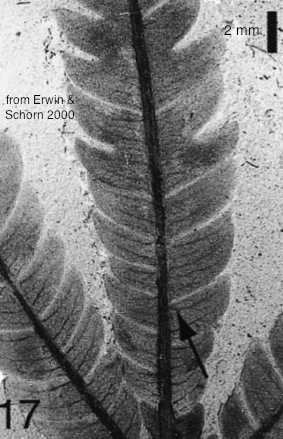
In the 1930s, it was discovered that Lyonothamnus wasn't just an island tree, that it once grew on the mainland.  Fossils from Death Valley in southern California were reported by Daniel Axelrod, who continued to describe new fossil Lyonothamnus locations in California, Nevada and Oregon into the mid-1990s.  The distinctive leaves and venation (arrangement of veins) of Lyonothamnus make fossils relatively easy to identify.  The fossilized leaves below clearly have long narrow primary segments with many secondary segments, and the best preserved fossils show the characteristic venation as well (closeup on right).  All fossil Lyonothamnus have compound leaves, similar to those of the island ironwood, suggesting that this is the more common form and that the simple leaves of the Catalina ironwood are a relatively-recent evolutionary development.


The island ironwood, with its beautiful fern-like leaves and red-and-gray shaggy bark, is becoming popular in landscaping, so one doesn’t need to travel to the Channel Islands to see it.  I found it growing in the San Luis Obispo Botanic Garden in El Chorro Park.  It is well-represented in the Channel Islands area of the Santa Barbara Botanic Garden, and in fact is part of the SBBG logo.  Island ironwood is the official tree of Santa Barbara County.
Island ironwood growing on the Cal Poly campus in San Luis Obispo, California.
Photo courtesy Cal Poly Plant Conservatory Tree Project.
Island ironwoods belong to the rose family, confirmed by the small white flowers reminiscent of some other members of the Rosaceae, such as spiraea.  While there is agreement among plant taxonomists regarding family assignment, the relationship of Lyonothamnus to other members of the rose family is not at all clear.  Perhaps this genus is sufficiently ancient that it lacks close relatives, making classification within the family difficult (Morgan et al. 1994).  Photo below courtesy Karduelis via Wikimedia Commons.

Of course the really interesting question is:  Why are there still ironwoods on the islands but not on the mainland?  We don’t really know and can only speculate, but that’s ok ... informed speculation is fun!
Native populations of Lyonothamnus spp. indicated in blue.
First, how might these trees have reached the Channel Islands from the mainland?  The islands are high points of ridges that are mostly underwater.  When I was a botany student in Santa Barbara oh-so-long ago, the thinking was that during times of glacial advance, sea level dropped enough to expose continuous ridges from the coast.  Subsequent sea floor mapping killed that idea.  Though sea level did drop sufficiently to connect some of the islands, there were no bridges to the mainland during the Pleistocene.  And the Pleistocene was recent -- less than 1 Ma -- while the fossil record suggests that Lyonothamnus may have disappeared from the mainland as far back as 6 Ma.

Perhaps these trees are relics of an even older time ... back when the Coast Ranges were being uplifted (starting 30 Ma), and before the Western Transverse Ranges rotated almost 90º, sticking the westernmost peaks out in the ocean.  Maybe ... but given the almost-intractable complexity of coastal California geology, I’m not going any further with this idea.

Why did Lyonothamnus disappear from the mainland?  On Santa Cruz Island, ironwoods occupy a narrow range of habitat -- “primarily north-facing coastal slopes, often along small faults” and often on sites with cold-air drainage (UCNRS 2007).  Perhaps Lyonothamnus thrived on the mainland in cooler wetter environments of the past, disappearing as the climate warmed.  Somehow it managed to persist in these island refugia.
That’s fortunate for us!  Lyonothamnus, missing for 6 million years until Santa Barbara resident Barclay Hazard discovered it on Santa Cruz Island in 1885, is still with us.  When we look at these trees, we can imagine woodlands of 15 million years ago, and marvel at ironwood-dominated landscapes where now there is desert.  It is this ability to peer into past worlds, even if only dimly, that makes fields such as plant geography, paleontology and geology so exciting.


Sources (in addition to links in post)

Erwin, D.M. and Schorn, H.E.  Revision of Lyonothamnus A. Gray (Rosaceae) from the Neogene of Western North America.  Int. J. of Plant Sci. 161: 179-193.

Morgan D.R., Soltis, D.E., and Robertson, K.R.  1994.  Systematic and evolutionary implications of rbcL sequence variation in Rosaceae.  Am. J. Bot. 81:890–903.

Smith, C.F.  1976.  A flora of the Santa Barbara region, California.  Santa Barbara Museum of Natural History.

Thorne, R.F.  1967.  A flora of Santa Catalina Island, California.  Aliso 6:1-77.

University of California Natural Reserve System.  May 2007.  Santa Cruz Island Reserve Brochurehttp://santacruz.ucnrs.org/SCIR%20brochure%20text%204=2007.pdf [accessed May 2012].