Wednesday, August 24, 2016

Beach-combing 11,000 Feet above Sea Level

My old friend Sparky, on an early Proterozoic beach in southeast Wyoming.

West of Laramie, Highway 130 crosses the rolling grasslands of the valley bottom for about 30 miles and then begins to climb, winding up through the Medicine Bow Mountains, through conifer forest and quaking aspen, past meadows and small lakes, past streams lined with yellow, blue and red wildflowers. Polished boulders lie scattered about, sparkling in the sun. For ten miles the road climbs. The meadows get bigger, the trees smaller. There are more and more boulders and outcrops until finally the landscape is dominated by rock. Most prominent is the Snowy Range—a wall 1500 feet high and seven miles long—a beach turned on its side—5600 feet of sand transformed into rock.
In 2014, the US Forest Service installed geological interpretive signs, designed by the Wyoming Geological Survey, at the high point of Highway 130. No longer are we limited to today’s scenery. Now we can view the Snowy Range in deep time—two billion years ago!—and appreciate the Earth’s awesome powers.

Accumulation

If we were to travel in time as well as space, and visit southeast Wyoming two billion years ago (early Proterozoic time), we would be standing on the southeast coast of a young North America. Looking northeast, we would see mountains in the distance. Erosion was rapidly wearing them down, being unimpeded by vegetation (land plants wouldn’t appear for another 1.5 billion years). Streams carried massive amounts of debris to the coast where they dropped their loads, building deltas and beaches.

Of course this tranquil coastal scene was not to last, the Earth being what it is—dynamic.

Transformation
A few hundred million years later, a drifting continental fragment or several island arcs bumped up against the coast. A collision of this scale has serious repercussions. The beds of sand—by now lithified into sandstone—were deformed into large steep folds. Immense pressure and heat transformed the sand to very durable quartzite. The landscape must have been spectacular, maybe similar to the Himalayas or Andes. But it too was ephemeral and soon gone—worn down and buried under younger sediments. The quartzite would lie hidden from view for something like 1.5 billion years.

Revelation
Then once again the land was shoved up and folded, during the widespread deformation that created the Rocky Mountains 70 to 40 million years ago. Erosion went to work immediately, as it does whenever mountains are uplifted, and the younger sedimentary strata were worn away to reveal rocks that came to be two billion years ago along that ancient coast. So let’s go beach-combing!
Emmie is fascinated by early Proterozoic rocks.
We won’t find any shells or seaweed or dead fish on this beach—two billion years ago was much too early for complex life—but our beach-combing will still be productive. Even though the quartzite is quite ancient, the metamorphism was low-grade (“only” 200-300º C), so structures and features of the original sand deposits are still visible! These are some of the clues geologists use to reconstruct the environment here two billion years ago (of course they don’t always agree).
The Snowy Range is mostly Medicine Peak quartzite, which is highly resistant to erosion. That’s why the Range stands above the rest of the Medicine Bow Mountains.
Original beds (layers) are still visible (left of center, beyond lake; click on image for a better view).
On the west side of Mirror Lake, beds of sand-turned-to-rock are tilted to nearly vertical.

Fine-scale sedimentary structures are common—such as bedding, cross-bedding, and layers of pebbles. Various minerals add color. Much of the rock is polished, for as recently as 12,000 years ago, glaciers were grinding their way across this area. Beauty combined with views into an ancient world keep me looking at rock after rock after rock.

Often the quartzite appears striped—showing layers of sand deposited at different times, under different conditions, or maybe from a different source.

Cross-bedding is common in places. The scale of the beds indicates this sand was deposited by water, perhaps in a river or subtidal delta (vs. large scale cross-bedding created by wind, as in dunes).

Medicine Peak quartzite includes occasional layers of quartz pebbles, sometimes enough to qualify as quartz pebble conglomerate. Pebbles need more vigorous transport than sand; maybe they were deposited when streamflow was high.
Arrows point to a pebble layer in cross section.
Closer view.
See that dark one?
It’s quartz pebble conglomerate!
An even better one!! It's so hard to quit searching ... just like in beach-combing.

The Snowy Range is about 45 miles west of Laramie, via Wyoming Highway 130. Stop at Libby Flats and the overlook to the west for great views, invigorating mountain air, and a healthy dose of geological edification.
(10,847 feet above sea level)
Snowy Range in the Medicine Bow Mountains. Arrow marks pullouts with geological signs (Google Earth).


Sources (in addition to links in post)

Hausel, WD. 1993. Guide to the geology, mining districts, and ghost towns of the Medicine Bow Mountains and Snowy Range Scenic Byway. Wyoming State Geological Survey Public Information Circular No. 32.

Houston, RS, and Karlstrom, KE. 1992. Geologic map of Precambrian metasedimentary rocks of the Medicine Bow Mountains, Albany and Carbon counties, Wyoming. USGS Miscellaneous Investigations Series Map I-2280. PDF

Karlstrom, KE, and Houston, RS. 1984. The Cheyenne Belt; analysis of a Proterozoic suture in southern Wyoming. Precambrian Research 25:415-446.

Lanthier, LR, 1979. Stratigraphy and structure of the lower part of the Precambrian Libby Creek Group, central Medicine Bow Mountains, Wyoming. Contributions to Geology, University of Wyoming. 17:135-147. 

Mears, B, Jr. 2001. Glacial records in the Medicine Bow Mountains and Sierra Madre of southern Wyoming and adjacent Colorado, with a traveler’s guide to their sites. Wyoming State Geological Survey Public Information Circular No. 41.

Tuesday, August 16, 2016

The Night's Alluring Advertising

Oenothera nuttallii.

I awoke in the middle of the night to a powerful fragrance emanating from the kitchen—a mix of jasmine and wintergreen and the benzyl benzoate beloved of veterinarians. I didn’t notice the abundant nitrogen-bearing compounds, for their disgusting stink was masked by perfumey scents and sharp animalic notes. But I should be clear—only later would I learn these details. At the time, I only recognized the thick sweet yeasty smell of Nuttall's evening primroses in bloom.

True to their name, evening primroses open at dusk. Nuttall’s evening primrose is well-suited to dim light, with a strong fragrance that lures pollinators to a large white target, where they’re rewarded with nutritious nectar. While sipping the nectar, the visitor inadvertently picks up pollen, and hopefully carries it to the receptive stigma of another evening primrose of the same species—leading to fertilization, seed production, and the perpetuation of life.
“A 5-spotted hawkmoth, Manduca quiquemaculata, drinks nectar from an opening Oenothera harringtonii flower. If you look closely [click on image], you will see that pollen has accumulated on the moth’s proboscis. Hawkmoths are important pollinators of many members of the evening primrose family, Onagraceae, and other night-flowering plant species.” (Krissa Skogen; used with permission)
The evening primroses in my kitchen were collected from a nearby abandoned railroad. I brought them home intending to make macro portraits, but I waited too long. The petals wilted and turned pink, signaling “all done.” Other flowers were waiting in the wings, however—folded and rolled up in their buds. They bloomed that night, filling my kitchen with their potent scent. After a few photos, I took them outside to the woodshed, leaving the door open for any pollinators that might be around.
This flower’s clearly finished, being pink. Pollinators, you might as well look elsewhere.
Midnight in the kitchen.
Morning in the woodshed.
The flowers remained open for several hours that morning. Inside the shed, they stayed still enough for the macro portraits I had hoped for.
The petals are highly reflective, and release aromatic compounds—terrific advertising.
There really is yummy nectar down in this hole!
Evening primrose pollen comes in strings, held together with viscin threads. Most online sources define “viscin” as a product of the mucilaginous sap of mistletoe, but there's more to it. In some plants, including orchids and evening primroses, pollen grains are held together with clear elastic viscin threads. More info here and here.
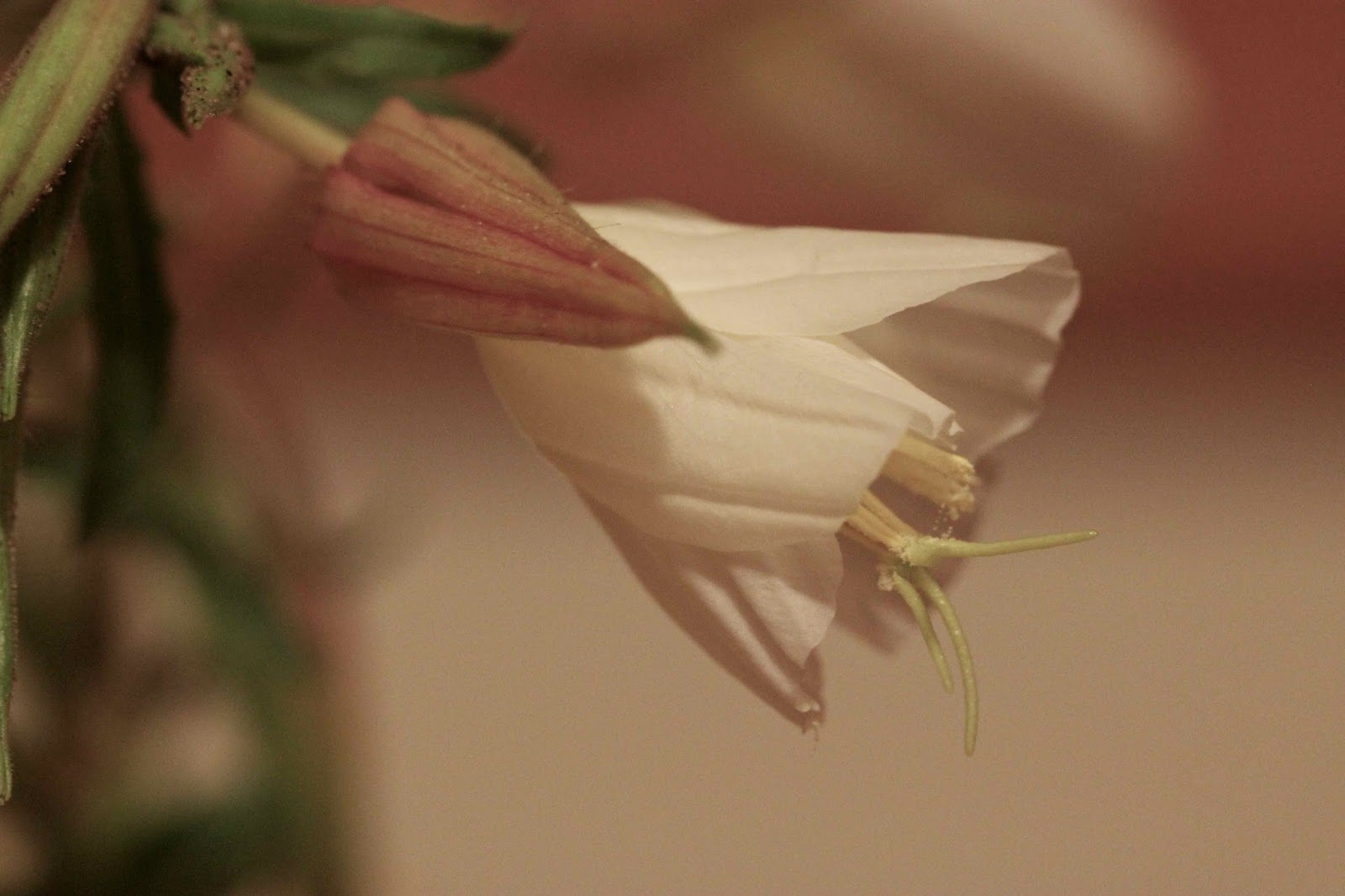
Viscin threads and pollen grains hang from anthers. Note extended 4-lobed green stigma.
Oenothera nuttallii  is thought to be an outcrosser. Keeping the stigma beyond the anthers discourages self-pollination.
Finally starting to wilt. But the stigmas are still out there waiting for pollen.

I had read that some evening primrose flowers open very quickly, so I collected stems with buds, hoping to catch them in the act. I put them in a vase in the kitchen. 
Drooping slender buds looked too young. Plump ascending buds looked more promising.
Surely these are ready to bloom!
The calyx of one of the buds had split, providing a glimpse of carefully packaged petals with green stigma lobes at the tip.

At 7:30 I turned off the lights and opened all the windows, bringing the cool dimness of dusk to the kitchen. I took up watch, reading by headlamp, but for an hour I noticed nothing. At 8:35 I let the dog in, and returned to that strong distinctive fragrance—a flower was fully open! These evening primroses are fast indeed. Soon others followed.
8:42:  Splits develop in the calyx, stigma lobes emerging.
8:42.5:  Calyx folded back, petals are starting to unfurl.
8:43:  Petals continue to spread and unfold.
At 8:44, I heard a faint but definite “pop”—a third flower had literally popped open!
This one wasted no time.
Petals spread and unfold. Fold lines remain visible until flowers close the next morning.
By 8:50, when I turned off the camera, four flowers had opened, and were filling the kitchen with their thick distinctive scent. I moved them outside and wished them the best.


Nuttall’s evening primrose is said to have a strong or even unpleasant fragrance. Eager to know more, I went searching. But Google and academic databases produced nothing specific for Oenothera nuttallii. I found a slender lead—a paper about volatile compounds in yellow-flowered evening primroses. Author Rob Raguso promptly responded to my inquiry:
“Specific to O. nuttallii, we have a large data set and a paper in prep on the phylogenetic distribution of floral scent in Oenothera section Anogra, including both lab and field data for O. nuttallii. It is a fascinating plant and there is much more to be learned about it! I hope to have the paper submitted by the end of the year, with my co-authors. Will be happy to share with you once it is.”
Floral scents are complex. Sometimes only a single compound is involved, but more often there are 20 to 60, or even 100 (Knudsen & Gershenzon 2006). Raguso and his colleagues have identified 16 volatile compounds in Nuttall’s evening primrose. The majority, about two-thirds of all emissions, are really foul-smelling nitrogen-bearing compounds. Yet to me, these evening primroses smell sickeningly sweet at worst, and only when they're confined to a small room.

The explanation lies in our differential reactions to specific compounds, as Raguso explained:
“… an important point is that human (and insect) perception of plant volatiles is not always dominated by the most abundant compounds. In the case of O. nuttallii, there is a relatively large and consistent presences of methyl salicylate, known to many as wintergreen oil! Also, there is a small amount of a very sweet, perfumey compound called cis-jasmone, which has a very penetrating effect to human subjects. So the blend is very dimensional, from sharp "animalic" notes (as described by the great chemist/perfumer Roman Kaiser) to distinctive wintergreen and jasmine scents, with a heavy, almost medicinal presence lent by the largest volatile compound in our sample, benzyl benzoate.”

Which pollinators find this blend irresistible? Moths. The Raguso lab is currently studying responses of hawkmoths to compounds released by Nuttall’s evening primrose. Krissa Skogen has shown that the hawkmoths that pollinate Harrington’s evening primrose will travel up to twenty miles in a night. Do equally wide-ranging hawkmoths pollinate Nuttall’s evening primrose? If so, the required outcrossing is almost certainly assured!
A receptive stigma extended well beyond the anthers, waiting for pollen from afar.

Sources (in addition to links in post)

Many thanks to Rob Raguso, Professor and Chair of the Dept. of Neurobiology and Behavior at Cornell University, for sharing his research results for Nuttall’s evening primrose.

Krissa Skogen of the Chicago Botanic Garden provided the great photo of the hawkmoth and evening primrose. For more about her research on hawkmoths and Harrington’s evening primrose, see Science Scents.

Knudsen, JT, and Gershenzon, J. 2006. The chemical diversity of floral scent, in Dudareva, N, and Pichersky, E, eds. Biology of floral scent. CRC Press.

Raguso, RA, et al. 2007. Floral biology of North American Oenothera Sect. Lavauxia (Onagraceae): advertisements, rewards, and extreme variation in floral depth. Annals of the Missouri Botanical Garden 94:236-257. http://www.jstor.org/stable/40035498