Sunday, April 27, 2014

Are you an alder or a birch?

We were hiking in Curt Gowdy State Park a few weeks ago when we met two leafless trees standing by a creek.  “Are you an alder or a birch?” I asked the first (above).  There was no reply.  I posed the same question of the second (below), with the same result.  Both stood silently except for an occasional whisper of branchlets in the wind.
It was a valid question.  Alders and birches are both in the birch family (Betulaceae).  You might say they’re cousins -- different genera, with alders in the genus Alnus and birches in Betula.  They’re enough alike to be confusing, especially when they don’t have leaves.  I was pretty sure one of these trees was an alder and the other a birch, and I was hoping there was an easy way to tell them apart this time of year.  I looked into it when I got home and found it’s not as simple as I had hoped.  But it’s not that hard either.

Both alders and birches are said to have smooth bark, but this is a little misleading.  I think the authorities mean they don’t have furrowed bark.  Many species of alder and birch have prominent lenticels -- prominent enough that the bark isn’t all that smooth.
Lenticels are pores allowing gas exchange through bark.  This is Tree #2.
Alders and birches both have separate male and female catkins (flower clusters), with the two sexes on the same tree (monoecious).  Fortunately their female catkins differ, and therein lies a way to tell the cousins apart.

Tree #1 was dominated by male catkins ... the guys were in full bloom!
If you look close, you can see small reddish female catkins near the top of the male ones (click on image below).
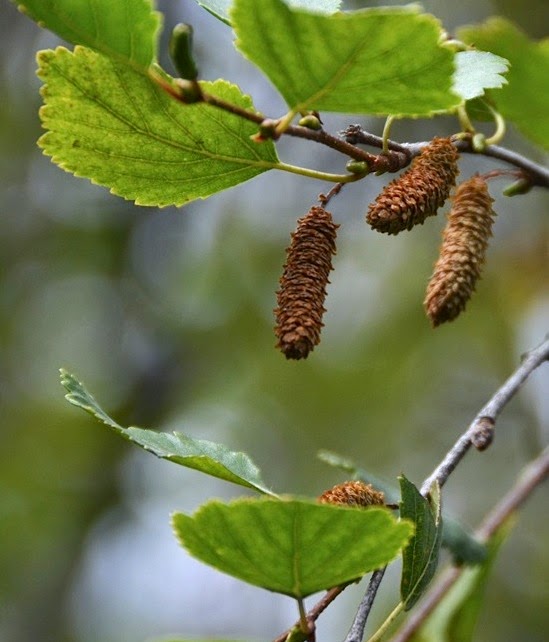
Most useful to us were the old female catkins from last year, persisting as woody cones. They revealed the identity of Tree #1 -- it's an alder.  [These aren’t true cones, found on conifers, but we’ll call them that anyway.]
Darker woody "cones" are last year's female catkins.
Tree #2 had lots of catkins as well.  The male ones were immature -- still hadn’t opened.
Young male catkins, roughly an inch long.
High on the tree were scattered female catkins from last year.  Their papery bracts gave them away.  These are birch cones.  They’ll soon fall apart and be gone.
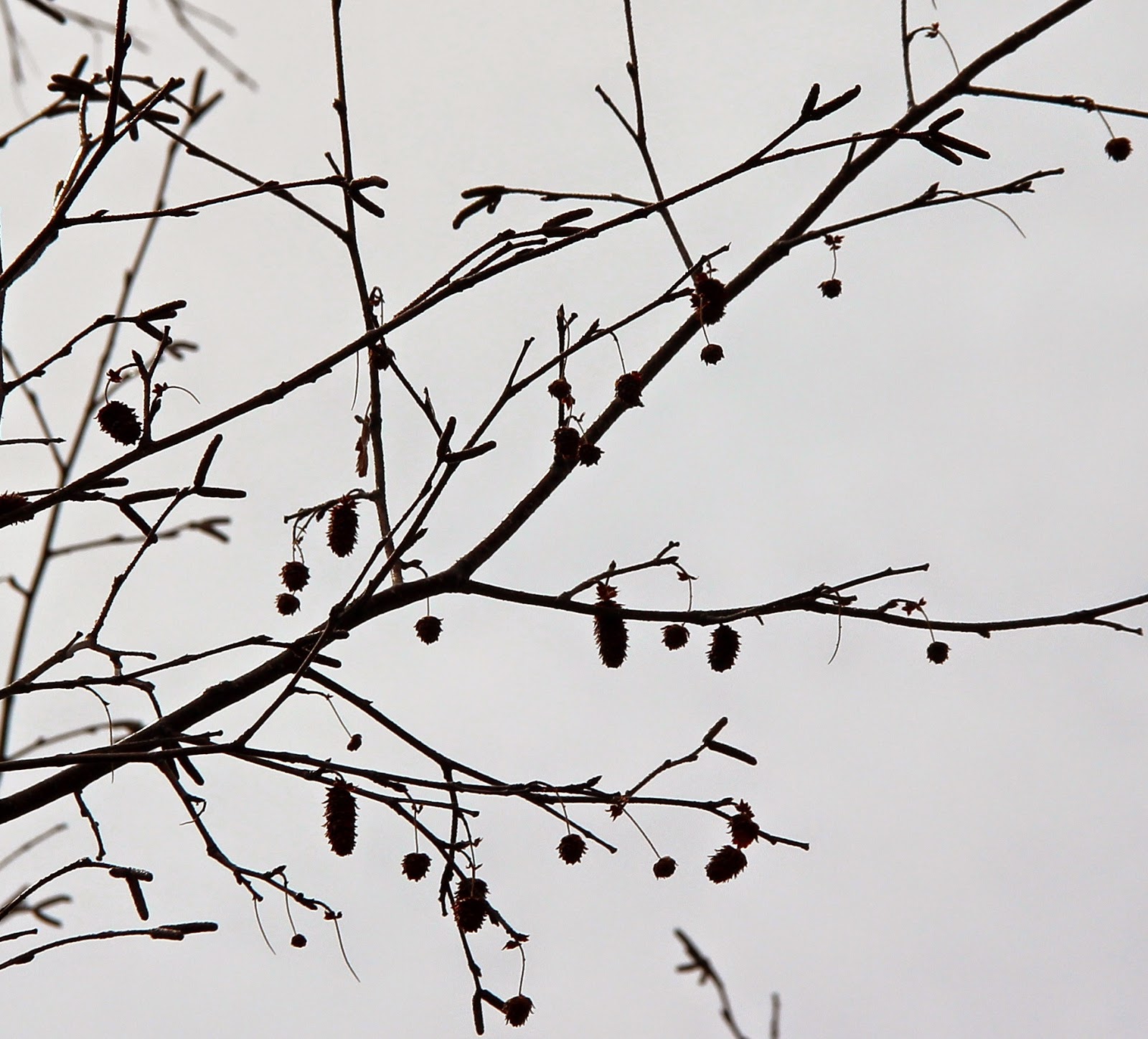
Tree #2 is a birch, with pendulous papery-bracted female "cones" (click on image to view).
In the field I used my Rocky Mountain Tree Finder to key out the two trees.  They are the mountain or thin-leaved alder (Alnus incana var. tenuifolia), and the water birch (Betula occidentalis).  Both are fairly common along streams in Wyoming.
Mountain alder (Tree #1); courtesy Zelimir Borzan, University Zagreb, Bugwood.org
Mountain alder is sometimes called speckled alder, I suspect for the prominent lenticels.
Water birch (Tree #2) in its prime, with mature female catkins.  UFEI, Cal Poly San Luis Obispo
The bark of water birch sometimes is a pretty red, contrasting nicely with the lenticels.
At the base of the water birch we found an old leaf.  It helped with identification.

--- ✿ ✿ ✿ ✿ ✿ ✿ ✿ ---

These trees became the first observations in the newly-launched iNaturalist project Plants of the Southern Laramie Mountains.

Thursday, April 24, 2014

How aspen use green ... or do they?

Our aspen are starting to flower but are still leafless.  Doesn’t matter, they can photosynthesize anyway.
New Under the Sun is hosting April’s Berry-Go-Round; the theme is plant color:
“You can talk about your favorite colors, unusual colors, pigment biosynthesis, how plants use color, how humans have painted new colors onto our favorite plants, color patterns, temporal color changes etc.”
This time of year, “plant color” makes me think of the bright flashes that start appearing in the drab brown-and-gray landscapes that have been with us all winter -- yellow sagebrush buttercups and purple pasque flowers and fresh green leaves popping from buds.  But even though Spring technically arrived over a month ago, it’s still late winter here.  There are occasional wildflowers -- a few brave individuals blooming -- but most are waiting. Trees are still leafless.  However, if you walk through aspen, a bit of green might catch your eye.
Quaking aspen, Populus tremuloides.  Notice it’s greener on the south side.
Some aspen trees have green bark.  It’s more obvious in younger ones.  In 1957, L.C. Pearson and D.B. Lawrence were living in Minnesota where green-barked aspen are common.  They looked at cross-sections of bark under a microscope and found that the green color was localized in plastids (compartments within cells).  This was intriguing, as others had suggested it was due to a parasitic fungus.  They realized that these were just regular plastids, not some abnormal growth.
A bright green layer visible through the very thin (0.2 mm) outer layer of bark.
They decided to investigate further.  They periodically collected bark and leaves from the north and south sides of aspen trees, extracted the green pigment, and analyzed it.  Absorption spectra for pigment from both bark and leaves matched that of chlorophyll, used by plants to photosynthesize and convert sunshine to food.  They also were able to show that the green pigment in the bark was photosynthetically active.
Absorption spectra of pigments in aspen dissolved in ether.  Data of August 3.  Chlorophyll a measured at 6600 A [peak on right].  From Pearson and Lawrence 1958; PDF available here.
Chlorophyll levels in bark were highest when leaves were just starting to appear, and then dropped off, suggesting green bark is a way to get a head start on the growing season.  Maybe this is why deciduous aspen can thrive where growing seasons are short ... where most other trees are evergreen conifers.
The bark is paler green in shady situations.
Before you go, let’s clarify one thing.  Contrary to what was suggested in the title, aspen don’t “use” green.  In fact most plants don’t -- they throw it away.  Chlorophyll is green because it reflects green light.  It absorbs red and blue for photosynthesis.  Here’s another spectrograph, this one in color so you can better see what colors plants use -- not green.
“Absorbance spectra of free chlorophyll a (blue) and b (red) in a solvent.”  Source