 |
|
All photo-poetry montages by Hollis (click to read). Thank you, poets, for your words.
|
The Grand Valley, in western Colorado, is a land bounded by rock. To the north, the Book Cliffs stretch for almost 200 miles—sinuous bands of muted sandstones and shales. To the south stands the steep face of the Uncompahgre Plateau—red, yellow, buff and orange sandstone walls, on a foundation of dark ancient rock. And in between—in the community of Fruita, just off the roundabout near the west end of town, on the second floor of the old bank building—eponymous Lithic Press makes words into books and sends them off, dispersing poetry across the Southern Rocky Mountains and Colorado Plateau (in this land of rock, we find ourselves using physiographic provinces rather than political subdivisions).
First off the press was Whacking the Punchline, a small square spiral-bound collection of compression sketches by Jack Mueller, published in 2008. Since then, 27 more books—many in custom format—have been ushered into the world. Lithic recently joined a national trend of small independent presses opening brick-and-mortar bookstores. They hung out their shingle in 2015.
 |
|
Lithic’s shingle features predatory Xiphactinus—“probably the most photographed fossil specimen in the world” (click on photo to view the smaller fish inside; source).
|
 |
|
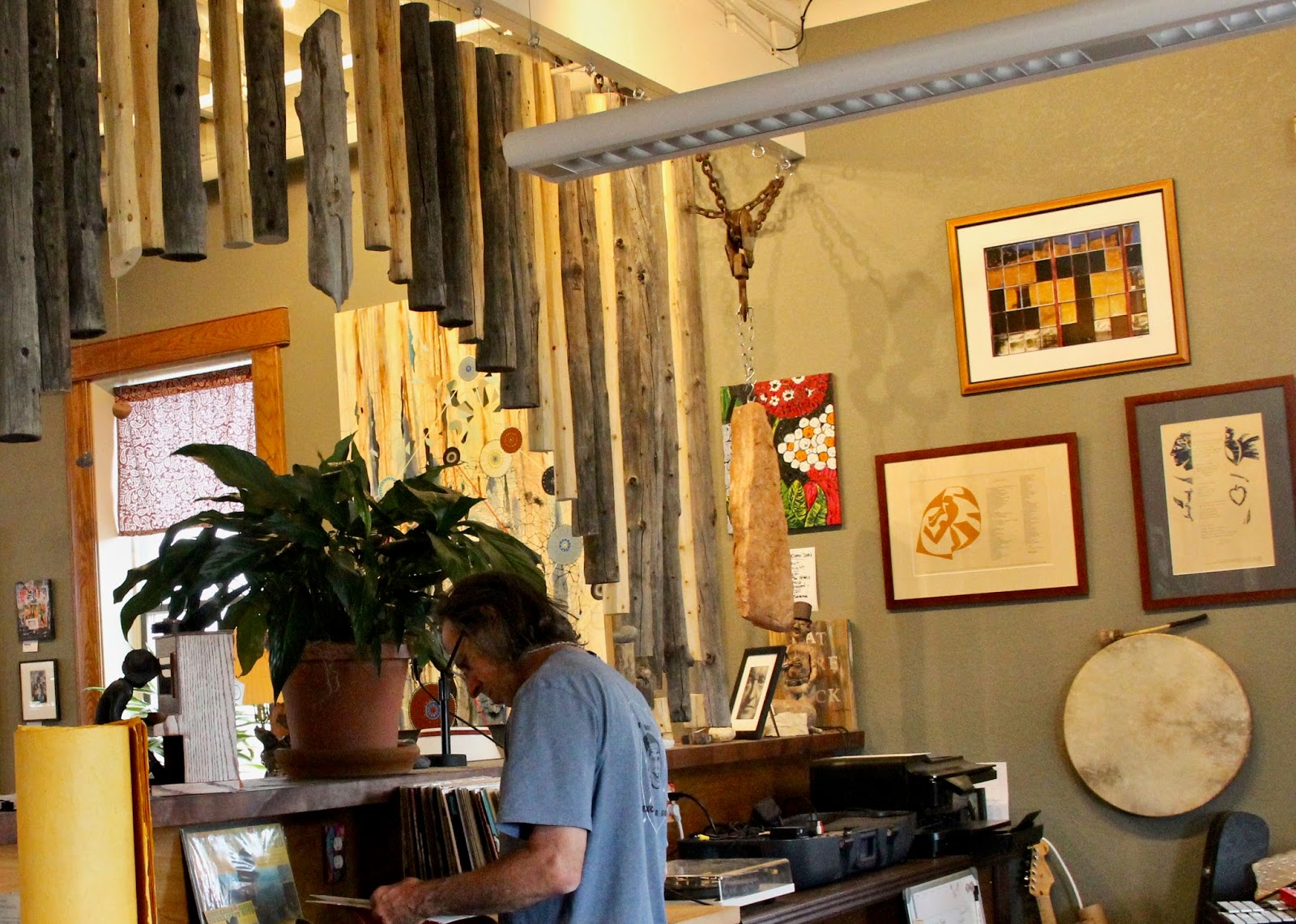
Lithic Bookstore & Gallery—a space for design, sales, poetry readings, contemplation, inspiration.
|
 |
| Danny Rosen, at the office. |
Last September, I stopped in Fruita to enjoy the local literary scene, as I do most years. This time I cornered Lithic-owner Danny Rosen in his office. “I have some questions for you” I said firmly, swinging a six-pack for emphasis. We sat down for an interview.
How did the name Lithic Press come about?
The name stems from my background in geology; the word means stone-like or pertaining to stone. Also, it alludes to early methods of printing. Lithography involved spreading a greasy kind of ink onto etched limestone to print from one medium to another.
How did the name Lithic Press come about?
The name stems from my background in geology; the word means stone-like or pertaining to stone. Also, it alludes to early methods of printing. Lithography involved spreading a greasy kind of ink onto etched limestone to print from one medium to another.
What kinds of books does LP publish—what subjects, genres?
So far, Lithic has published books of poetry—largely because that has been my interest. I would like to publish other genres in the future, like natural history. More than any particular subject matter, I want to work with writers who pay attention to language, tell intriguing stories, teach me something.

What’s your policy on manuscript submission?
We do not accept unsolicited manuscripts; we accept manuscripts largely by invitation. I had an open submission period last year for chapbook manuscripts (simple books, folded and stapled, 20-40 pages long). We received over 100 submissions. It was time-consuming to go through all of them, and unpleasant to send out so many rejections. I don't anticipate doing that regularly. But we did get a few books out of it.
Though we don’t advertise for submissions, they show up anyway … frequently. Seems everyone who ever wrote a poem wants a book. Maybe that's a reflection of “celebrity culture.” Being a publisher offers interesting viewpoints on human psychology! Recently we've been reaching out to writers we admire, asking for manuscripts. This year and next we have books coming out by writers in North Carolina, South Carolina, Oregon, New York, California, and Bombay.

What is the Lithic bookmaking process?
I facilitate the process. One way or another I find manuscripts (or they find me). I don't edit so much as closely read each manuscript to find errors and give suggestions. The books I've done for Jack Mueller required a lot of work, a labor of love. He's a close friend, and this friendship played a big part in the creation of Lithic Press. I wanted to publish his work—I love it so much and I think it has great value. Amor Fati took four years to complete.
Most of our books start with manuscripts that are fairly polished when we receive them—that’s what I want. My strength is to make books for strong writers, not to help make writers strong. The early phases can be very exciting, when the idea first turns into a concept of an artifact. We decide what the book will look like: size, shape, kind of paper and binding type, font and font size, and so on. Kyle Harvey does all the design and layout for Lithic. He is very talented and imaginative. I nudge him continually, to be open to what possibilities we may conjure: new kinds of paper, different presentations.
Most of our books start with manuscripts that are fairly polished when we receive them—that’s what I want. My strength is to make books for strong writers, not to help make writers strong. The early phases can be very exciting, when the idea first turns into a concept of an artifact. We decide what the book will look like: size, shape, kind of paper and binding type, font and font size, and so on. Kyle Harvey does all the design and layout for Lithic. He is very talented and imaginative. I nudge him continually, to be open to what possibilities we may conjure: new kinds of paper, different presentations.


I want every book to stand alone as a fine artifact—a handsome object that feels good in the hand, that makes a contribution to the human story—a little something to spread around, leave behind.

I’ve been fascinated with books all my life. As a kid, I was blown away by “All the Books in the Library.” To make something that will go into that library feels like important work. Someone said to me recently that I was like a midwife to the book. That’s a strange but accurate description. It’s awesome to hold a newborn book and usher it into the world.
 |
|
Going Down Grand, Lithic’s pocket-sized book of poems for your next trip down.
|

Yet stones have stood for a thousand years, and pained thoughts found
The honey of peace in old poems.
–Robinson Jeffers


