Showing posts with label lanceleaf cottonwood. Show all posts

Sunday, February 8, 2015

Of Anchor Ice & Cottonwood Flowers

It was the first of February, 8:30 AM, and 17º F after a cloudy night with light snow.  When I reached the river, I saw two men with poles standing in the water as ice floated by.  What were they doing?!  Fishing? hunting crawdads? collecting garbage? maybe playing ice golf, an ancient Scandinavian sport?
Will this be the final putt?
The men intently studied the river as my lanceleaf cottonwood tree stood by.
This month’s tree-following post was to be about my search for a new tree, but the cottonwood I've followed for a year now led me to two unexpected and interesting things. First there were the men who were taking photos of ice on the river bed.
They used a GoPro action camera – the kind folks wear to record adrenalin-inducing activities.
Ice on the river bed?  How can that be?  Ice floats, being less dense than water.  True ... but as I now know, under the right conditions a special kind of ice forms – anchor ice.  It’s really interesting and worth keeping an eye out for.  I’m glad I asked those guys what they were doing.

Cold nights are best, well below freezing.  Where the river is fast-moving and shallow, water may become super-cooled and stay liquid below its normal freezing temperature.  The sand, gravel, rocks, etc. that it’s flowing over also cool to that temperature.  The water is moving right along so surface ice doesn't form, but floating crystals (frazil) freeze out.  They stick to material on the river bed and to each other, making gray-green soft slushy ice.  When the day begins to warm, anchor ice begins to break free and float downstream.  Soon it’s all gone.  [Here’s a summary with clear explanations, and another in PDF format.]


Top: gravel and small rocks on bottom of anchor ice removed from river bed

Middle: anchor ice anchored to river bed

Bottom: anchor ice breaking free from river bed 

(modified from Kempema et al. 2008; click on image to see more detail)


Gray-green detached anchor ice floating downstream.
For years I’ve watched murky globs of ice float down the river on cold mornings.  I always thought they had broken off from ice along the river margins.  Now I know better.  The things you learn when you follow a tree!

Anchor ice was pretty minimal that day and has been for most of this unusually-mild winter.  But it can be dramatic with significant impacts, like creating dams and scouring river beds.  “Seeing is believing” so have a look at this anchor ice video – a “nature treat for the day” from the northeast USA.

--- ✿ ✿ ✿ ✿ ✿ ✿ ✿ ---

The second thing of interest is actually quite amazing ... my tree is blooming in February!
Cottonwood in full bloom; click on image to see fringed bracts, young ovaries and stigmas as in diagram below.

Suspicious?  You should be.  It is blooming ... but in my kitchen.
Last month when I was wondering if my cottonwood was the bitter kind, I collected twigs with buds to examine at home.  The true bitter cottonwood, the narrowleaf, has very resinous buds, but those on my tree aren’t – this suggests it's a hybrid.  When I was done, I put the twigs in a small container with water to see if maybe something interesting would happened.

Something did.  Now there are two female catkins (flower clusters), other buds have tiny bits of green at the tips – leaves? – and little twigs have grown roots!  Of course now I will put them in a pot.  Maybe something interesting will happen ...
I’m not surprised to find flowers out of season and roots growing from tiny twigs.  Cottonwoods are notoriously opportunistic.  They produce prodigious amounts of cottony seeds and cast them to the wind.  Maybe – just maybe – one  will land in a suitable place and grow.  Some species sucker and spread readily, as does mine.  Fallen live branches can root and grow.  And they grow fast.  My tree may look majestic, with all the noble characteristics we associate with trees – strength, great stature, longevity, steadfastness.  But it’s really more like a scrappy nine-lived alley-cat, resigned to (and ignoring) the capricious hand of fate.  Try anything and everything ... be ready ... live fast and die young ... wotthehell, wotthehell
Mehitabel (by Don Marquis).


More about anchor ice in the Laramie River:

Kempema, E, Ettema, R, and McGee, B.  2008.  Insights from anchor ice formation in the Laramie River, Wyoming.  19th IAHR International Symposium on Ice.

Kempema, E, and Ettema, R.  2010.  Anchor ice rafting:  observations from the Laramie River.  River Research and Applications 27:1126-1135.

Wednesday, January 7, 2015

Am I following a cottonwood of the bitter kind?

The Laramie River is lined with the wrong kind of cottonwood, including mine (left).
... we arrived on the 10th March at a small branch of the North fork of the Platte, where we found an abundance of wood.  This stream is about one hundred feet wide, meandering north-eastwardly through a beautiful and fertile valley ...  It’s margin is partially wooded with large cottonwood of the bitter kind.  The sweet cottonwood ... is nowhere to be found    William Henry Ashley, 1825 (Dale 1918)
Cottonwoods were an important winter fuel in the American West in the 1800s, not just for heat but also to fuel the main mode of transport – the horse.  When grass was poor or covered in snow, the inhabitants – Indians, explorers, trappers and early settlers – collected young branches and inner bark to feed their horses.
Young cottonwood branches and upper branches of older trees were provided as forage for their [Teton Dakota] horses and were said to be as “good for them as oats.”  White trappers and travelers have recorded their observations as to the value of the cottonwood as forage.  (Gilmore 1919)
When the round leaf or sweet-bark cottonwood can be had abundantly, horses may be wintered with but little inconvenience.  They are very fond of this bark, and, judging by the effect produced from feeding it to my horses last winter, I suppose it almost, if not quite, as nutricious as timothy hay.   William Henry Ashley, 1825 (Dale 1918)
Horses survived and even thrived on sweet cottonwood at lower elevations, but they wouldn’t eat the bitter cottonwood of higher valleys and mountains.  In winter a horse would starve in these places.
No sweet cottonwoods anywhere.
Fur trader William Ashley and a small band of trappers camped for several days in the Laramie Valley in March of 1825, while exploring a “central route” to the Pacific.  They had been in the region long enough to know the cottonwoods.  They recognized those along the river as “of the bitter kind” while "The sweet cottonwood, such as affords food for horses, is nowhere to be found" (Dale 1918).

Not all trappers were as savvy.  In the fall of 1831, a party led by Captain AK Stephens chose the Laramie Valley for their winter camp.  Game was abundant, and the river was lined with cottonwoods.  But they didn’t notice that these were the wrong kind until the snows came; then it was too late to move.  They survived, as there was plenty of game and firewood, but their horses didn’t.
My cottonwood tree shortly after new-years day, 2015.
On new-years day, notwithstanding our horses were nearly all dead, as being fully satisfied that the few that were yet living must die soon, we concluded to have a feast in our best style; for which purpose we made preparation by sending out four of our best hunters, to get a choice piece of meat for the occasion. These men killed ten Buffaloe, from which they selected one of the fattest humps they could find and brought in, and after roasting it handsomely before the fire, we all seated ourselves upon the ground, encircling, what we there called a splendid repast to dine upon. Feasting sumptuously, cracking a few jokes, taking a few rounds with our rifles, and wishing heartily for some liquor, having none at that place we spent the day.  Zenas Leonard, 1832 (Leonard 1904)
WY Game & Fish also mistakenly assumed that cottonwoods along the Laramie River were of the sweet kind.
Today we call the sweet cottonwood “Plains cottonwood” or Populus deltoides ssp. monilifera.  The bitter one is the narrowleaf cottonwood, P. angustifolia.  Historians have assumed that early travelers such as Ashley found narrowleafs along the Laramie River (e.g. Dale 1918).  However the cottonwoods I’ve found there appear to be the lanceleaf cottonwood, Populus x acuminata, a widespread natural hybrid between the Plains and narrowleaf cottonwoods.

Below are leaves from the three cottonwoods.  From top to bottom: sweet Plains cottonwood (source), bitter narrowleaf cottonwood (source), and a cottonwood from the Laramie River – probably the hybrid lanceleaf, with broader blades and longer petioles.
When a bitter narrowleaf cottonwood crosses with a sweet Plains cottonwood, what's the result ... bitter or sweet?
Maybe I'll recruit friends to taste the inner bark of the three cottonwoods.  We could do blindfold taste tests ... how scientific!  But will I find any such intrepid companions?
Was it lanceleaf cottonwoods that the trappers camped in, finding them as bitter and unpalatable as the narrowleaf “parent”?  Or did they camp among narrowleafs – the true bitter cottonwoods?  To answer this, we need to know where specifically narrowleaf and lanceleaf (hybrid) cottonwoods grow in the Laramie Valley and vicinity.

I thought this would be easy to figure out.  In Laramie we’re lucky to have the Rocky Mountain Herbarium, at the University of Wyoming.  It's the largest herbarium between St. Louis and those on the West Coast, and the largest anywhere for Rocky Mountain plants.  The local area is generally well-represented, yet when I looked for lanceleaf cottonwood specimens from the Laramie Valley, I found only four ... and none from the river.  Most were collected on the university campus.  There was one specimen of narrowleaf cottonwood from the river, upstream in the mountains to the west.

This summer when mature leaves are available, I’ll collect a specimen from my cottonwood and add it to the Rocky Mountain Herbarium, thereby immortalizing the tree!  Hopefully I can decide what this cottonwood would best be called.  Is it sufficiently different from the narrowleaf to be called a lanceleaf?  With back-crossing, every variation is possible.  If time permits, I’ll visit other places along the river to see which cottonwoods grow where.  There's so much to learn ...
The distant cottonwood (center) is the tree I’m following.


Was my tree alive when Ashley traveled along the Laramie River in 1825?  Did Stephens and his trappers spend the winter near it in 1832?  If so, it would have been a young sapling or sucker shoots.  Cottonwoods grow fast and generally die young, only occasionally reaching 100 years of age or more (Weir 2014).


☞I’m grateful to Steve Sutter, Cultural Records Specialist with the Wyoming State Historic Preservation Office, for introducing me to the role of cottonwoods in early exploration of the American West.  A simple question – "what kind of cottonwood grows along the river?" – and the discussions that followed made this post possible.

Sources

Cain, K.  2007.  The cottonwood tree; an American champion.  Boulder, CO:  Johnson Books.

Dale, HC, ed.  1918.  The Ashley-Smith explorations and the discovery of a central route to the Pacific 1822-1829.  Cleveland: Arthur H. Clark Co.  Available at Google books.

Gilmore, MR.  1919.  Use of plants by the Indians of the Missouri River region.  Bureau of American Ethnology.

Leonard, Z (Wagner, WF, ed).  1904.  Leonard's narrative, adventure of Zenas Leonard, fur trader and trapper, 1831-1836.  Cleveland: The Burrows Brothers Company.  Available at Google books.

Thybony, S.  1981.  The enthnohistory and prehistory of the Medicine Bow National Forest in Eckles, J ed.  Cultural resource overview; Medicine Bow National Forest including the Thunder Basin National Grassland.

Weir, SK.  2014.  Plains cottonwood (PDF).  Accessed January 5, 2015.
Join the fun ... follow a tree!  Kindly hosted by Lucy Corrander.

Sunday, December 7, 2014

Tree-following: Bark


tree-following (noun):  informal  The practice of observing a tree over the course of a year and reporting on it monthly, usually online.  ORIGIN: early 21st century, from tree + follow; see also Loose and Leafy

Sorry, just kidding, “tree-following” isn’t in the dictionary (yet).  But it’s well-established in my vocabulary, as I've followed trees for two years now.  This year I chose a lanceleaf cottonwood (Populus x acuminata) growing on the bank of the Laramie River.  It started as a bare skeleton, developed a large green canopy, and now is back to a bare skeleton.
February 2014.
Cottonwoods in full summer dress, June 2014 (my tree on right).
My tree and Rich's bench in early December 2014.
I’ve learned a lot about this tree – its height, when it flowers (and which sex appears first), when it casts its seeds to the wind, what it does all summer, and when the leaves turn color and fall ... and also how cottonwoods have figured prominently in the rural American West.  But I’ve pretty much ignored the bark.  That’s because it’s humdrum compared with other trees ... not so much other trees here, but rather those elsewhere with their colorful trunks decorated in lichen, fungi and even plants.  Is it our climate?  Is it too cold? too dry?  As always, tree-following leads to questions.
Beautiful old tree in County Durham, UK.  Courtesy Phil Gates – The sweet chestnut that refuses to die.
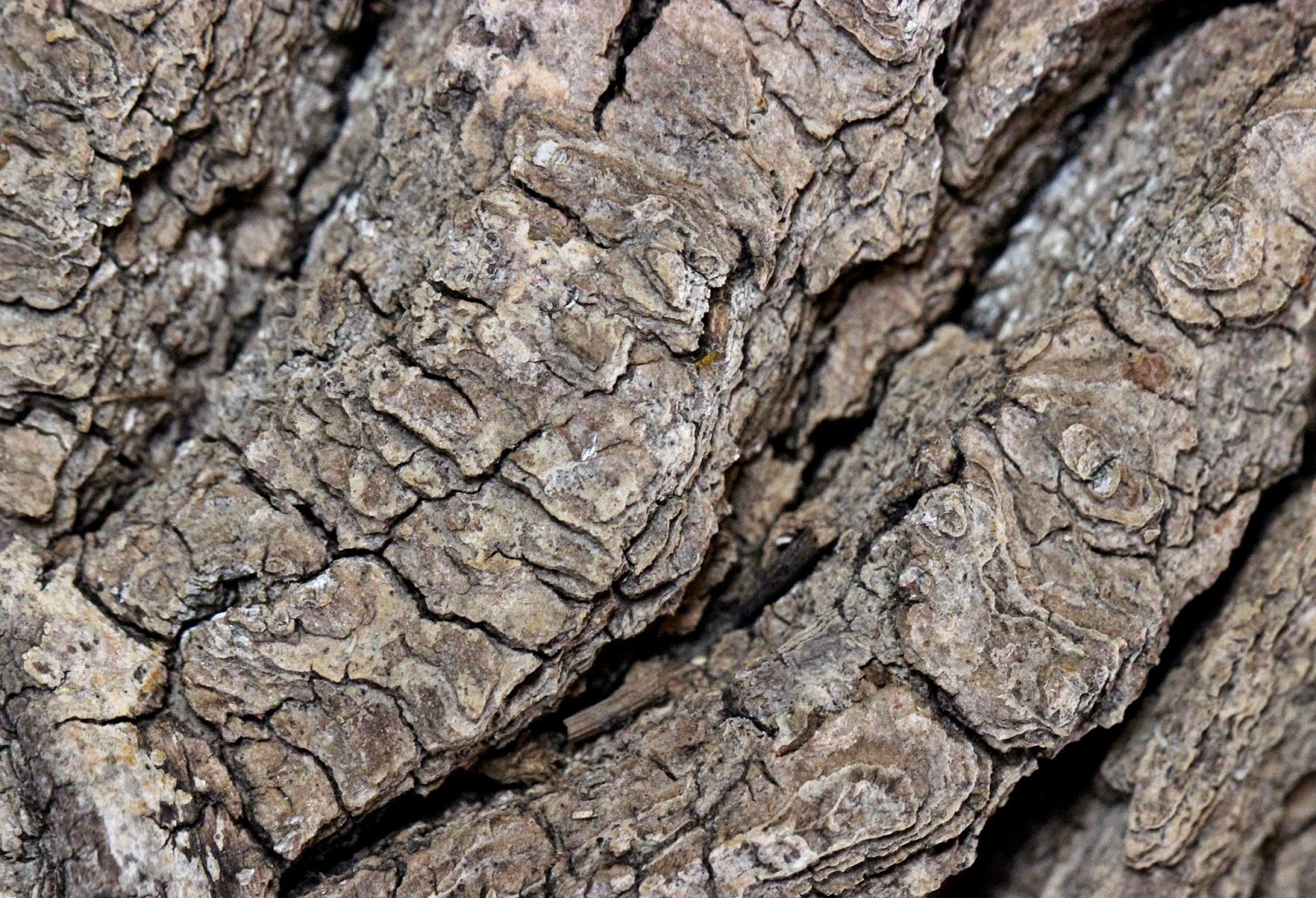
The cottonwood’s leaves are long gone, so it’s time to examine the bark.  Most noticeable is the difference between young and old.  Young bark reminds me of the cottonwood’s cousin, the quaking aspen (also a Populus – P. tremuloides).
With age, dark furrows fracture the pale bark.
I believe there’s a little lichen between the furrows! (orange blotches)
Old bark is darker, thick and deeply furrowed.  Color varies from brown to shades of gray and almost black.
This bark looks like a Google Earth view of buttes, cliffs and drainages!
Looking up-tree at older and younger bark.
The robin’s nest Mary spotted in September is easy to see now.  Will she (the robin) be back next year?  I’ll let you know.
Nest dusted with snow.
Looking close, I found entrances to other homes ... whose?  woodpeckers?
Probably not woodpeckers ... the entrances are only five millimeters across ;-)
This year’s tree-following has given me a rich collection of cottonwood memories.  The most vivid are wind-related, for wind and cottonwoods are inseparable.  Wind sends the cottony seeds flying, and makes fresh young leaves dance in the sunshine.  Cottonwood leaves whisper in summer breezes, and howl in gales.

I'm not alone in my memories.  Those who experience wind in cottonwoods often are left with strong impressions.
“This peculiarity of the foliage of the cottonwood is quite remarkable, so that it is said the air is never so still that there is not motion of cottonwood leaves.  Even in still summer afternoons, and at night when all else was still, they [tribes of the Great Plains] could ever hear the rustling of cottonwood leaves by the passage of little vagrant currents of air.  And the winds themselves were the paths of the Higher Powers, so they were constantly reminded of the mystic character of this tree.”  Melvin R. Gilmore (1919)
“From the upper branches of the cottonwood trees overhead – whose shimmering, tremulous leaves are hardly ever quiet, but if the wind stirs at all, rustle and quiver all day long – comes now and then the soft melancholy cooing of the mourning dove, whose voice always seems far away.” Theodore Roosevelt (1888)
TR at a roundup.  Our 26th president loved the American West and all things symbolic of it.
In The Song of the Lark (1915) Willa Cather described cottonwoods as “wind-loving trees ... whose roots are always seeking water and whose leaves are always talking about it."  Ed Abbey (1956) saw them more darkly.  He lamented the decline of the American West, now populated by phantoms “dying of nostalgia and bitterness”.  He could hear them “shivering, chattering among the leaves of the old dry mortal cottonwoods down by the river – whispering and moaning and hissing with the wind.”

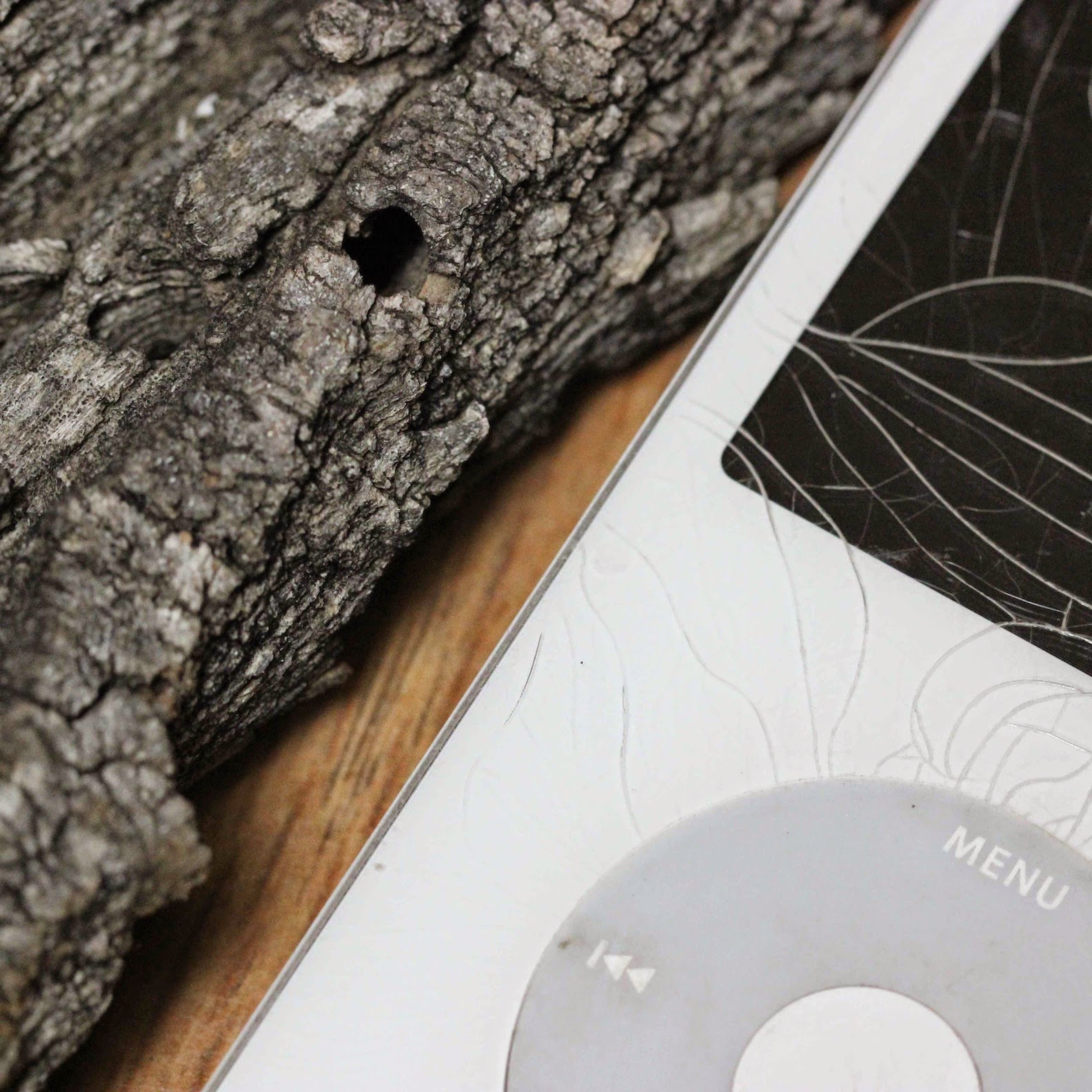
It will be another six months before cottonwood leaves emerge and grow large enough to dance, whisper and howl in the wind.  Laramie winters are long!  So I kept the bark I had brought home to photograph, and put it on a table to remind me of summer days ahead.


Sources

Abbey, Edward.  1956.  The Brave Cowboy.  Dodd, Mead & Co.

Cather, Willa.  1915.  The Song of the Lark.  Houghton Mifflin Co.

Gilmore, Melvin R.  1919.  Use of plants by the Indians of the Missouri River region.  Bureau of American Ethnology.

Roosevelt, Theodore.  1888.  Ranch Life and the Hunting Trail.  The Century Co.

For more tree news visit December's gathering, kindly hosted by Lucy.

Sunday, November 9, 2014

Cottonwood Houses, Cottonwood Stars


Many years ago, in the heat of summer, little girls sat in the shade of cottonwood trees and made tipis from the leaves.
These they made in numbers and placed them in circles like the camp circle of their tribe.
“A circle of cottonwood-leaf toy tipis made by Indian children of Plains tribes” (Gilmore 1919).
I myself have spent a lot of time among cottonwoods as I’m following one this year – a lanceleaf cottonwood.  I’ve been keeping an eye out for stories.  I've found plenty, but none obviously about the lanceleaf.  It's definitely not the cottonwood of the toy tipi story.  The leaves are too narrow, and their bases are tapered.
Lanceleaf cottonwood, Populus x acuminata.
Most cottonwood stories probably refer to the Plains cottonwood, Populus deltoides ssp. monilifera.  It’s common in much of the American West, and was important to indigenous people, early travelers, and settlers – for shade, fuel and building materials.
A Plains cottonwood.  I ate lunch in its shade every day during a grassland project.
It was the Plains cottonwood – Wága chan of the Dakota – that supplied leaves for toy tipis.  In early October, I collected leaves from the Plains cottonwood in my yard, and spines from the matrimony vine (Lycium barbarum) to make my own, following the story carefully.
Building materials.
They split a leaf a short distance down from the tip along the midrib; at equal distances from the tip they tore across from the margin slightly; then, bending back the margin above the rents for the smoke flaps, and drawing together the leaf-margins below the rents and fastening them with a splinter or a thorn, they had a toy tipi.
Smoke flaps regulate draft and ventilate the tipi, especially smoke from the fire.
These [I] made in numbers and placed them in circles like the camp circle of [a] tribe.
The toy tipi story comes from ethnobotanist Melvin Gilmore (1919).  In the early 1900s he visited elderly Indians of the Great Plains who had gathered native plants and still knew the old names and uses.  He hoped to document this knowledge "while it may still be obtained, before the death of all the old people who alone possess it.”  They were happy to share the knowledge “in order that, as they said, future generations of their own people as well as the white people may know and understand their manner of life."

--- ✿ ✿ ✿ ✿ ✿ ✿ ✿ ---

Lanceleaf cottonwoods may not be good for leaf tipis, but like all cottonwoods, they do have stars inside.  The story of the cottonwood star comes from rural Nebraska, by way of Kathleen Cain (2007).  Her father once asked her “Have you ever seen the cottonwood star?”  She hadn’t.
He turned the twig so I could gaze directly into its center.  Running crosswise through the middle of the small piece of wood, the cut revealed a reddish-brown and nearly perfect five-pointed star.
You have to find one with a sturdy knuckle ... You have to cut cleanly ... No hacking.  Not jagged.  One cut is best.
A Pex tube cutter worked well.
A sturdy knuckle.
I selected a twig with a sturdy knuckle – the joint between two years’ growth – and cut through it easily and cleanly.  I saw a tiny reddish-brown spot, the pith where nutrients are stored and transported.  Then I looked through a 10x hand lens.  It was indeed a star!
A macro lens revealed the cottonwood star nicely.  It’s only 6 mm across.
The path of the hidden star stretches out into the future of every cottonwood branch.


Sources

Cain, K.  2007.  The cottonwood tree; an American champion.  Boulder, CO:  Johnson Books.

Gilmore, M.R.  1919.  Use of plants by the Indians of the Missouri River region.  Bureau of American Ethnology.

This post is part of this month's gathering of tree-followers kindly hosted by Lucy.

Tuesday, October 7, 2014

Tree-following: that first question

Do you remember that first question ... back in February when the cottonwoods were leafless, the ground in snow, and the river under ice?
“Is this a single individual, connected underground?”
Time passed, more questions arose:  What kind of cottonwood? (lanceleaf)  How tall? (58.4 feet)  Male or female? (female).  But the first question was never answered.
Cottonwood at dawn.  Is this a single tree, or six?
Most cottonwoods send up suckers -- shoots from buds on the roots.  Old stumps and even fallen branches sometimes produce shoots that grow to maturity.  So it’s reasonable to suspect that this clump is a single individual.  Most cottonwoods along the Laramie River are clumped like this.
Lanceleaf cottonwoods along the Laramie River in early morning light.  Note bird on wire (more later).
Then a clue appeared.  The east half of the cottonwood tree I'm following is now yellow, the west half still green.  Perhaps this isn’t a single tree after all.  We investigated.
My cottonwood tree(s) -- now green and yellow.
Its canopy.
Glen at base of tree(s).
We crept into the little glen among the trunks.  The sound of pitter-patter footsteps and buzz-like whispers swelled and then quickly subsided -- probably river elves fleeing their sanctuary.  To the east towered three stems (maybe-trees) with yellow leaves.  Two to the south still had green leaves as did the younger one to the northwest, which split just above the ground.
Three stems with yellow leaves (green ones belong to stems on right out-of-sight).
Two stems to the south still sport green leaves, though they're fading.
This younger stem became two at some point.
So how many trees?  Might we say at least two -- the yellow and the green?  Then a vague distant memory from botany-student days surfaced.  Being immobile, plants may resort to phenotypic plasticity and produce different forms from the same inherited DNA.  Besides, I like the whole clump and want to follow it.  Are you wondering how one follows an immobile organism?  Apparently you don’t know of the tree-following frenzy hosted by Lucy Corrander.  Visit this month’s gathering to learn more.
A bird with a distinctive silhouette.
Back to the bird on the wire.  A belted kingfisher has been fishing from this wire across the river just upstream from the footbridge for at least 20 years.  As the EPA says, “No information was found in the literature on life expectancy for this species.”  So every year I wonder:  Is this a single bird, or many?
Sometimes our “intrusions” benefit wildlife -- belted kingfishers love telephone wires near streams and ponds.